QUESTION IMAGE
Question
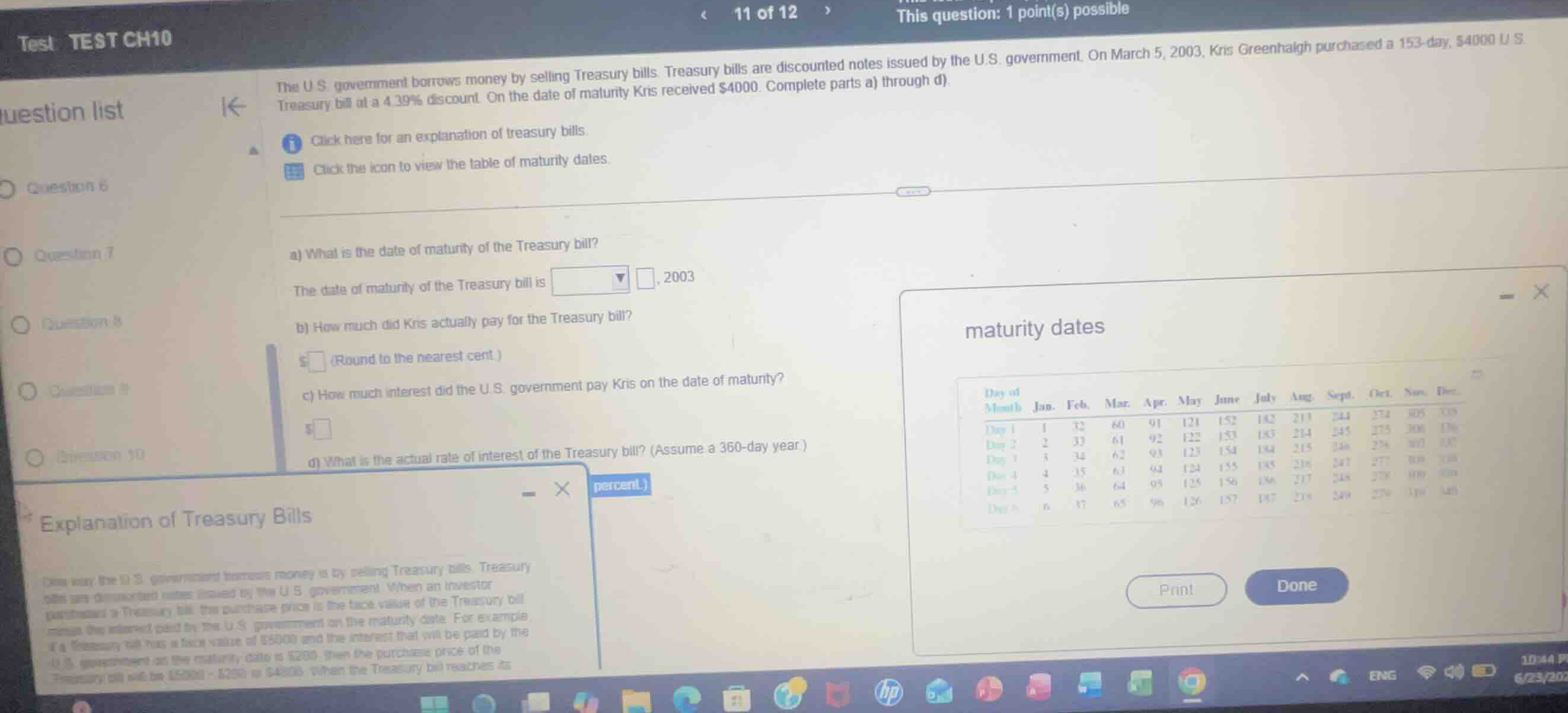
the u.s. government borrows money by selling treasury bills. treasury bills are discounted notes issued by the u.s. government. on march 5, 2003, kris greenhalgh purchased a 153-day, $4000 u.s. treasury bill at a 4.39% discount. on the date of maturity, kris received $4000. complete parts a) through d).
a) what is the date of maturity of the treasury bill?
the date of maturity of the treasury bill is month day, 2003.
b) how much did kris actually pay for the treasury bill?
$ (round to the nearest cent.)
c) how much interest did the u.s. government pay kris on the date of maturity?
$
d) what is the actual rate of interest of the treasury bill? (assume a 360-day year.)
percent.
<pre_analysis>
{
"quality": "clear",
"question_count": 4,
"skills_matched": [
"step_cot",
"explain_then_answer",
"tutor"
],
"needs_drawing": false,
"concepts_used": [],
"new_concepts": [
"Treasury Bill Valuation",
"Simple Discount Note",
"Actual Interest Rate"
],
"current_concepts": [
"Treasury Bill Valuation",
"Simple Discount Note",
"Actual Interest Rate"
]
}
</pre_analysis>
<reasoning>
Find the date of maturity
To find the maturity date, we start from the purchase date of March 5, 2003, and add 153 days.
Using the maturity dates table:
- March 5 is day number \(64\) of the year (since March 1 is day 60, so March 5 is \(60 + 5 - 1 = 64\)).
- Adding 153 days: \(64 + 153 = 217\).
- Looking up day 217 in the table, day 213 is August 1, so day 217 is August 5.
Thus, the maturity date is August 5, 2003.
Calculate the purchase price
The Treasury bill is a discounted note.
- Face Value (\(L\)) = \(\$4000\)
- Discount Rate (\(d\)) = \(4.39\% = 0.0439\)
- Time (\(t\)) = \(\frac{153}{360}\) years (using the standard 360-day banker's year for discount calculations)
The discount (\(D\)) is:
\[
D = L \cdot d \cdot t = 4000 \cdot 0.0439 \cdot \frac{153}{360} = 175.60 \cdot \frac{153}{360} = 74.63
\]
The purchase price (\(P\)) is:
\[
P = L - D = 4000 - 74.63 = 3925.37
\]
Kris paid \(\$3925.37\).
Calculate the interest paid
The interest paid by the U.S. government to Kris is the difference between the face value received at maturity and the purchase price paid:
\[
I = L - P = 4000 - 3925.37 = 74.63
\]
Thus, the interest is \(\$74.63\).
Calculate the actual interest rate
The actual interest rate (\(r\)) is the simple interest rate earned on the actual amount invested (\(P\)):
\[
I = P \cdot r \cdot t \implies r = \frac{I}{P \cdot t}
\]
Substitute the values:
\[
r = \frac{74.63}{3925.37 \cdot \frac{153}{360}} = \frac{74.63 \cdot 360}{3925.37 \cdot 153} = \frac{26866.8}{600581.61} \approx 0.0447346
\]
Converting to a percentage and rounding to the nearest hundredth of a percent:
\[
r \approx 4.47\%
\]
</reasoning>
<answer>
Question a
The date of maturity of the Treasury bill is August 5, 2003.
Question b
Kris actually paid \(\$3925.37\) for the Treasury bill.
Question c
The U.S. government paid Kris \(\$74.63\) in interest on the date of maturity.
Question d
The actual rate of interest of the Treasury bill is \(4.47\%\).
</answer>
<post_analysis>
{
"subject": "Mathematics",
"question_type": "Multi-part",
"knowledge_point": [
"Mathematics",
"Algebra",
"Annuity Formulas"
]
}
</post_analysis>
Snap & solve any problem in the app
Get step-by-step solutions on Sovi AI
Photo-based solutions with guided steps
Explore more problems and detailed explanations
<pre_analysis>
{
"quality": "clear",
"question_count": 4,
"skills_matched": [
"step_cot",
"explain_then_answer",
"tutor"
],
"needs_drawing": false,
"concepts_used": [],
"new_concepts": [
"Treasury Bill Valuation",
"Simple Discount Note",
"Actual Interest Rate"
],
"current_concepts": [
"Treasury Bill Valuation",
"Simple Discount Note",
"Actual Interest Rate"
]
}
</pre_analysis>
<reasoning>
Find the date of maturity
To find the maturity date, we start from the purchase date of March 5, 2003, and add 153 days.
Using the maturity dates table:
- March 5 is day number \(64\) of the year (since March 1 is day 60, so March 5 is \(60 + 5 - 1 = 64\)).
- Adding 153 days: \(64 + 153 = 217\).
- Looking up day 217 in the table, day 213 is August 1, so day 217 is August 5.
Thus, the maturity date is August 5, 2003.
Calculate the purchase price
The Treasury bill is a discounted note.
- Face Value (\(L\)) = \(\$4000\)
- Discount Rate (\(d\)) = \(4.39\% = 0.0439\)
- Time (\(t\)) = \(\frac{153}{360}\) years (using the standard 360-day banker's year for discount calculations)
The discount (\(D\)) is:
\[
D = L \cdot d \cdot t = 4000 \cdot 0.0439 \cdot \frac{153}{360} = 175.60 \cdot \frac{153}{360} = 74.63
\]
The purchase price (\(P\)) is:
\[
P = L - D = 4000 - 74.63 = 3925.37
\]
Kris paid \(\$3925.37\).
Calculate the interest paid
The interest paid by the U.S. government to Kris is the difference between the face value received at maturity and the purchase price paid:
\[
I = L - P = 4000 - 3925.37 = 74.63
\]
Thus, the interest is \(\$74.63\).
Calculate the actual interest rate
The actual interest rate (\(r\)) is the simple interest rate earned on the actual amount invested (\(P\)):
\[
I = P \cdot r \cdot t \implies r = \frac{I}{P \cdot t}
\]
Substitute the values:
\[
r = \frac{74.63}{3925.37 \cdot \frac{153}{360}} = \frac{74.63 \cdot 360}{3925.37 \cdot 153} = \frac{26866.8}{600581.61} \approx 0.0447346
\]
Converting to a percentage and rounding to the nearest hundredth of a percent:
\[
r \approx 4.47\%
\]
</reasoning>
<answer>
Question a
The date of maturity of the Treasury bill is August 5, 2003.
Question b
Kris actually paid \(\$3925.37\) for the Treasury bill.
Question c
The U.S. government paid Kris \(\$74.63\) in interest on the date of maturity.
Question d
The actual rate of interest of the Treasury bill is \(4.47\%\).
</answer>
<post_analysis>
{
"subject": "Mathematics",
"question_type": "Multi-part",
"knowledge_point": [
"Mathematics",
"Algebra",
"Annuity Formulas"
]
}
</post_analysis>