QUESTION IMAGE
Question
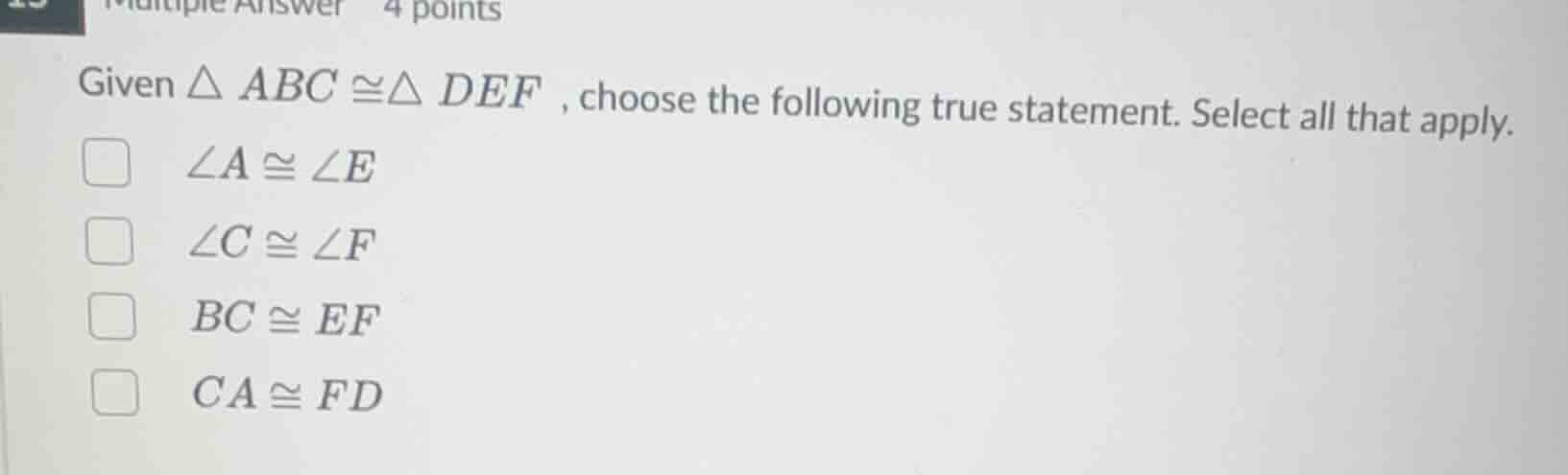
given \\(\delta abc \cong \delta def\\), choose the following true statement. select all that apply.
\\(\angle a \cong \angle e\\)
\\(\angle c \cong \angle f\\)
\\(bc \cong ef\\)
\\(ca \cong fd\\)
<pre_analysis>
{
"quality": "clear",
"question_count": 1,
"skills_matched": [
"direct_cot",
"multiple_choice_formatter",
"explain_then_answer",
"quick"
],
"needs_drawing": false,
"concepts_used": [],
"new_concepts": [],
"current_concepts": [
"Triangle Congruence Statement",
"Corresponding Parts"
]
}
</pre_analysis>
<reasoning>
Analyze the congruence statement
The given congruence statement is \(\Delta ABC \cong \Delta DEF\). This statement establishes a precise one-to-one correspondence between the vertices of the two triangles:
- Vertex \(A\) corresponds to vertex \(D\).
- Vertex \(B\) corresponds to vertex \(E\).
- Vertex \(C\) corresponds to vertex \(F\).
Evaluate corresponding angles
Using the vertex correspondence, we determine the corresponding angles:
- \(\angle A \cong \angle D\) (Thus, \(\angle A \cong \angle E\) is false).
- \(\angle B \cong \angle E\).
- \(\angle C \cong \angle F\) (Thus, \(\angle C \cong \angle F\) is true).
Evaluate corresponding sides
Using the vertex correspondence, we determine the corresponding sides:
- Side \(AB\) corresponds to side \(DE\), so \(AB \cong DE\).
- Side \(BC\) corresponds to side \(EF\), so \(BC \cong EF\) (Thus, \(BC \cong EF\) is true).
- Side \(CA\) corresponds to side \(FD\), so \(CA \cong FD\) (Thus, \(CA \cong FD\) is true).
</reasoning>
<answer>
<mcq-option>\(\angle A \cong \angle E\)</mcq-option>
<mcq-correct>\(\angle C \cong \angle F\)</mcq-correct>
<mcq-correct>\(BC \cong EF\)</mcq-correct>
<mcq-correct>\(CA \cong FD\)</mcq-correct>
</answer>
<post_analysis>
{
"subject": "Mathematics",
"question_type": "Multiple Choice",
"knowledge_point": [
"Mathematics",
"Geometry",
"Triangle Congruence Statement"
]
}
</post_analysis>
Snap & solve any problem in the app
Get step-by-step solutions on Sovi AI
Photo-based solutions with guided steps
Explore more problems and detailed explanations
<pre_analysis>
{
"quality": "clear",
"question_count": 1,
"skills_matched": [
"direct_cot",
"multiple_choice_formatter",
"explain_then_answer",
"quick"
],
"needs_drawing": false,
"concepts_used": [],
"new_concepts": [],
"current_concepts": [
"Triangle Congruence Statement",
"Corresponding Parts"
]
}
</pre_analysis>
<reasoning>
Analyze the congruence statement
The given congruence statement is \(\Delta ABC \cong \Delta DEF\). This statement establishes a precise one-to-one correspondence between the vertices of the two triangles:
- Vertex \(A\) corresponds to vertex \(D\).
- Vertex \(B\) corresponds to vertex \(E\).
- Vertex \(C\) corresponds to vertex \(F\).
Evaluate corresponding angles
Using the vertex correspondence, we determine the corresponding angles:
- \(\angle A \cong \angle D\) (Thus, \(\angle A \cong \angle E\) is false).
- \(\angle B \cong \angle E\).
- \(\angle C \cong \angle F\) (Thus, \(\angle C \cong \angle F\) is true).
Evaluate corresponding sides
Using the vertex correspondence, we determine the corresponding sides:
- Side \(AB\) corresponds to side \(DE\), so \(AB \cong DE\).
- Side \(BC\) corresponds to side \(EF\), so \(BC \cong EF\) (Thus, \(BC \cong EF\) is true).
- Side \(CA\) corresponds to side \(FD\), so \(CA \cong FD\) (Thus, \(CA \cong FD\) is true).
</reasoning>
<answer>
<mcq-option>\(\angle A \cong \angle E\)</mcq-option>
<mcq-correct>\(\angle C \cong \angle F\)</mcq-correct>
<mcq-correct>\(BC \cong EF\)</mcq-correct>
<mcq-correct>\(CA \cong FD\)</mcq-correct>
</answer>
<post_analysis>
{
"subject": "Mathematics",
"question_type": "Multiple Choice",
"knowledge_point": [
"Mathematics",
"Geometry",
"Triangle Congruence Statement"
]
}
</post_analysis>