Sovi.AI - AI Math Tutor

Scan to solve math questions

QUESTION IMAGE

given \\(\\delta abc \\cong \\delta def\\), choose the following true s…

Question

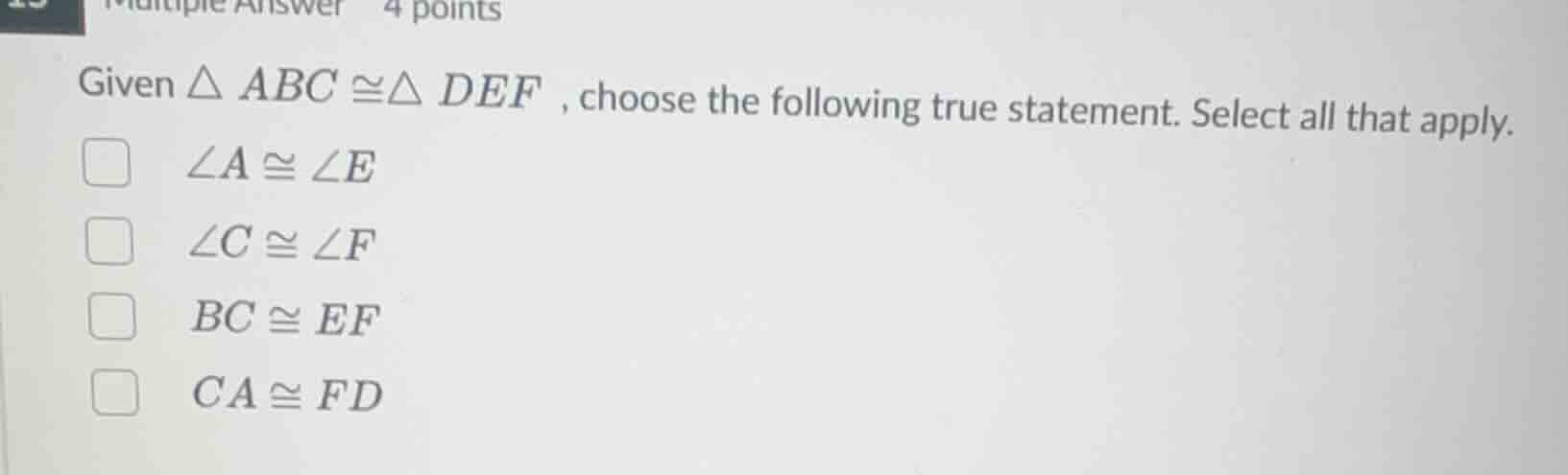
given \\(\delta abc \cong \delta def\\), choose the following true statement. select all that apply.

\\(\angle a \cong \angle e\\)
\\(\angle c \cong \angle f\\)
\\(bc \cong ef\\)
\\(ca \cong fd\\)

Explanation:

Response

<pre_analysis>
{
"quality": "clear",
"question_count": 1,
"skills_matched": [
"direct_cot",
"multiple_choice_formatter",
"explain_then_answer",
"quick"
],
"needs_drawing": false,
"concepts_used": [],
"new_concepts": [],
"current_concepts": [
"Triangle Congruence Statement",
"Corresponding Parts"
]
}
</pre_analysis>

<reasoning>

Analyze the congruence statement

The given congruence statement is \(\Delta ABC \cong \Delta DEF\). This statement establishes a precise one-to-one correspondence between the vertices of the two triangles:

  • Vertex \(A\) corresponds to vertex \(D\).
  • Vertex \(B\) corresponds to vertex \(E\).
  • Vertex \(C\) corresponds to vertex \(F\).

Evaluate corresponding angles

Using the vertex correspondence, we determine the corresponding angles:

  • \(\angle A \cong \angle D\) (Thus, \(\angle A \cong \angle E\) is false).
  • \(\angle B \cong \angle E\).
  • \(\angle C \cong \angle F\) (Thus, \(\angle C \cong \angle F\) is true).

Evaluate corresponding sides

Using the vertex correspondence, we determine the corresponding sides:

  • Side \(AB\) corresponds to side \(DE\), so \(AB \cong DE\).
  • Side \(BC\) corresponds to side \(EF\), so \(BC \cong EF\) (Thus, \(BC \cong EF\) is true).
  • Side \(CA\) corresponds to side \(FD\), so \(CA \cong FD\) (Thus, \(CA \cong FD\) is true).

</reasoning>

<answer>
<mcq-option>\(\angle A \cong \angle E\)</mcq-option>
<mcq-correct>\(\angle C \cong \angle F\)</mcq-correct>
<mcq-correct>\(BC \cong EF\)</mcq-correct>
<mcq-correct>\(CA \cong FD\)</mcq-correct>
</answer>

<post_analysis>
{
"subject": "Mathematics",
"question_type": "Multiple Choice",
"knowledge_point": [
"Mathematics",
"Geometry",
"Triangle Congruence Statement"
]
}
</post_analysis>

Answer:

<pre_analysis>
{
"quality": "clear",
"question_count": 1,
"skills_matched": [
"direct_cot",
"multiple_choice_formatter",
"explain_then_answer",
"quick"
],
"needs_drawing": false,
"concepts_used": [],
"new_concepts": [],
"current_concepts": [
"Triangle Congruence Statement",
"Corresponding Parts"
]
}
</pre_analysis>

<reasoning>

Analyze the congruence statement

The given congruence statement is \(\Delta ABC \cong \Delta DEF\). This statement establishes a precise one-to-one correspondence between the vertices of the two triangles:

  • Vertex \(A\) corresponds to vertex \(D\).
  • Vertex \(B\) corresponds to vertex \(E\).
  • Vertex \(C\) corresponds to vertex \(F\).

Evaluate corresponding angles

Using the vertex correspondence, we determine the corresponding angles:

  • \(\angle A \cong \angle D\) (Thus, \(\angle A \cong \angle E\) is false).
  • \(\angle B \cong \angle E\).
  • \(\angle C \cong \angle F\) (Thus, \(\angle C \cong \angle F\) is true).

Evaluate corresponding sides

Using the vertex correspondence, we determine the corresponding sides:

  • Side \(AB\) corresponds to side \(DE\), so \(AB \cong DE\).
  • Side \(BC\) corresponds to side \(EF\), so \(BC \cong EF\) (Thus, \(BC \cong EF\) is true).
  • Side \(CA\) corresponds to side \(FD\), so \(CA \cong FD\) (Thus, \(CA \cong FD\) is true).

</reasoning>

<answer>
<mcq-option>\(\angle A \cong \angle E\)</mcq-option>
<mcq-correct>\(\angle C \cong \angle F\)</mcq-correct>
<mcq-correct>\(BC \cong EF\)</mcq-correct>
<mcq-correct>\(CA \cong FD\)</mcq-correct>
</answer>

<post_analysis>
{
"subject": "Mathematics",
"question_type": "Multiple Choice",
"knowledge_point": [
"Mathematics",
"Geometry",
"Triangle Congruence Statement"
]
}
</post_analysis>