QUESTION IMAGE
Question
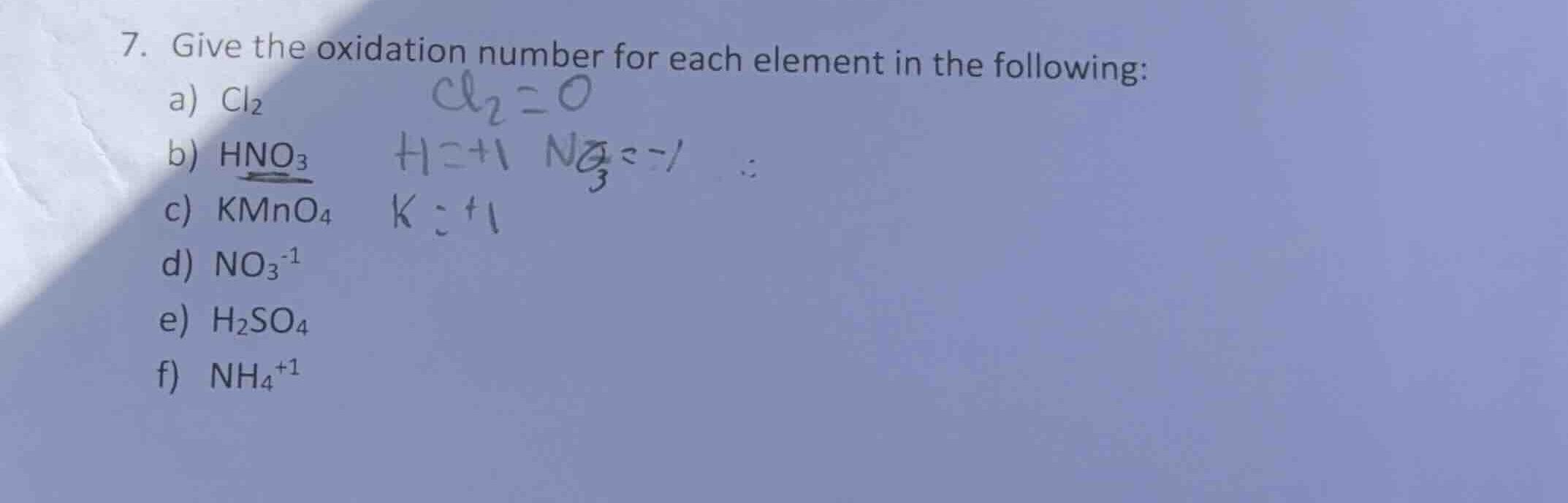
- give the oxidation number for each element in the following:
a) \\(\text{cl}_2\\)
b) \\(\text{hno}_3\\)
c) \\(\text{kmno}_4\\)
d) \\(\text{no}_3^{-1}\\)
e) \\(\text{h}_2\text{so}_4\\)
f) \\(\text{nh}_4^{+1}\\)
Identify rules for oxidation states
We apply standard rules to assign oxidation numbers:
- Free elements in their molecular state have an oxidation number of \(0\).
- Hydrogen is typically \(+1\) when bonded to nonmetals.
- Oxygen is typically \(-2\) in most compounds.
- Group 1 alkali metals (like \(\text{K}\)) always have an oxidation number of \(+1\).
- The sum of oxidation numbers in a neutral compound is \(0\), and in a polyatomic ion, it equals the ion's charge.
Determine oxidation numbers for a, b, and c
- For a) \(\text{Cl}_2\):
This is a pure elemental form.
$$\text{Cl} = 0$$
- For b) \(\text{HNO}_3\):
Hydrogen is \(+1\), oxygen is \(-2\).
$$(+1) + \text{N} + 3(-2) = 0 \implies \text{N} = +5$$
$$\text{H} = +1, \quad \text{N} = +5, \quad \text{O} = -2$$
- For c) \(\text{KMnO}_4\):
Potassium is \(+1\), oxygen is \(-2\).
$$(+1) + \text{Mn} + 4(-2) = 0 \implies \text{Mn} = +7$$
$$\text{K} = +1, \quad \text{Mn} = +7, \quad \text{O} = -2$$
Determine oxidation numbers for d, e, and f
- For d) \(\text{NO}_3^{-1}\):
Oxygen is \(-2\). The sum equals the charge \(-1\).
$$\text{N} + 3(-2) = -1 \implies \text{N} = +5$$
$$\text{N} = +5, \quad \text{O} = -2$$
- For e) \(\text{H}_2\text{SO}_4\):
Hydrogen is \(+1\), oxygen is \(-2\).
$$2(+1) + \text{S} + 4(-2) = 0 \implies \text{S} = +6$$
$$\text{H} = +1, \quad \text{S} = +6, \quad \text{O} = -2$$
- For f) \(\text{NH}_4^{+1}\):
Hydrogen is \(+1\). The sum equals the charge \(+1\).
$$\text{N} + 4(+1) = +1 \implies \text{N} = -3$$
$$\text{N} = -3, \quad \text{H} = +1$$

Snap & solve any problem in the app
Get step-by-step solutions on Sovi AI
Photo-based solutions with guided steps
Explore more problems and detailed explanations
Question 7
a) \(\text{Cl}_2\):
- \(\text{Cl} = 0\)
b) \(\text{HNO}_3\):
- \(\text{H} = +1\)
- \(\text{N} = +5\)
- \(\text{O} = -2\)
c) \(\text{KMnO}_4\):
- \(\text{K} = +1\)
- \(\text{Mn} = +7\)
- \(\text{O} = -2\)
d) \(\text{NO}_3^{-1}\):
- \(\text{N} = +5\)
- \(\text{O} = -2\)
e) \(\text{H}_2\text{SO}_4\):
- \(\text{H} = +1\)
- \(\text{S} = +6\)
- \(\text{O} = -2\)
f) \(\text{NH}_4^{+1}\):
- \(\text{N} = -3\)
- \(\text{H} = +1\)