QUESTION IMAGE
Question
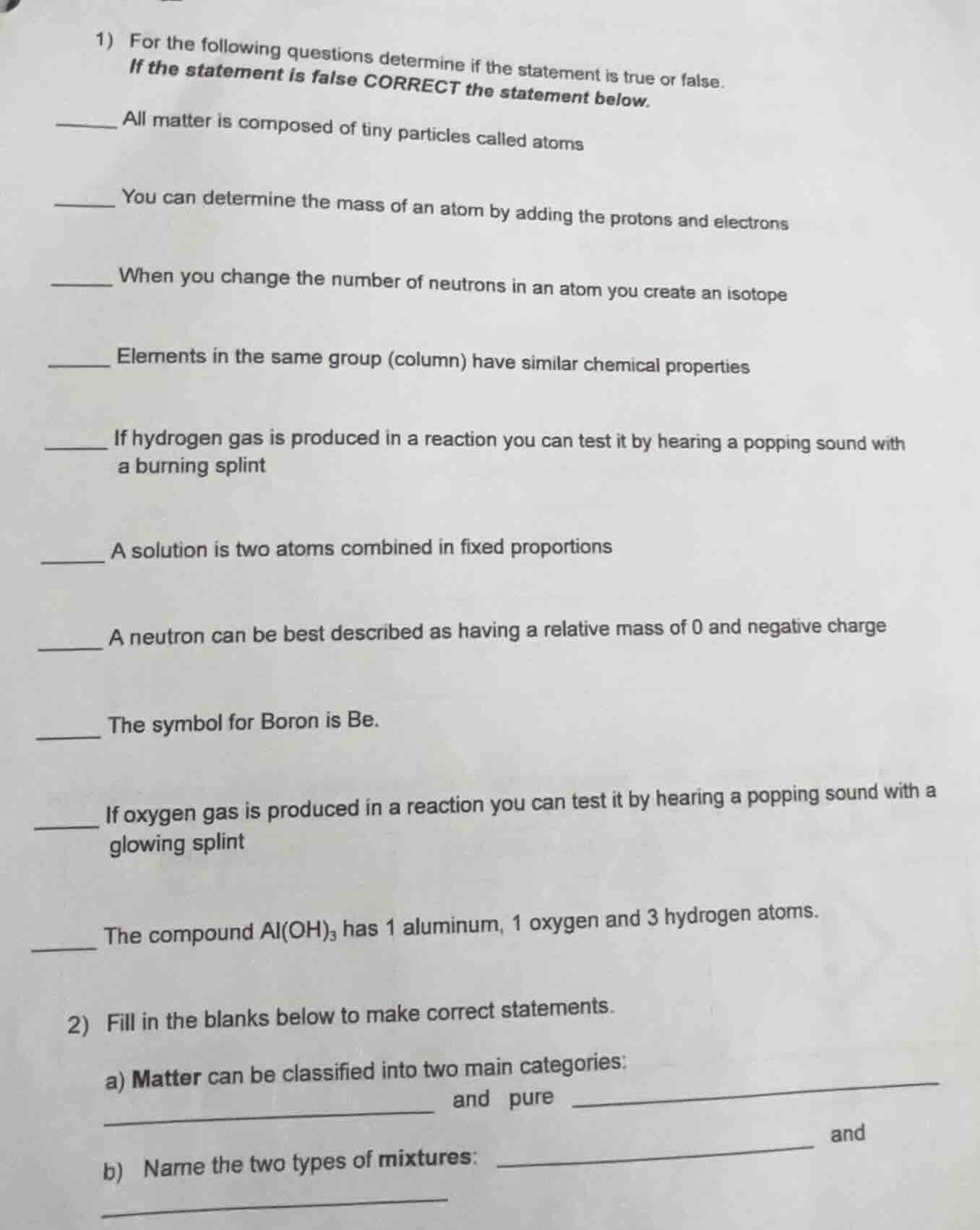
- for the following questions determine if the statement is true or false.
if the statement is false correct the statement below.
______ all matter is composed of tiny particles called atoms
______ you can determine the mass of an atom by adding the protons and electrons
______ when you change the number of neutrons in an atom you create an isotope
______ elements in the same group (column) have similar chemical properties
______ if hydrogen gas is produced in a reaction you can test it by hearing a popping sound with a burning splint
______ a solution is two atoms combined in fixed proportions
______ a neutron can be best described as having a relative mass of 0 and negative charge
______ the symbol for boron is be.
______ if oxygen gas is produced in a reaction you can test it by hearing a popping sound with a glowing splint
______ the compound \\(\text{al(oh)}_3\\) has 1 aluminum, 1 oxygen and 3 hydrogen atoms.
- fill in the blanks below to make correct statements.
a) matter can be classified into two main categories:
______________________ and pure ______________________
b) name the two types of mixtures: ______________________ and ______________________
The questions test fundamental concepts in introductory chemistry.
- Matter is composed of atoms.
- Atomic mass is concentrated in the nucleus, which contains protons and neutrons; electrons have negligible mass.
- Isotopes are atoms of the same element with different numbers of neutrons.
- Elements in the same periodic group share chemical properties due to having the same number of valence electrons.
- Hydrogen gas burns with a characteristic "squeaky pop" sound when exposed to a flame.
- A solution is a homogeneous mixture, not a chemical compound with fixed atomic ratios.
- Neutrons have a relative mass of approximately 1 atomic mass unit and carry no electrical charge.
- The chemical symbol for Boron is B, while Be represents Beryllium.
- Oxygen gas supports combustion and is tested by its ability to relight a glowing splint.
- The subscript outside the parentheses in \(\text{Al(OH)}_3\) multiplies all atoms inside, yielding 3 oxygen and 3 hydrogen atoms.
- Matter is broadly classified into mixtures and pure substances, and mixtures are further categorized as homogeneous (uniform composition) or heterogeneous (non-uniform composition).

Snap & solve any problem in the app
Get step-by-step solutions on Sovi AI
Photo-based solutions with guided steps
Explore more problems and detailed explanations
1)
- True
- False. You can determine the mass of an atom by adding the protons and neutrons.
- True
- True
- True
- False. A compound is two or more different atoms chemically combined in fixed proportions. (Alternatively, a solution is a homogeneous mixture of two or more substances.)
- False. A neutron can be best described as having a relative mass of 1 and neutral (zero) charge.
- False. The symbol for Boron is B. (Be is the symbol for Beryllium.)
- False. If oxygen gas is produced in a reaction you can test it by seeing if it relights a glowing splint.
- False. The compound \(\text{Al(OH)}_3\) has 1 aluminum, 3 oxygen and 3 hydrogen atoms.
2)
a) mixtures and pure substances
b) homogeneous and heterogeneous