QUESTION IMAGE
Question
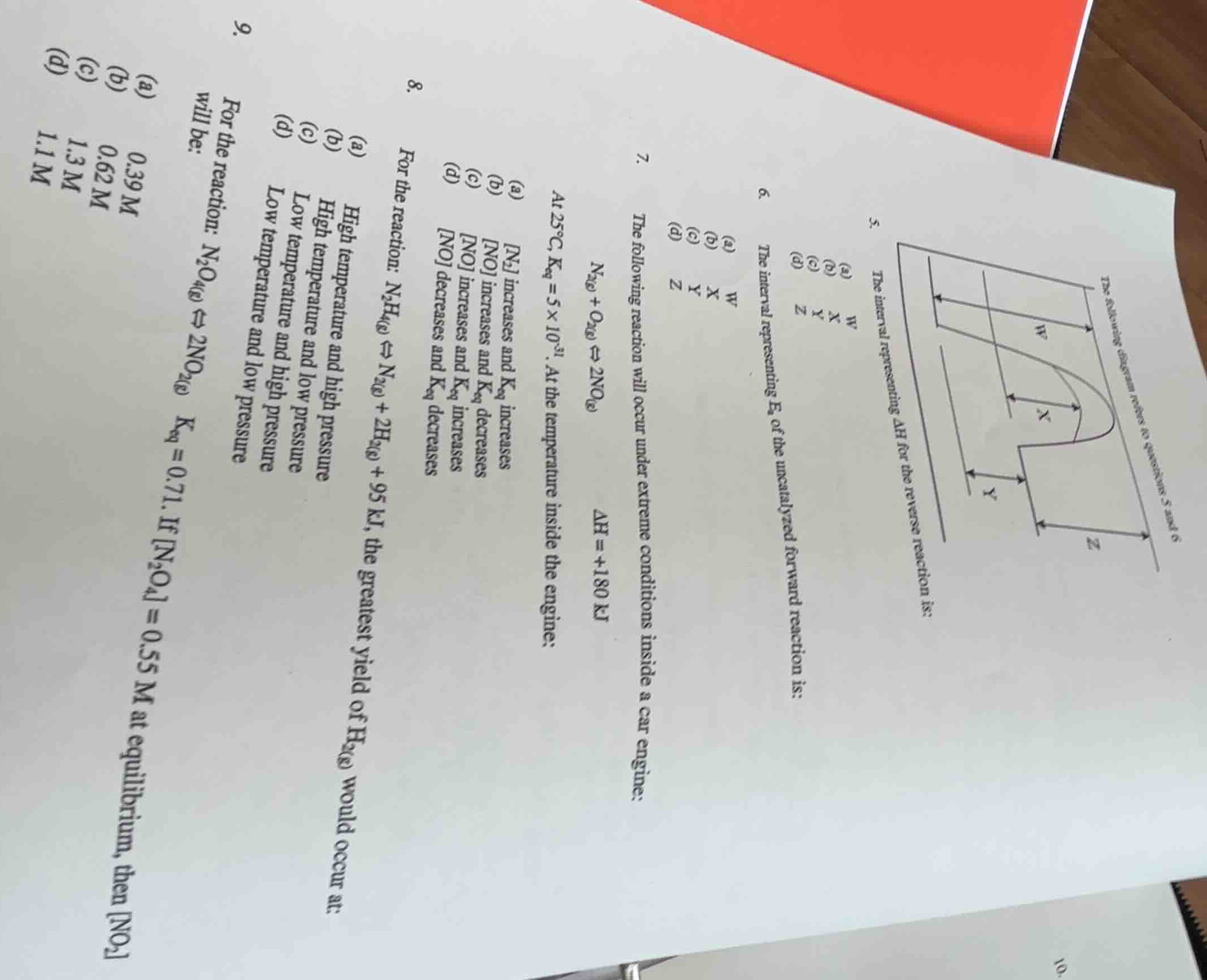
the following diagram refers to questions 5 and 6
- the interval representing \\(\delta h\\) for the reverse reaction is:
(a) w
(b) x
(c) y
(d) z
- the interval representing \\(e_a\\) of the uncatalyzed forward reaction is:
(a) w
(b) x
(c) y
(d) z
- the following reaction will occur under extreme conditions inside a car engine:
\
_{2(g)} + o_{2(g)} \
ightleftharpoons 2no_{(g)} \quad \delta h = +180\text{ kj}\\
at \\(25^\circ\text{c}\\), \\(k_{eq} = 5 \times 10^{-31}\\). at the temperature inside the engine:
(a) \\(n_2\\) increases and \\(k_{eq}\\) increases
(b) \\(no\\) increases and \\(k_{eq}\\) decreases
(c) \\(no\\) increases and \\(k_{eq}\\) increases
(d) \\(no\\) decreases and \\(k_{eq}\\) decreases
- for the reaction: \\(n_2h_{4(g)} \
ightleftharpoons n_{2(g)} + 2h_{2(g)} + 95\text{ kj}\\), the greatest yield of \\(h_{2(g)}\\) would occur at:
(a) high temperature and high pressure
(b) high temperature and low pressure
(c) low temperature and high pressure
(d) low temperature and low pressure
- for the reaction: \\(n_2o_{4(g)} \
ightleftharpoons 2no_{2(g)}\quad k_{eq} = 0.71\\). if \\(n_2o_4 = 0.55\text{ m}\\) at equilibrium, then \\(no_2\\) will be:
(a) 0.39 m
(b) 0.62 m
(c) 1.3 m
(d) 1.1 m
Analyze the reaction coordinate diagram for questions 5 and 6
The diagram shows potential energy on the vertical axis versus reaction progress on the horizontal axis.
- \(W\) represents the activation energy of the uncatalyzed forward reaction (from reactants to the peak of the higher curve).
- \(X\) represents the activation energy of the catalyzed forward reaction (from reactants to the peak of the lower curve).
- \(Y\) represents the enthalpy change \(\Delta H\) of the reaction (the difference in energy between products and reactants). Since products are at lower energy than reactants, the forward reaction is exothermic, and the reverse reaction is endothermic. The magnitude of \(\Delta H\) is represented by the interval \(Y\).
- \(Z\) represents the potential energy of the products relative to the baseline.
Determine the interval representing \(\Delta H\) for the reverse reaction
For question 5, the enthalpy change \(\Delta H\) is the energy difference between the reactants and products.
The interval \(Y\) represents this difference.
Thus, the interval representing \(\Delta H\) for the reverse reaction is \(Y\).
Determine the interval representing \(E_a\) of the uncatalyzed forward reaction
For question 6, the activation energy \(E_a\) of the uncatalyzed forward reaction is the energy barrier from the reactants to the highest peak (uncatalyzed transition state).
This corresponds to the interval \(W\).
Analyze the effect of temperature on the equilibrium inside a car engine
For question 7, the reaction is:
At \(25^\circ\text{C}\), \(K_{eq} = 5 \times 10^{-31}\).
Inside a car engine, the temperature is extremely high (much higher than \(25^\circ\text{C}\)).
Since the reaction is endothermic (\(\Delta H > 0\)), increasing the temperature shifts the equilibrium to the right (towards products).
Therefore, the concentration of \(\text{NO}\) increases, and the equilibrium constant \(K_{eq}\) increases because \(K_{eq}\) is temperature-dependent and increases for endothermic reactions as temperature rises.
Determine conditions for the greatest yield of \(\text{H}_{2(g)}\)
For question 8, the reaction is:
This reaction is exothermic (\(\Delta H = -95\text{ kJ}\)) and produces more moles of gas (\(1 \text{ mol N}_2\text{H}_4
ightarrow 1 \text{ mol N}_2 + 2 \text{ mol H}_2\), so \(1 \text{ mol}
ightarrow 3 \text{ mol}\)).
To maximize the yield of products (\(\text{H}_2\)):
- Since it is exothermic, a low temperature shifts the equilibrium to the right.
- Since it produces more moles of gas, a low pressure shifts the equilibrium to the side with more moles of gas (the right).
Thus, the greatest yield occurs at low temperature and low pressure.
Calculate the equilibrium concentration of \(\text{NO}_2\)
For question 9, the reaction is:
\[\text{N}_2\text{O}_{4(g…

Snap & solve any problem in the app
Get step-by-step solutions on Sovi AI
Photo-based solutions with guided steps
Explore more problems and detailed explanations
Question 5
- (a) W
- (b) Y (Correct answer)
- (c) X
- (d) Z
Question 6
- (a) W (Correct answer)
- (b) X
- (c) Y
- (d) Z
Question 7
- (a) [\(\text{NO}\)] increases and \(K_{eq}\) increases (Correct answer)
- (b) [\(\text{NO}\)] increases and \(K_{eq}\) decreases
- (c) [\(\text{NO}\)] decreases and \(K_{eq}\) increases
- (d) [\(\text{NO}\)] decreases and \(K_{eq}\) decreases
Question 8
- (a) High temperature and high pressure
- (b) High temperature and low pressure
- (c) Low temperature and high pressure
- (d) Low temperature and low pressure (Correct answer)
Question 9
- (a) 0.39 M
- (b) 0.62 M (Correct answer)
- (c) 1.3 M
- (d) 1.1 M