QUESTION IMAGE
Question
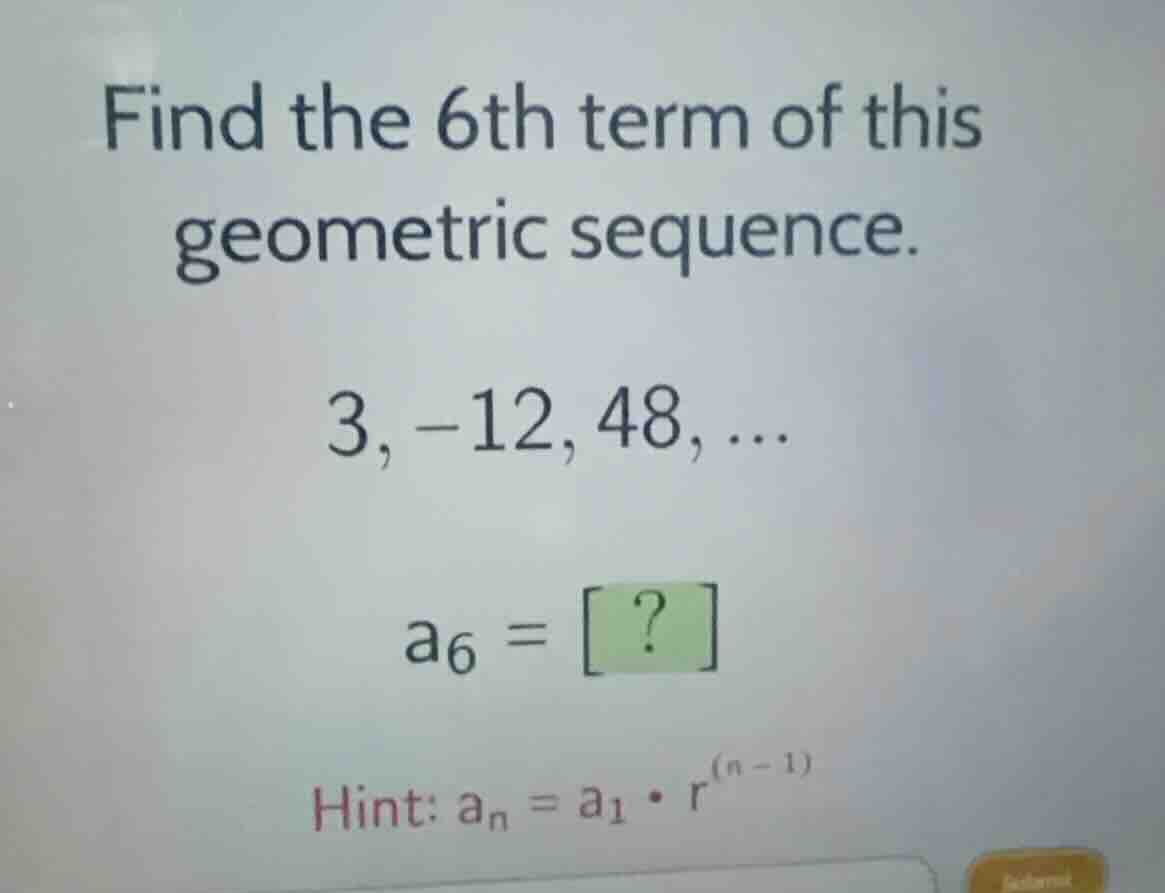
find the 6th term of this geometric sequence.
(3, -12, 48, \dots)
(a_6 = ?)
hint: (a_n = a_1 \cdot r^{(n-1)})
<pre_analysis>
{
"quality": "clear",
"question_count": 1,
"skills_matched": [
"step_cot",
"blank_filling_formatter",
"explain_then_answer",
"tutor"
],
"needs_drawing": false,
"concepts_used": [],
"new_concepts": [
"Geometric Sequences",
"Common Ratio",
"Geometric Sequence Formula"
],
"current_concepts": [
"Geometric Sequences",
"Common Ratio",
"Geometric Sequence Formula"
]
}
</pre_analysis>
<reasoning>
Identify the first term and target term
We are given the geometric sequence:
\[3, -12, 48, \dots\]
The first term of the sequence is:
\[a_1 = 3\]
We want to find the 6th term, which means:
\[n = 6\]
Calculate the common ratio
To find the common ratio \(r\), we divide any term by its preceding term:
\[r = \frac{a_2}{a_1} = \frac{-12}{3} = -4\]
We can verify this with the next term:
\[\frac{a_3}{a_2} = \frac{48}{-12} = -4\]
Thus, the common ratio is \(r = -4\).
Apply the geometric sequence formula
The formula for the \(n\)-th term of a geometric sequence is:
\[a_n = a_1 \cdot r^{(n-1)}\]
Substituting our known values \(a_1 = 3\), \(r = -4\), and \(n = 6\):
\[a_6 = 3 \cdot (-4)^{(6-1)}\]
\[a_6 = 3 \cdot (-4)^5\]
Compute the final value
First, calculate the exponent:
\[(-4)^5 = -1024\]
Now, multiply by the first term:
\[a_6 = 3 \cdot (-1024) = -3072\]
</reasoning>
<answer>
Find the 6th term of this geometric sequence.
\(3, -12, 48, \dots\)
\(a_6 =\) <blank>-3072</blank>
</answer>
<post_analysis>
{
"subject": "Mathematics",
"question_type": "Fill-in-the-blank",
"knowledge_point": [
"Mathematics",
"Algebra",
"Geometric Sequences"
]
}
</post_analysis>
Snap & solve any problem in the app
Get step-by-step solutions on Sovi AI
Photo-based solutions with guided steps
Explore more problems and detailed explanations
<pre_analysis>
{
"quality": "clear",
"question_count": 1,
"skills_matched": [
"step_cot",
"blank_filling_formatter",
"explain_then_answer",
"tutor"
],
"needs_drawing": false,
"concepts_used": [],
"new_concepts": [
"Geometric Sequences",
"Common Ratio",
"Geometric Sequence Formula"
],
"current_concepts": [
"Geometric Sequences",
"Common Ratio",
"Geometric Sequence Formula"
]
}
</pre_analysis>
<reasoning>
Identify the first term and target term
We are given the geometric sequence:
\[3, -12, 48, \dots\]
The first term of the sequence is:
\[a_1 = 3\]
We want to find the 6th term, which means:
\[n = 6\]
Calculate the common ratio
To find the common ratio \(r\), we divide any term by its preceding term:
\[r = \frac{a_2}{a_1} = \frac{-12}{3} = -4\]
We can verify this with the next term:
\[\frac{a_3}{a_2} = \frac{48}{-12} = -4\]
Thus, the common ratio is \(r = -4\).
Apply the geometric sequence formula
The formula for the \(n\)-th term of a geometric sequence is:
\[a_n = a_1 \cdot r^{(n-1)}\]
Substituting our known values \(a_1 = 3\), \(r = -4\), and \(n = 6\):
\[a_6 = 3 \cdot (-4)^{(6-1)}\]
\[a_6 = 3 \cdot (-4)^5\]
Compute the final value
First, calculate the exponent:
\[(-4)^5 = -1024\]
Now, multiply by the first term:
\[a_6 = 3 \cdot (-1024) = -3072\]
</reasoning>
<answer>
Find the 6th term of this geometric sequence.
\(3, -12, 48, \dots\)
\(a_6 =\) <blank>-3072</blank>
</answer>
<post_analysis>
{
"subject": "Mathematics",
"question_type": "Fill-in-the-blank",
"knowledge_point": [
"Mathematics",
"Algebra",
"Geometric Sequences"
]
}
</post_analysis>