Sovi.AI - AI Math Tutor

Scan to solve math questions

QUESTION IMAGE

the excerpt from act 2, scene 1, of julius caesar. brutus. let us be sa…

Question

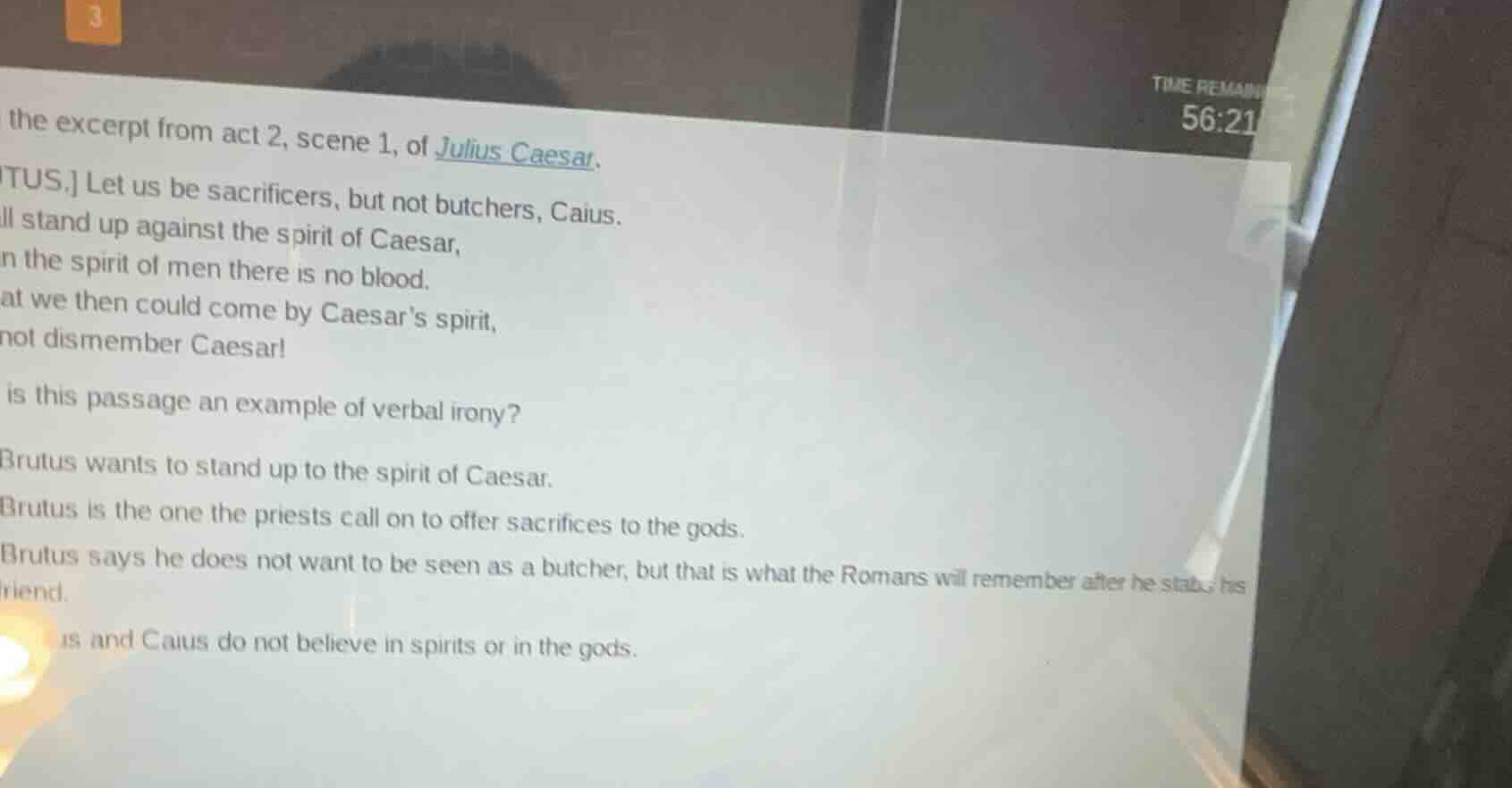
the excerpt from act 2, scene 1, of julius caesar.

brutus. let us be sacrificers, but not butchers, caius.
we all stand up against the spirit of caesar,
and in the spirit of men there is no blood.
o, that we then could come by caesars spirit,
and not dismember caesar!

why is this passage an example of verbal irony?

brutus wants to stand up to the spirit of caesar.
brutus is the one the priests call on to offer sacrifices to the gods.
brutus says he does not want to be seen as a butcher, but that is what the romans will remember after he stabs his friend.
brutus and caius do not believe in spirits or in the gods.

Explanation:

Response

<pre_analysis>
{
"quality": "clear",
"question_count": 1,
"skills_matched": [
"direct_cot",
"multiple_choice_formatter",
"explain_then_answer",
"tutor",
"mastery_adaptive_brevity"
],
"needs_drawing": false,
"concepts_used": [
"Julius Caesar Plot",
"Situational Irony",
"Dramatic Irony"
],
"new_concepts": [
"Verbal Irony"
],
"current_concepts": [
"Julius Caesar Plot",
"Situational Irony",
"Dramatic Irony",
"Verbal Irony"
]
}
</pre_analysis>

<reasoning>

Identify the question and the excerpt

The question asks why the given passage from Act 2, Scene 1 of Julius Caesar is an example of irony (specifically situational/dramatic irony, though the prompt text asks "Why is this passage an example of irony?").

The excerpt reads:
"Let us be sacrificers, but not butchers, Caius.
We all stand up against the spirit of Caesar,
And in the spirit of men there is no blood.
O, that we then could come by Caesar's spirit,
And not dismember Caesar!"

Analyze the options

Using the Julius Caesar Plot knowledge point:

  • Option 1: "Brutus wants to stand up to the spirit of Caesar." (This is a literal statement he makes, not the source of irony.)
  • Option 2: "Brutus is the one the priests call on to offer sacrifices to the gods." (This is factually incorrect in the context of the play.)
  • Option 3: "Brutus says he does not want to be seen as a butcher, but that is what the Romans will remember after he stabs his friend." (This highlights the contrast between Brutus's noble intentions of a clean "sacrifice" and the brutal, bloody reality of the assassination that leads to them being viewed as butchers. This is a classic example of irony.)
  • Option 4: "Brutus and Caius do not believe in spirits or in the gods." (This is incorrect; they frequently reference the gods and portents.)

Connect to irony concepts

Using the Situational Irony and Dramatic Irony knowledge points:
Brutus's desire to kill Caesar "carving him as a dish fit for the gods, not hewing him as a carcass fit for hounds" is highly ironic because the actual assassination becomes a chaotic, bloody spectacle. Antony later uses this very imagery to turn the Roman mob against the conspirators, branding them as murderers and butchers rather than honorable sacrificers. Thus, the third option perfectly explains the irony.
</reasoning>

<answer>
<mcq-option>(A) Brutus wants to stand up to the spirit of Caesar.</mcq-option>
<mcq-option>(B) Brutus is the one the priests call on to offer sacrifices to the gods.</mcq-option>
<mcq-correct>(C) Brutus says he does not want to be seen as a butcher, but that is what the Romans will remember after he stabs his friend.</mcq-correct>
<mcq-option>(D) Brutus and Caius do not believe in spirits or in the gods.</mcq-option>
</answer>

<post_analysis>
{
"subject": "Arts",
"question_type": "Multiple Choice",
"knowledge_point": [
"Arts",
"Drama Analysis",
"Shakespearean Drama"
]
}
</post_analysis>

Answer:

<pre_analysis>
{
"quality": "clear",
"question_count": 1,
"skills_matched": [
"direct_cot",
"multiple_choice_formatter",
"explain_then_answer",
"tutor",
"mastery_adaptive_brevity"
],
"needs_drawing": false,
"concepts_used": [
"Julius Caesar Plot",
"Situational Irony",
"Dramatic Irony"
],
"new_concepts": [
"Verbal Irony"
],
"current_concepts": [
"Julius Caesar Plot",
"Situational Irony",
"Dramatic Irony",
"Verbal Irony"
]
}
</pre_analysis>

<reasoning>

Identify the question and the excerpt

The question asks why the given passage from Act 2, Scene 1 of Julius Caesar is an example of irony (specifically situational/dramatic irony, though the prompt text asks "Why is this passage an example of irony?").

The excerpt reads:
"Let us be sacrificers, but not butchers, Caius.
We all stand up against the spirit of Caesar,
And in the spirit of men there is no blood.
O, that we then could come by Caesar's spirit,
And not dismember Caesar!"

Analyze the options

Using the Julius Caesar Plot knowledge point:

  • Option 1: "Brutus wants to stand up to the spirit of Caesar." (This is a literal statement he makes, not the source of irony.)
  • Option 2: "Brutus is the one the priests call on to offer sacrifices to the gods." (This is factually incorrect in the context of the play.)
  • Option 3: "Brutus says he does not want to be seen as a butcher, but that is what the Romans will remember after he stabs his friend." (This highlights the contrast between Brutus's noble intentions of a clean "sacrifice" and the brutal, bloody reality of the assassination that leads to them being viewed as butchers. This is a classic example of irony.)
  • Option 4: "Brutus and Caius do not believe in spirits or in the gods." (This is incorrect; they frequently reference the gods and portents.)

Connect to irony concepts

Using the Situational Irony and Dramatic Irony knowledge points:
Brutus's desire to kill Caesar "carving him as a dish fit for the gods, not hewing him as a carcass fit for hounds" is highly ironic because the actual assassination becomes a chaotic, bloody spectacle. Antony later uses this very imagery to turn the Roman mob against the conspirators, branding them as murderers and butchers rather than honorable sacrificers. Thus, the third option perfectly explains the irony.
</reasoning>

<answer>
<mcq-option>(A) Brutus wants to stand up to the spirit of Caesar.</mcq-option>
<mcq-option>(B) Brutus is the one the priests call on to offer sacrifices to the gods.</mcq-option>
<mcq-correct>(C) Brutus says he does not want to be seen as a butcher, but that is what the Romans will remember after he stabs his friend.</mcq-correct>
<mcq-option>(D) Brutus and Caius do not believe in spirits or in the gods.</mcq-option>
</answer>

<post_analysis>
{
"subject": "Arts",
"question_type": "Multiple Choice",
"knowledge_point": [
"Arts",
"Drama Analysis",
"Shakespearean Drama"
]
}
</post_analysis>