QUESTION IMAGE
Question
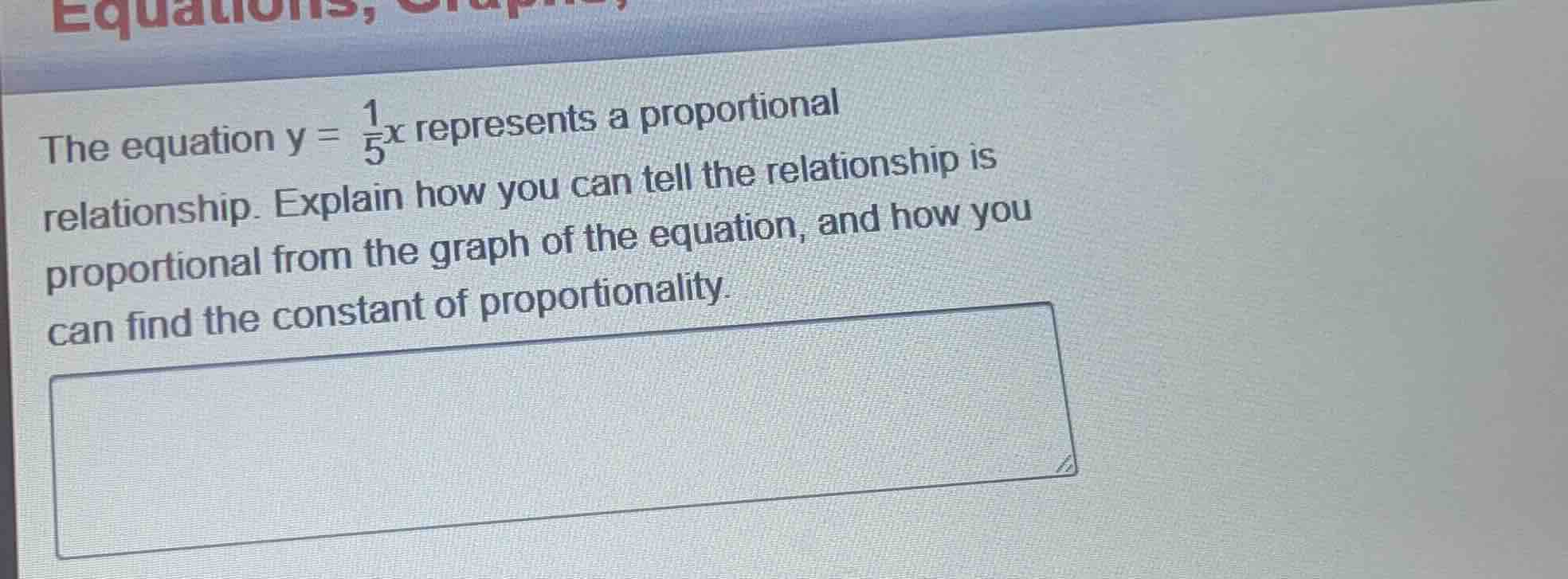
the equation \\(y = \frac{1}{5}x\\) represents a proportional relationship. explain how you can tell the relationship is proportional from the graph of the equation, and how you can find the constant of proportionality.
<pre_analysis>
{
"quality": "clear",
"question_count": 1,
"skills_matched": [
"step_cot",
"explain_then_answer",
"tutor",
"mastery_adaptive_brevity"
],
"needs_drawing": true,
"concepts_used": [
"Constant of Proportionality",
"Proportional Relationship Equation",
"Graphing Proportional Relationships"
],
"new_concepts": [],
"current_concepts": [
"Constant of Proportionality",
"Proportional Relationship Equation",
"Graphing Proportional Relationships"
]
}
</pre_analysis>
<reasoning>
Identify proportional graph features
Using the Graphing Proportional Relationships knowledge point
\[
\]
Identify the constant of proportionality
Using the Constant of Proportionality and Proportional Relationship Equation knowledge points
\[
\]
</reasoning>
<answer>
The graph of the equation \(y = \frac{1}{5}x\) represents a proportional relationship because it is a straight line that passes through the origin \((0,0)\).
The constant of proportionality is the coefficient of \(x\) in the equation \(y = kx\), which is \(\frac{1}{5}\). On the graph, this is represented by the slope of the line, which can be found by taking any point on the line \((x, y)\) other than the origin and calculating the ratio \(\frac{y}{x}\).
</answer>
<plot>
{
"elements": [
{
"type": "functiongraph",
"params": [{"js": "0.2*x", "latex": "\frac{1}{5}x"}, -2, 10],
"properties": {
"strokeColor": "#8C55F2",
"strokeWidth": 3,
"name": "y = 1/5 x",
"withLabel": true
}
},
{
"type": "point",
"params": [[0, 0]],
"properties": {
"name": "(0,0)",
"size": 4,
"color": "#F2557F",
"withLabel": true
}
},
{
"type": "point",
"params": [[5, 1]],
"properties": {
"name": "(5,1)",
"size": 4,
"color": "#5583F2",
"withLabel": true
}
}
]
}
</plot>
<post_analysis>
{
"subject": "Mathematics",
"question_type": "Free Response",
"knowledge_point": [
"Mathematics",
"Geometry",
"Graphing Proportional Relationships"
]
}
</post_analysis>
Snap & solve any problem in the app
Get step-by-step solutions on Sovi AI
Photo-based solutions with guided steps
Explore more problems and detailed explanations
<pre_analysis>
{
"quality": "clear",
"question_count": 1,
"skills_matched": [
"step_cot",
"explain_then_answer",
"tutor",
"mastery_adaptive_brevity"
],
"needs_drawing": true,
"concepts_used": [
"Constant of Proportionality",
"Proportional Relationship Equation",
"Graphing Proportional Relationships"
],
"new_concepts": [],
"current_concepts": [
"Constant of Proportionality",
"Proportional Relationship Equation",
"Graphing Proportional Relationships"
]
}
</pre_analysis>
<reasoning>
Identify proportional graph features
Using the Graphing Proportional Relationships knowledge point
\[
\]
Identify the constant of proportionality
Using the Constant of Proportionality and Proportional Relationship Equation knowledge points
\[
\]
</reasoning>
<answer>
The graph of the equation \(y = \frac{1}{5}x\) represents a proportional relationship because it is a straight line that passes through the origin \((0,0)\).
The constant of proportionality is the coefficient of \(x\) in the equation \(y = kx\), which is \(\frac{1}{5}\). On the graph, this is represented by the slope of the line, which can be found by taking any point on the line \((x, y)\) other than the origin and calculating the ratio \(\frac{y}{x}\).
</answer>
<plot>
{
"elements": [
{
"type": "functiongraph",
"params": [{"js": "0.2*x", "latex": "\frac{1}{5}x"}, -2, 10],
"properties": {
"strokeColor": "#8C55F2",
"strokeWidth": 3,
"name": "y = 1/5 x",
"withLabel": true
}
},
{
"type": "point",
"params": [[0, 0]],
"properties": {
"name": "(0,0)",
"size": 4,
"color": "#F2557F",
"withLabel": true
}
},
{
"type": "point",
"params": [[5, 1]],
"properties": {
"name": "(5,1)",
"size": 4,
"color": "#5583F2",
"withLabel": true
}
}
]
}
</plot>
<post_analysis>
{
"subject": "Mathematics",
"question_type": "Free Response",
"knowledge_point": [
"Mathematics",
"Geometry",
"Graphing Proportional Relationships"
]
}
</post_analysis>