Sovi.AI - AI Math Tutor

Scan to solve math questions

QUESTION IMAGE

in the early 1800s, which nation did the united states fear would take …

Question

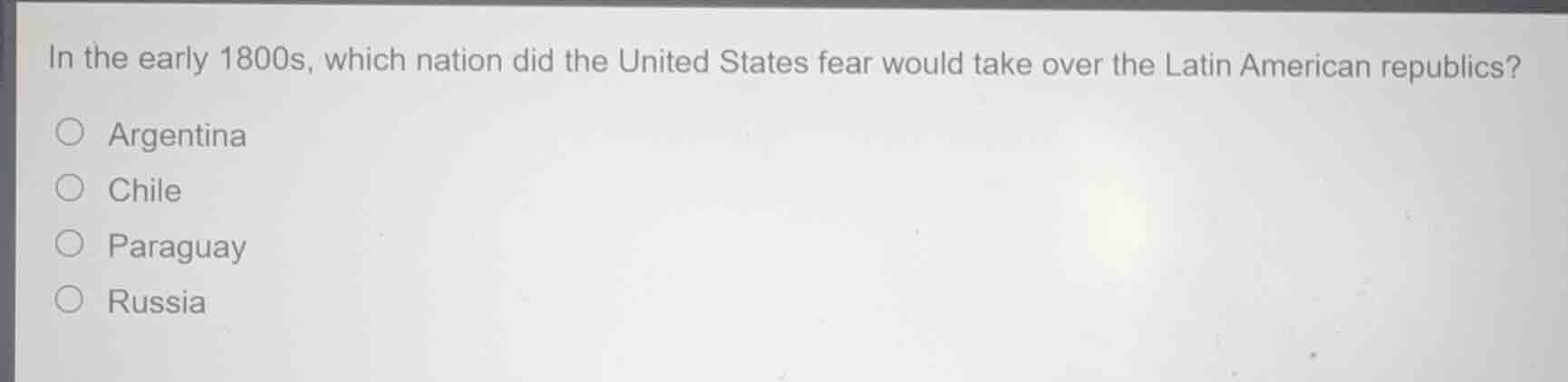
in the early 1800s, which nation did the united states fear would take over the latin american republics?

argentina
chile
paraguay
russia

Explanation:

Response

<pre_analysis>
{
"quality": "clear",
"question_count": 1,
"skills_matched": [
"direct_cot",
"multiple_choice_formatter",
"explain_then_answer",
"quick"
],
"needs_drawing": false,
"concepts_used": [
"Monroe Doctrine Context",
"Latin American Revolutions"
],
"new_concepts": [],
"current_concepts": [
"Monroe Doctrine Context",
"Latin American Revolutions",
"US Foreign Policy"
]
}
</pre_analysis>

<reasoning>

Analyze the historical context of the early 1800s

In the early 1800s, many Latin American colonies successfully fought for independence from Spain and Portugal, establishing new republics. The United States, under President James Monroe, wanted to prevent European powers from recolonizing these newly independent nations or expanding their territory in the Americas.

Identify the foreign threats to the Western Hemisphere

While Spain sought to reclaim its lost colonies, other European empires also posed expansionist threats. Specifically, the Russian Empire was actively expanding its presence southward from Alaska along the Pacific coast of North America and asserting claims over the Oregon Country, which alarmed both the United States and Great Britain.

Evaluate the multiple-choice options

  • Argentina, Chile, and Paraguay were newly independent Latin American republics themselves, not outside nations threatening to take over the region.
  • Russia was a major European imperial power actively expanding in North America and threatening the sovereignty of the Western Hemisphere, prompting the declaration of the Monroe Doctrine in 1823.

</reasoning>

<answer>
<mcq-option>(A) Argentina</mcq-option>
<mcq-option>(B) Chile</mcq-option>
<mcq-option>(C) Paraguay</mcq-option>
<mcq-correct>(D) Russia</mcq-correct>
</answer>

<post_analysis>
{
"subject": "Social Science",
"question_type": "Multiple Choice",
"knowledge_point": [
"Social Science",
"U.S. History",
"Monroe Doctrine Context"
]
}
</post_analysis>

Answer:

<pre_analysis>
{
"quality": "clear",
"question_count": 1,
"skills_matched": [
"direct_cot",
"multiple_choice_formatter",
"explain_then_answer",
"quick"
],
"needs_drawing": false,
"concepts_used": [
"Monroe Doctrine Context",
"Latin American Revolutions"
],
"new_concepts": [],
"current_concepts": [
"Monroe Doctrine Context",
"Latin American Revolutions",
"US Foreign Policy"
]
}
</pre_analysis>

<reasoning>

Analyze the historical context of the early 1800s

In the early 1800s, many Latin American colonies successfully fought for independence from Spain and Portugal, establishing new republics. The United States, under President James Monroe, wanted to prevent European powers from recolonizing these newly independent nations or expanding their territory in the Americas.

Identify the foreign threats to the Western Hemisphere

While Spain sought to reclaim its lost colonies, other European empires also posed expansionist threats. Specifically, the Russian Empire was actively expanding its presence southward from Alaska along the Pacific coast of North America and asserting claims over the Oregon Country, which alarmed both the United States and Great Britain.

Evaluate the multiple-choice options

  • Argentina, Chile, and Paraguay were newly independent Latin American republics themselves, not outside nations threatening to take over the region.
  • Russia was a major European imperial power actively expanding in North America and threatening the sovereignty of the Western Hemisphere, prompting the declaration of the Monroe Doctrine in 1823.

</reasoning>

<answer>
<mcq-option>(A) Argentina</mcq-option>
<mcq-option>(B) Chile</mcq-option>
<mcq-option>(C) Paraguay</mcq-option>
<mcq-correct>(D) Russia</mcq-correct>
</answer>

<post_analysis>
{
"subject": "Social Science",
"question_type": "Multiple Choice",
"knowledge_point": [
"Social Science",
"U.S. History",
"Monroe Doctrine Context"
]
}
</post_analysis>