QUESTION IMAGE
Question
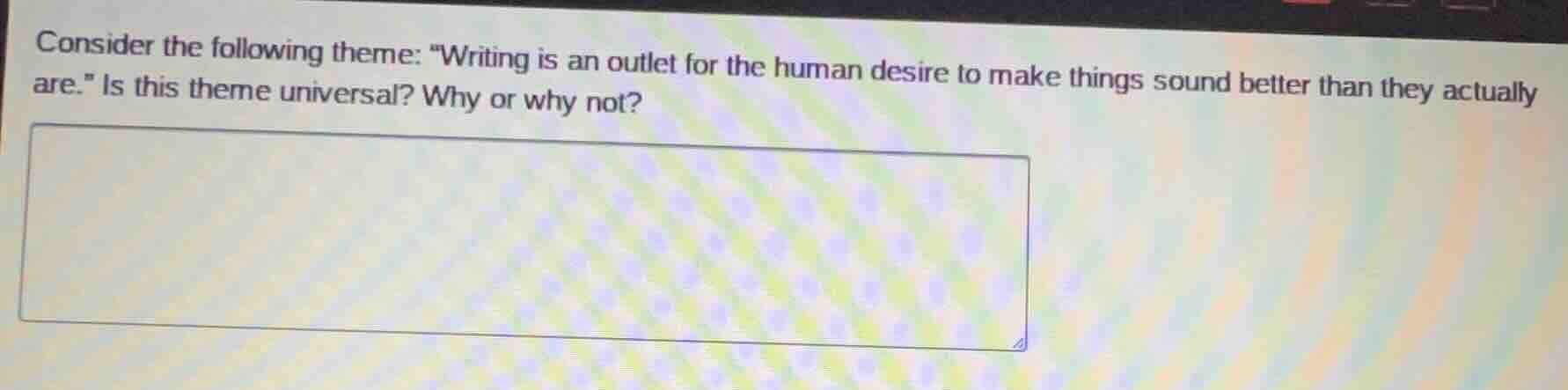
consider the following theme: \writing is an outlet for the human desire to make things sound better than they actually are.\ is this theme universal? why or why not?
<pre_analysis>
{
"quality": "clear",
"question_count": 1,
"skills_matched": [
"direct_cot",
"explain_then_answer",
"tutor",
"mastery_adaptive_brevity"
],
"needs_drawing": false,
"concepts_used": [
"Universal Theme"
],
"new_concepts": [],
"current_concepts": [
"Universal Theme",
"Literary Theme"
]
}
</pre_analysis>
<reasoning>
Define a universal theme
Using the Universal Theme knowledge point
A universal theme is an idea, lesson, or central message that applies to anyone, regardless of cultural differences, geographic location, or historical time period. It addresses fundamental aspects of the shared human experience.
Analyze the proposed theme
The statement "Writing is an outlet for the human desire to make things sound better than they actually are" focuses on a specific medium (writing) and a specific motivation (embellishment or idealization). While the desire to improve or beautify reality is a common human trait, limiting the outlet strictly to "writing" makes the statement too narrow to be fully universal. Many cultures and individuals throughout history have used oral storytelling, visual arts, music, or performance—rather than written text—to fulfill this exact same desire.
Evaluate universality
To make this theme truly universal, it must transcend the specific medium of writing. The underlying human impulse to romanticize, embellish, or seek comfort in idealized narratives is indeed universal. However, because the prompt's statement binds this impulse exclusively to the act of writing, the theme itself is not strictly universal in its current phrasing.
</reasoning>
<answer>
No, this theme is not strictly universal because it is tied specifically to the medium of writing. While the underlying human desire to embellish, idealize, or romanticize reality is a universal trait shared across all cultures and eras, writing is only one of many creative outlets (alongside oral storytelling, music, and visual art) used to express it.
</answer>
<post_analysis>
{
"subject": "Arts",
"question_type": "Free Response",
"knowledge_point": [
"Arts",
"Literary Analysis",
"Universal Theme"
]
}
</post_analysis>
Snap & solve any problem in the app
Get step-by-step solutions on Sovi AI
Photo-based solutions with guided steps
Explore more problems and detailed explanations
<pre_analysis>
{
"quality": "clear",
"question_count": 1,
"skills_matched": [
"direct_cot",
"explain_then_answer",
"tutor",
"mastery_adaptive_brevity"
],
"needs_drawing": false,
"concepts_used": [
"Universal Theme"
],
"new_concepts": [],
"current_concepts": [
"Universal Theme",
"Literary Theme"
]
}
</pre_analysis>
<reasoning>
Define a universal theme
Using the Universal Theme knowledge point
A universal theme is an idea, lesson, or central message that applies to anyone, regardless of cultural differences, geographic location, or historical time period. It addresses fundamental aspects of the shared human experience.
Analyze the proposed theme
The statement "Writing is an outlet for the human desire to make things sound better than they actually are" focuses on a specific medium (writing) and a specific motivation (embellishment or idealization). While the desire to improve or beautify reality is a common human trait, limiting the outlet strictly to "writing" makes the statement too narrow to be fully universal. Many cultures and individuals throughout history have used oral storytelling, visual arts, music, or performance—rather than written text—to fulfill this exact same desire.
Evaluate universality
To make this theme truly universal, it must transcend the specific medium of writing. The underlying human impulse to romanticize, embellish, or seek comfort in idealized narratives is indeed universal. However, because the prompt's statement binds this impulse exclusively to the act of writing, the theme itself is not strictly universal in its current phrasing.
</reasoning>
<answer>
No, this theme is not strictly universal because it is tied specifically to the medium of writing. While the underlying human desire to embellish, idealize, or romanticize reality is a universal trait shared across all cultures and eras, writing is only one of many creative outlets (alongside oral storytelling, music, and visual art) used to express it.
</answer>
<post_analysis>
{
"subject": "Arts",
"question_type": "Free Response",
"knowledge_point": [
"Arts",
"Literary Analysis",
"Universal Theme"
]
}
</post_analysis>