Sovi.AI - AI Math Tutor

Scan to solve math questions

QUESTION IMAGE

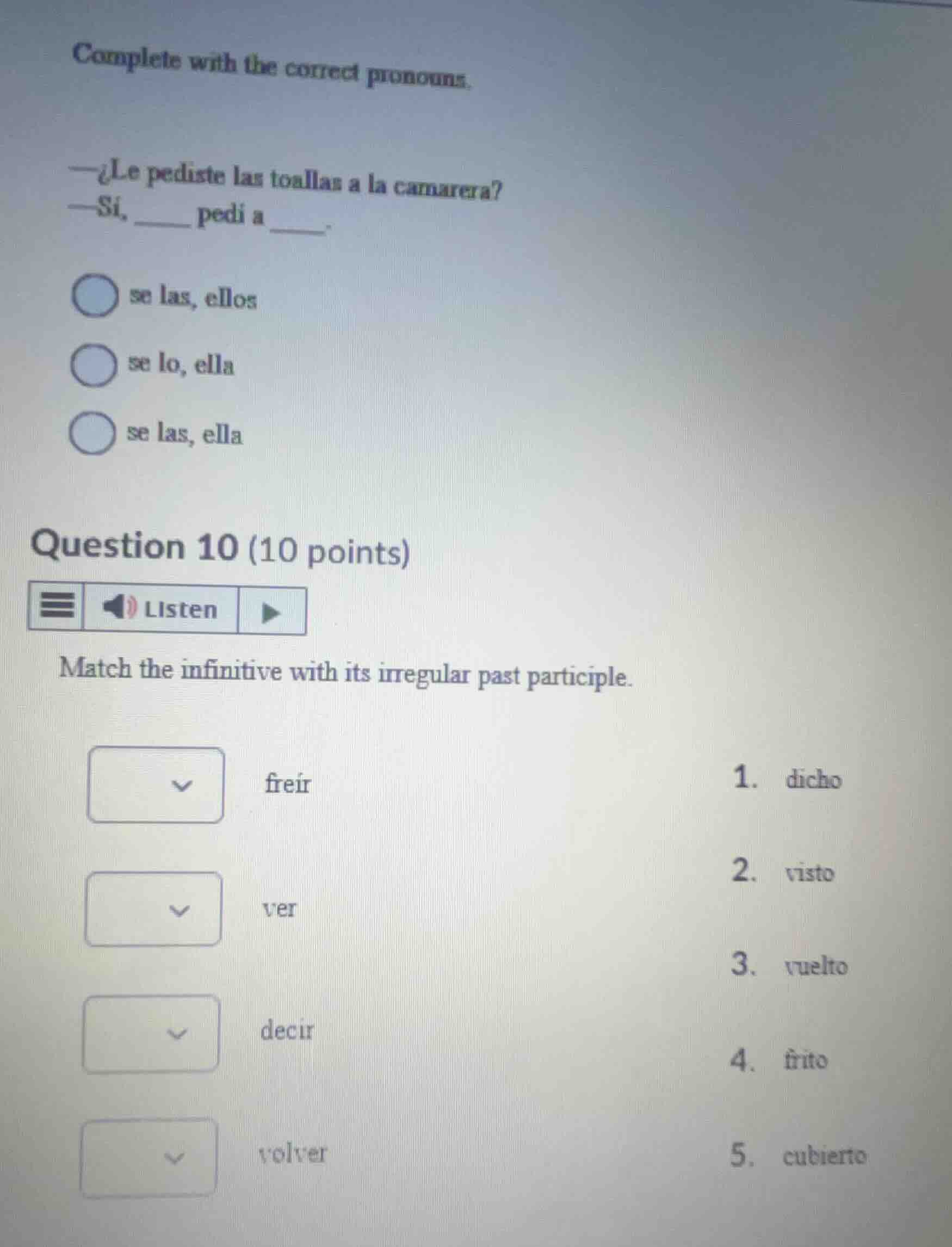
complete with the correct pronouns. -\\u00bfle pediste las toallas a la…

Question

complete with the correct pronouns.

-\\u00bfle pediste las toallas a la camarera?
-s\\u00ed, __ ped\\u00ed a __.

se las, ellos
se lo, ella
se las, ella

question 10 (10 points)
match the infinitive with its irregular past participle.

fre\\u00edr
ver
decir
volver

  1. dicho
  2. visto
  3. vuelto
  4. frito
  5. cubierto

Explanation:

Response

<pre_analysis>
{
"quality": "clear",
"question_count": 2,
"skills_matched": [
"direct_cot",
"explain_then_answer",
"quick"
],
"needs_drawing": false,
"concepts_used": [],
"new_concepts": [],
"current_concepts": [
"Spanish Double Object Pronouns",
"Spanish Past Participles"
]
}
</pre_analysis>

<reasoning>

Analyze the first question (pronouns)

The question asks to complete: "—¿Le pediste las toallas a la camarera? —Sí, _ pedí a _."

  • "las toallas" (feminine plural direct object) becomes "las".
  • "a la camarera" (singular feminine indirect object) becomes "le", which changes to "se" before "las". Thus, the double object pronoun is "se las".
  • "a la camarera" is replaced by the prepositional pronoun "ella".
  • The correct option is "se las, ella".

Analyze the second question (irregular past participles)

Match each infinitive with its irregular past participle:

  • freír -> frito (4)
  • ver -> visto (2)
  • decir -> dicho (1)
  • volver -> vuelto (3)

</reasoning>

<answer>

Question 1

<mcq-option>se las, ellos</mcq-option>
<mcq-option>se lo, ella</mcq-option>
<mcq-correct>se las, ella</mcq-correct>

Question 2

InfinitivePast Participle
vervisto
decirdicho
volvervuelto

</answer>

<post_analysis>
{
"subject": "Others",
"question_type": "Multi-part",
"knowledge_point": [
"Others",
"Spanish",
"Spanish Grammar"
]
}
</post_analysis>

Answer:

<pre_analysis>
{
"quality": "clear",
"question_count": 2,
"skills_matched": [
"direct_cot",
"explain_then_answer",
"quick"
],
"needs_drawing": false,
"concepts_used": [],
"new_concepts": [],
"current_concepts": [
"Spanish Double Object Pronouns",
"Spanish Past Participles"
]
}
</pre_analysis>

<reasoning>

Analyze the first question (pronouns)

The question asks to complete: "—¿Le pediste las toallas a la camarera? —Sí, _ pedí a _."

  • "las toallas" (feminine plural direct object) becomes "las".
  • "a la camarera" (singular feminine indirect object) becomes "le", which changes to "se" before "las". Thus, the double object pronoun is "se las".
  • "a la camarera" is replaced by the prepositional pronoun "ella".
  • The correct option is "se las, ella".

Analyze the second question (irregular past participles)

Match each infinitive with its irregular past participle:

  • freír -> frito (4)
  • ver -> visto (2)
  • decir -> dicho (1)
  • volver -> vuelto (3)

</reasoning>

<answer>

Question 1

<mcq-option>se las, ellos</mcq-option>
<mcq-option>se lo, ella</mcq-option>
<mcq-correct>se las, ella</mcq-correct>

Question 2

InfinitivePast Participle
vervisto
decirdicho
volvervuelto

</answer>

<post_analysis>
{
"subject": "Others",
"question_type": "Multi-part",
"knowledge_point": [
"Others",
"Spanish",
"Spanish Grammar"
]
}
</post_analysis>