QUESTION IMAGE
Question
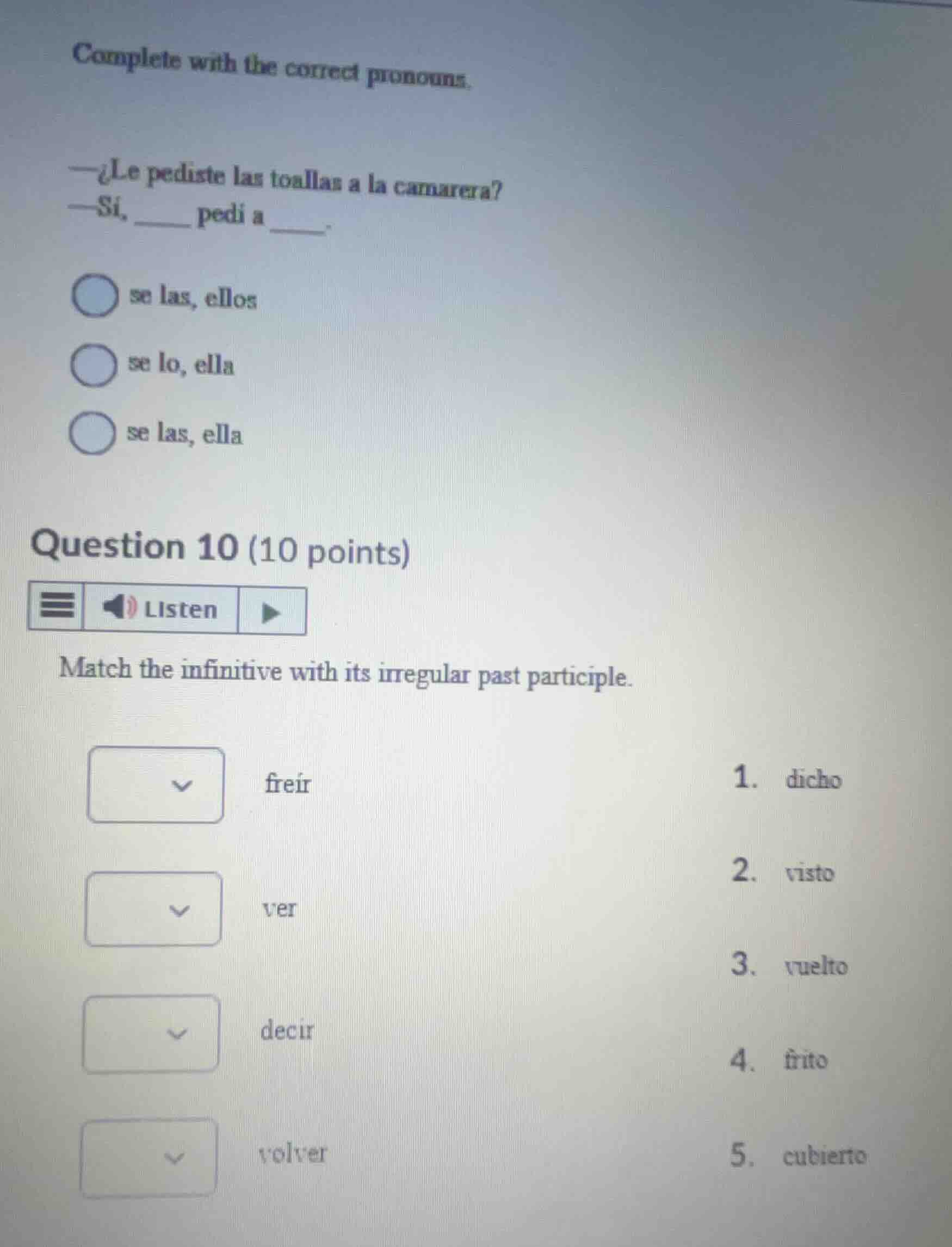
complete with the correct pronouns.
-\\u00bfle pediste las toallas a la camarera?
-s\\u00ed, __ ped\\u00ed a __.
se las, ellos
se lo, ella
se las, ella
question 10 (10 points)
match the infinitive with its irregular past participle.
fre\\u00edr
ver
decir
volver
- dicho
- visto
- vuelto
- frito
- cubierto
<pre_analysis>
{
"quality": "clear",
"question_count": 2,
"skills_matched": [
"direct_cot",
"explain_then_answer",
"quick"
],
"needs_drawing": false,
"concepts_used": [],
"new_concepts": [],
"current_concepts": [
"Spanish Double Object Pronouns",
"Spanish Past Participles"
]
}
</pre_analysis>
<reasoning>
Analyze the first question (pronouns)
The question asks to complete: "—¿Le pediste las toallas a la camarera? —Sí, _ pedí a _."
- "las toallas" (feminine plural direct object) becomes "las".
- "a la camarera" (singular feminine indirect object) becomes "le", which changes to "se" before "las". Thus, the double object pronoun is "se las".
- "a la camarera" is replaced by the prepositional pronoun "ella".
- The correct option is "se las, ella".
Analyze the second question (irregular past participles)
Match each infinitive with its irregular past participle:
- freír -> frito (4)
- ver -> visto (2)
- decir -> dicho (1)
- volver -> vuelto (3)
</reasoning>
<answer>
Question 1
<mcq-option>se las, ellos</mcq-option>
<mcq-option>se lo, ella</mcq-option>
<mcq-correct>se las, ella</mcq-correct>
Question 2
| Infinitive | Past Participle |
|---|---|
| ver | visto |
| decir | dicho |
| volver | vuelto |
</answer>
<post_analysis>
{
"subject": "Others",
"question_type": "Multi-part",
"knowledge_point": [
"Others",
"Spanish",
"Spanish Grammar"
]
}
</post_analysis>
Snap & solve any problem in the app
Get step-by-step solutions on Sovi AI
Photo-based solutions with guided steps
Explore more problems and detailed explanations
<pre_analysis>
{
"quality": "clear",
"question_count": 2,
"skills_matched": [
"direct_cot",
"explain_then_answer",
"quick"
],
"needs_drawing": false,
"concepts_used": [],
"new_concepts": [],
"current_concepts": [
"Spanish Double Object Pronouns",
"Spanish Past Participles"
]
}
</pre_analysis>
<reasoning>
Analyze the first question (pronouns)
The question asks to complete: "—¿Le pediste las toallas a la camarera? —Sí, _ pedí a _."
- "las toallas" (feminine plural direct object) becomes "las".
- "a la camarera" (singular feminine indirect object) becomes "le", which changes to "se" before "las". Thus, the double object pronoun is "se las".
- "a la camarera" is replaced by the prepositional pronoun "ella".
- The correct option is "se las, ella".
Analyze the second question (irregular past participles)
Match each infinitive with its irregular past participle:
- freír -> frito (4)
- ver -> visto (2)
- decir -> dicho (1)
- volver -> vuelto (3)
</reasoning>
<answer>
Question 1
<mcq-option>se las, ellos</mcq-option>
<mcq-option>se lo, ella</mcq-option>
<mcq-correct>se las, ella</mcq-correct>
Question 2
| Infinitive | Past Participle |
|---|---|
| ver | visto |
| decir | dicho |
| volver | vuelto |
</answer>
<post_analysis>
{
"subject": "Others",
"question_type": "Multi-part",
"knowledge_point": [
"Others",
"Spanish",
"Spanish Grammar"
]
}
</post_analysis>