QUESTION IMAGE
Question
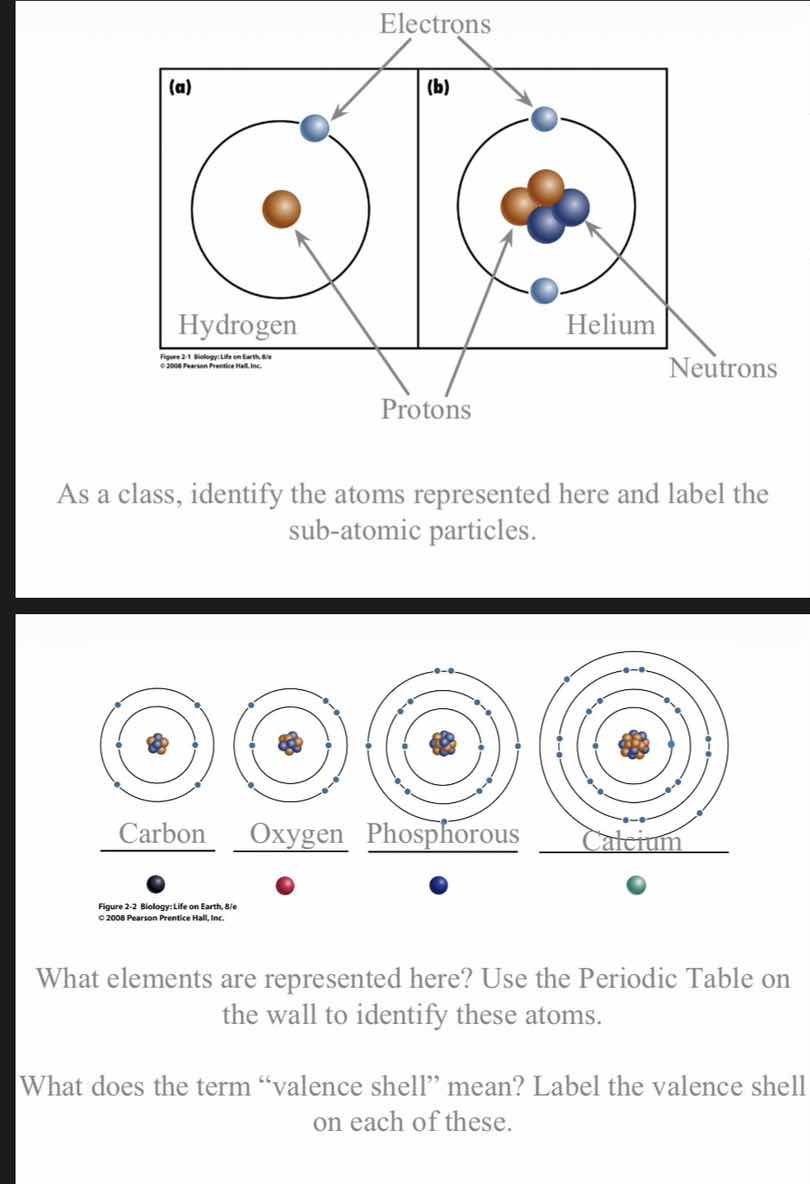
as a class, identify the atoms represented here and label the sub-atomic particles.
what elements are represented here? use the periodic table on the wall to identify these atoms.
what does the term \valence shell\ mean? label the valence shell on each of these.
Identify the class of atoms and label sub-atomic particles
The atoms shown in the first diagram are Hydrogen and Helium. As a class, these are atoms or chemical elements.
The sub-atomic particles labeled in the diagram are:
- Protons: The positively charged particles located in the nucleus (represented by the brown spheres).
- Neutrons: The neutral particles located in the nucleus of Helium (represented by the blue spheres in the nucleus).
- Electrons: The negatively charged particles orbiting the nucleus in shells (represented by the light blue spheres on the outer rings).
Identify the elements in the second diagram
By counting the protons (or total electrons in a neutral atom) and using the Periodic Table:
- Carbon: Has 6 electrons (2 in the inner shell, 4 in the outer shell).
- Oxygen: Has 8 electrons (2 in the inner shell, 6 in the outer shell).
- Phosphorus: Has 15 electrons (2 in the first shell, 8 in the second shell, 5 in the outer shell). Note: The image label says "Phosphorous" (an adjective spelling variant of Phosphorus).
- Calcium: Has 20 electrons (2 in the first, 8 in the second, 8 in the third, 2 in the outer shell).
Define the term "valence shell"
The valence shell is the outermost electron shell of an atom that contains electrons. These valence electrons are involved in forming chemical bonds with other atoms.
Label the valence shell on each atom
The valence shell is the outermost concentric ring containing electrons for each represented atom:
- For Carbon: The second (outermost) shell containing 4 electrons.
- For Oxygen: The second (outermost) shell containing 6 electrons.
- For Phosphorus: The third (outermost) shell containing 5 electrons.
- For Calcium: The fourth (outermost) shell containing 2 electrons.

Snap & solve any problem in the app
Get step-by-step solutions on Sovi AI
Photo-based solutions with guided steps
Explore more problems and detailed explanations
Question 1: Class and Sub-atomic Particles
- Class of representation: Atoms of chemical elements.
- Sub-atomic particles:
- Protons: Positively charged particles in the nucleus (brown spheres).
- Neutrons: Uncharged particles in the nucleus (blue spheres in the nucleus).
- Electrons: Negatively charged particles orbiting the nucleus (light blue spheres on the rings).
Question 2: Identified Elements
The elements represented in the second diagram are:
- Carbon (Atomic number 6)
- Oxygen (Atomic number 8)
- Phosphorus (Atomic number 15)
- Calcium (Atomic number 20)
Question 3: Definition of Valence Shell
The valence shell is the outermost occupied energy level (or electron shell) of an atom. It contains the valence electrons, which determine the chemical reactivity and bonding behavior of the element.
Question 4: Valence Shell Labels
The valence shell for each atom is:
- Carbon: The second (outermost) ring, containing 4 electrons.
- Oxygen: The second (outermost) ring, containing 6 electrons.
- Phosphorus: The third (outermost) ring, containing 5 electrons.
- Calcium: The fourth (outermost) ring, containing 2 electrons.