QUESTION IMAGE
Question
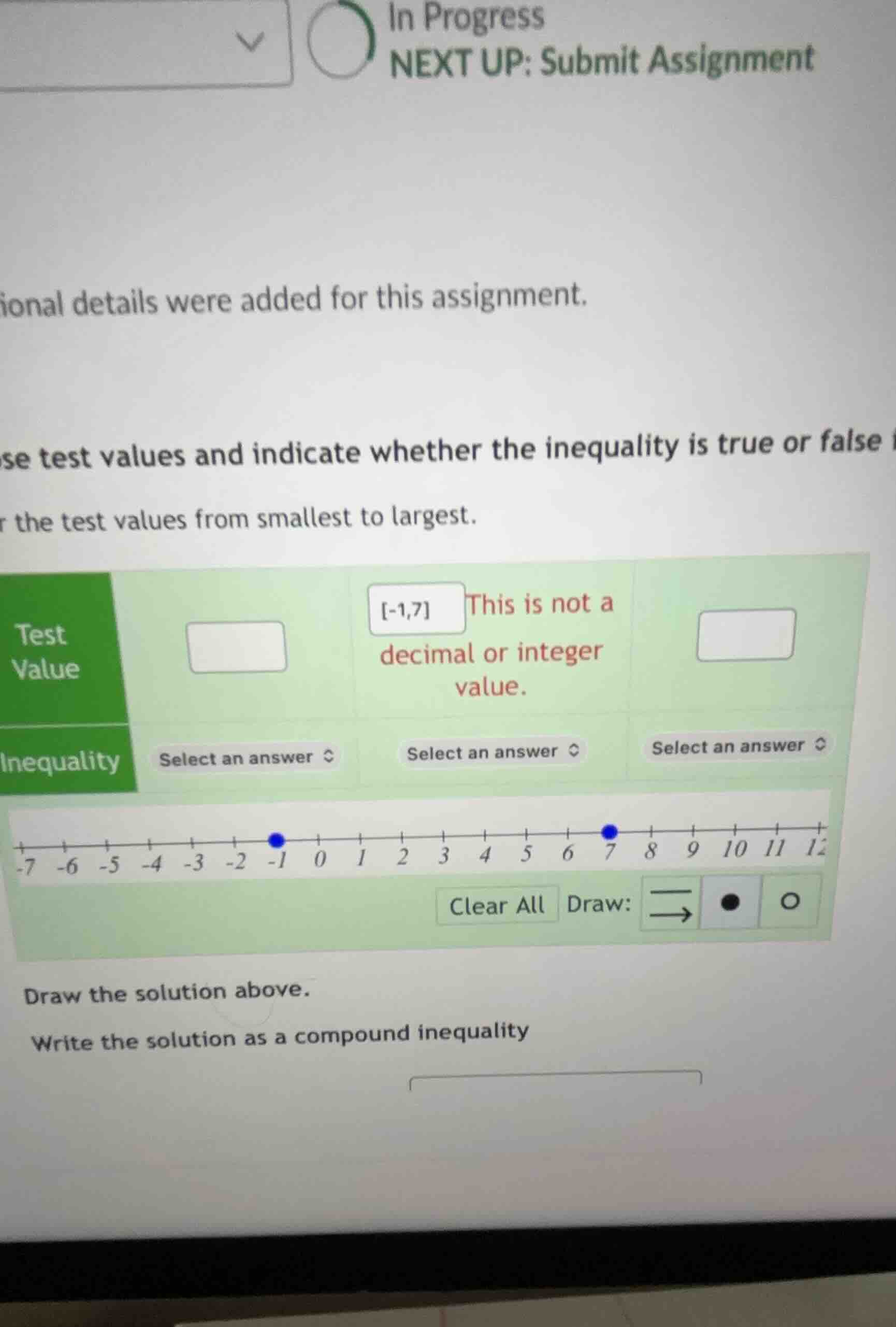
choose test values and indicate whether the inequality is true or false for the test values from smallest to largest.
test value:
inequality: select an answer select an answer select an answer
draw the solution above.
write the solution as a compound inequality
⚡ Using what you learned: Solving Compound Inequalities
Step 1: Identify the intervals and choose test values
The boundary points on the number line are \( -1 \) and \( 7 \). These points divide the number line into three distinct intervals:
- Left interval: \( (-\infty, -1) \)
- Middle interval: \( [-1, 7] \)
- Right interval: \( (7, \infty) \)
We need to choose one test value (an integer or decimal) from each interval, ordered from smallest to largest:
- For the left interval \( (-\infty, -1) \), we can choose \( -2 \).
- For the middle interval \( [-1, 7] \), we can choose \( 0 \).
- For the right interval \( (7, \infty) \), we can choose \( 8 \).
Step 2: Determine the truth value of the inequality
The blue solid dots at \( -1 \) and \( 7 \) indicate that these boundary points are included in the solution set. The interval between them, \( [-1, 7] \), represents the solution region where the inequality is true.
- For the test value \( -2 \) (outside the interval): False
- For the test value \( 0 \) (inside the interval): True
- For the test value \( 8 \) (outside the interval): False
Step 3: Write the compound inequality
Since the solution lies between \( -1 \) and \( 7 \) inclusive, we write this as a compound inequality:

Snap & solve any problem in the app
Get step-by-step solutions on Sovi AI
Photo-based solutions with guided steps
Explore more problems and detailed explanations
Table Values (from left to right):
- First Column:
- Test Value:
-2 - Inequality:
False - Second Column:
- Test Value:
0 - Inequality:
True - Third Column:
- Test Value:
8 - Inequality:
False
---