QUESTION IMAGE
Question
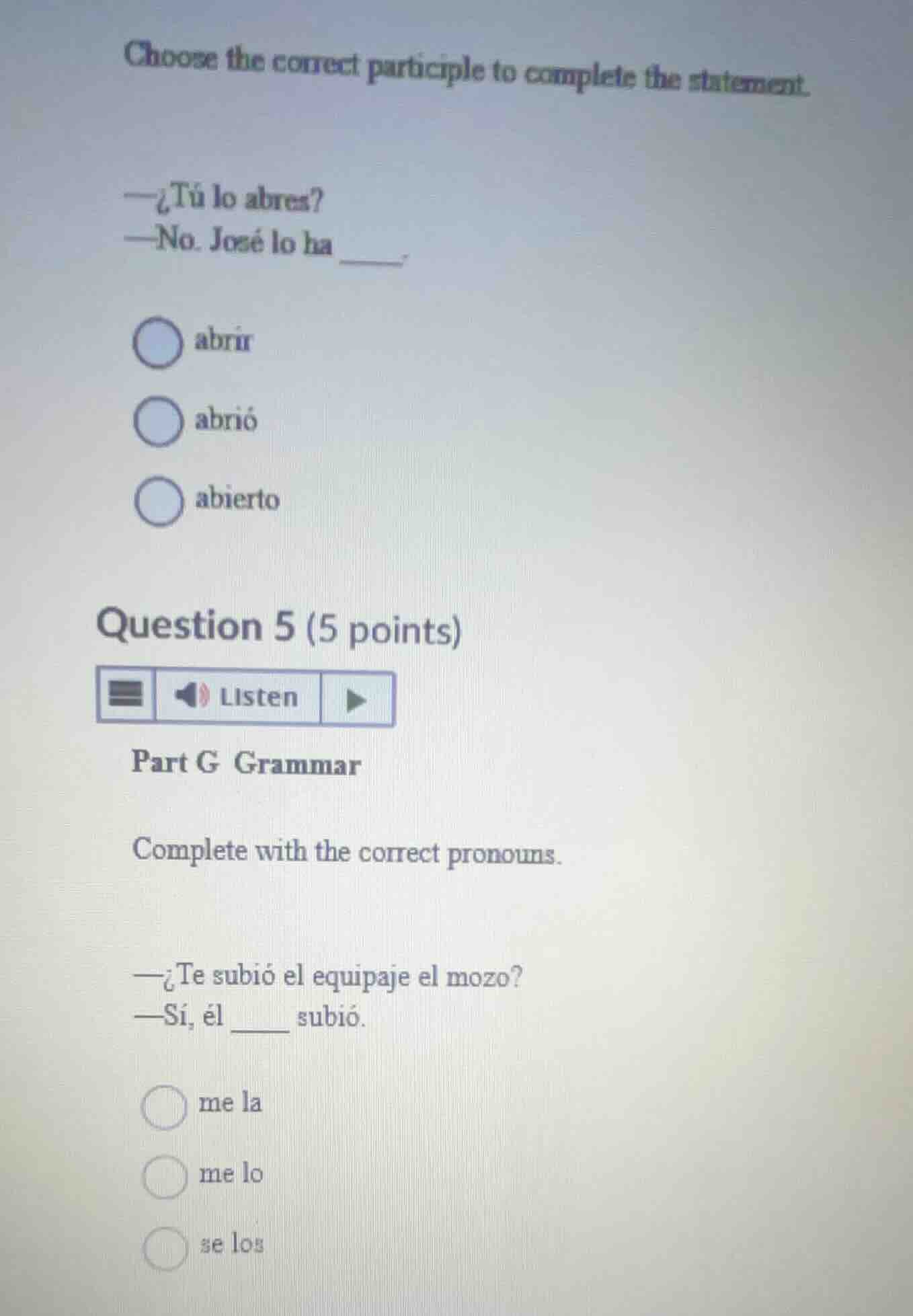
choose the correct participle to complete the statement.
-\iquestt\\u00fa lo abres?
-no. jos\\u00e9 lo ha ______.
abrir
abri\\u00f3
abierto
question 5 (5 points)
part g grammar
complete with the correct pronouns.
-\iquestte subi\\u00f3 el equipaje el mozo?
-s\\u00ed, \\u00e9l ______ subi\\u00f3.
me la
me lo
se los
<pre_analysis>
{
"quality": "clear",
"question_count": 2,
"skills_matched": [
"direct_cot",
"multiple_choice_formatter",
"explain_then_answer",
"quick"
],
"needs_drawing": false,
"concepts_used": [
"Spanish Past Participles",
"Spanish Double Object Pronouns"
],
"new_concepts": [],
"current_concepts": [
"Spanish Past Participles",
"Spanish Double Object Pronouns"
]
}
</pre_analysis>
<reasoning>
Analyze the first question
The prompt asks to choose the correct participle to complete: "—¿Tú lo abres? —No. José lo ha _____."
The auxiliary verb "ha" (from "haber") requires a past participle to form the present perfect tense.
The verb is "abrir" (to open), which has an irregular past participle: "abierto".
Analyze the second question
The prompt asks to complete with the correct pronouns: "—¿Te subió el equipaje el mozo? —Sí, él _____ subió."
The question asks: "Did the bellhop bring up the luggage for you?" ("te" = indirect object pronoun for "you"; "el equipaje" = direct object, masculine singular).
The response is: "Yes, he brought it up for me."
The indirect object pronoun changes from "te" (to you) to "me" (to me).
The direct object pronoun for "el equipaje" (masculine singular) is "lo".
Combining them in the correct order (indirect + direct) yields "me lo".
</reasoning>
<answer>
Question 1
<mcq-option>abrir</mcq-option>
<mcq-option>abrió</mcq-option>
<mcq-correct>abierto</mcq-correct>
Question 2
<mcq-option>me la</mcq-option>
<mcq-correct>me lo</mcq-correct>
<mcq-option>se los</mcq-option>
</answer>
<post_analysis>
{
"subject": "Others",
"question_type": "Multiple Choice",
"knowledge_point": [
"Others",
"Spanish",
"Spanish Grammar"
]
}
</post_analysis>
Snap & solve any problem in the app
Get step-by-step solutions on Sovi AI
Photo-based solutions with guided steps
Explore more problems and detailed explanations
<pre_analysis>
{
"quality": "clear",
"question_count": 2,
"skills_matched": [
"direct_cot",
"multiple_choice_formatter",
"explain_then_answer",
"quick"
],
"needs_drawing": false,
"concepts_used": [
"Spanish Past Participles",
"Spanish Double Object Pronouns"
],
"new_concepts": [],
"current_concepts": [
"Spanish Past Participles",
"Spanish Double Object Pronouns"
]
}
</pre_analysis>
<reasoning>
Analyze the first question
The prompt asks to choose the correct participle to complete: "—¿Tú lo abres? —No. José lo ha _____."
The auxiliary verb "ha" (from "haber") requires a past participle to form the present perfect tense.
The verb is "abrir" (to open), which has an irregular past participle: "abierto".
Analyze the second question
The prompt asks to complete with the correct pronouns: "—¿Te subió el equipaje el mozo? —Sí, él _____ subió."
The question asks: "Did the bellhop bring up the luggage for you?" ("te" = indirect object pronoun for "you"; "el equipaje" = direct object, masculine singular).
The response is: "Yes, he brought it up for me."
The indirect object pronoun changes from "te" (to you) to "me" (to me).
The direct object pronoun for "el equipaje" (masculine singular) is "lo".
Combining them in the correct order (indirect + direct) yields "me lo".
</reasoning>
<answer>
Question 1
<mcq-option>abrir</mcq-option>
<mcq-option>abrió</mcq-option>
<mcq-correct>abierto</mcq-correct>
Question 2
<mcq-option>me la</mcq-option>
<mcq-correct>me lo</mcq-correct>
<mcq-option>se los</mcq-option>
</answer>
<post_analysis>
{
"subject": "Others",
"question_type": "Multiple Choice",
"knowledge_point": [
"Others",
"Spanish",
"Spanish Grammar"
]
}
</post_analysis>