Sovi.AI - AI Math Tutor

Scan to solve math questions

QUESTION IMAGE

the children were playing quietly i had time to bake muffins. - the chi…

Question

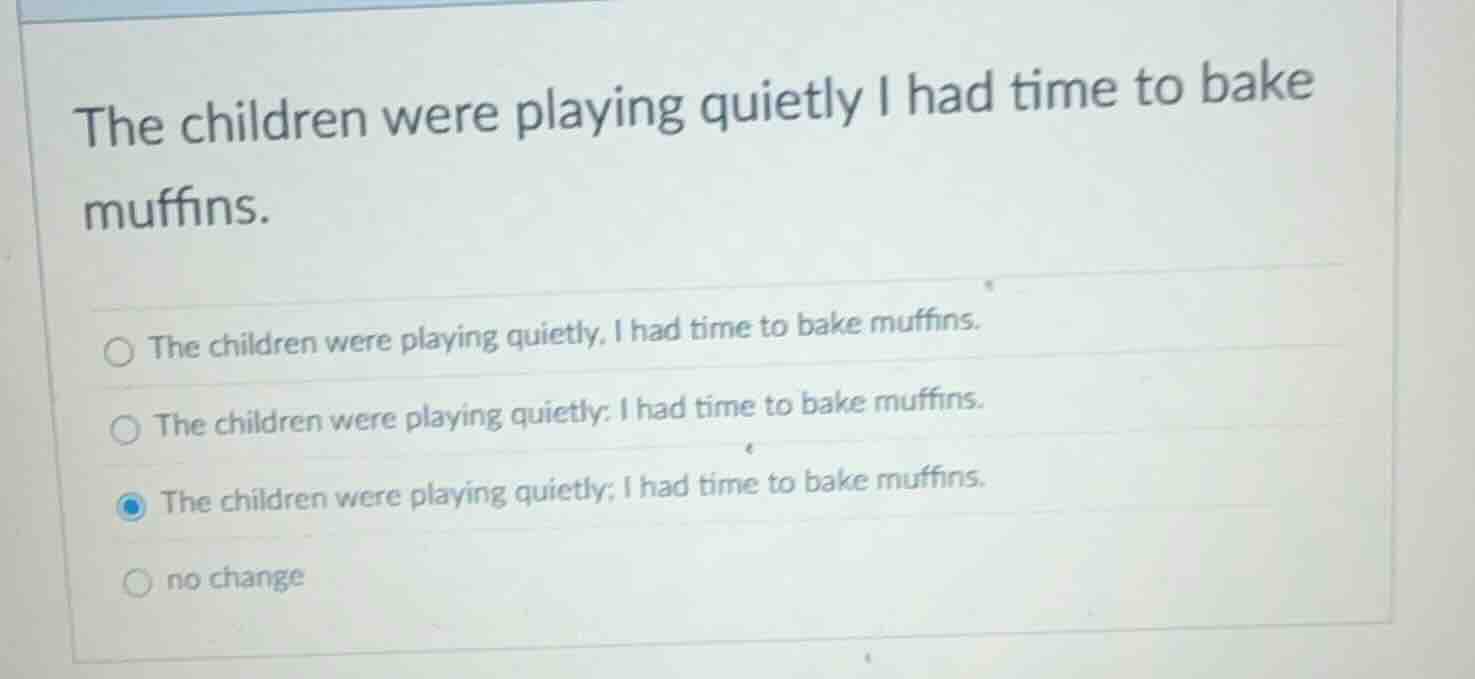
the children were playing quietly i had time to bake muffins.

  • the children were playing quietly, i had time to bake muffins.
  • the children were playing quietly: i had time to bake muffins.
  • the children were playing quietly; i had time to bake muffins.
  • no change

Explanation:

Response

<pre_analysis>
{
"quality": "clear",
"question_count": 1,
"skills_matched": [
"direct_cot",
"multiple_choice_formatter",
"explain_then_answer",
"quick"
],
"needs_drawing": false,
"concepts_used": [
"Run-on Sentences",
"Punctuation Rules"
],
"new_concepts": [],
"current_concepts": [
"Run-on Sentences",
"Punctuation Rules",
"Semicolon Usage"
]
}
</pre_analysis>

<reasoning>

Identify the grammatical error in the original sentence

The original sentence "The children were playing quietly I had time to bake muffins." consists of two independent clauses joined without any punctuation or coordinating conjunction, which is a run-on sentence (specifically, a fused sentence).

Evaluate the punctuation options

  • Option 1 uses a comma to join two independent clauses, creating a comma splice.
  • Option 2 uses a colon, which is incorrect here because the second clause does not explain, illustrate, or expand upon the first.
  • Option 3 uses a semicolon, which correctly joins two closely related independent clauses without a coordinating conjunction.
  • Option 4 ("no change") retains the run-on sentence.

Select the correct option

Option 3 correctly resolves the run-on sentence using a semicolon.
</reasoning>

<answer>
<mcq-option>(A) The children were playing quietly, I had time to bake muffins.</mcq-option>
<mcq-option>(B) The children were playing quietly: I had time to bake muffins.</mcq-option>
<mcq-correct>(C) The children were playing quietly; I had time to bake muffins.</mcq-correct>
<mcq-option>(D) no change</mcq-option>
</answer>

<post_analysis>
{
"subject": "Others",
"question_type": "Multiple Choice",
"knowledge_point": [
"Others",
"English Grammar",
"Sentence Structure and Punctuation"
]
}
</post_analysis>

Answer:

<pre_analysis>
{
"quality": "clear",
"question_count": 1,
"skills_matched": [
"direct_cot",
"multiple_choice_formatter",
"explain_then_answer",
"quick"
],
"needs_drawing": false,
"concepts_used": [
"Run-on Sentences",
"Punctuation Rules"
],
"new_concepts": [],
"current_concepts": [
"Run-on Sentences",
"Punctuation Rules",
"Semicolon Usage"
]
}
</pre_analysis>

<reasoning>

Identify the grammatical error in the original sentence

The original sentence "The children were playing quietly I had time to bake muffins." consists of two independent clauses joined without any punctuation or coordinating conjunction, which is a run-on sentence (specifically, a fused sentence).

Evaluate the punctuation options

  • Option 1 uses a comma to join two independent clauses, creating a comma splice.
  • Option 2 uses a colon, which is incorrect here because the second clause does not explain, illustrate, or expand upon the first.
  • Option 3 uses a semicolon, which correctly joins two closely related independent clauses without a coordinating conjunction.
  • Option 4 ("no change") retains the run-on sentence.

Select the correct option

Option 3 correctly resolves the run-on sentence using a semicolon.
</reasoning>

<answer>
<mcq-option>(A) The children were playing quietly, I had time to bake muffins.</mcq-option>
<mcq-option>(B) The children were playing quietly: I had time to bake muffins.</mcq-option>
<mcq-correct>(C) The children were playing quietly; I had time to bake muffins.</mcq-correct>
<mcq-option>(D) no change</mcq-option>
</answer>

<post_analysis>
{
"subject": "Others",
"question_type": "Multiple Choice",
"knowledge_point": [
"Others",
"English Grammar",
"Sentence Structure and Punctuation"
]
}
</post_analysis>