QUESTION IMAGE
Question
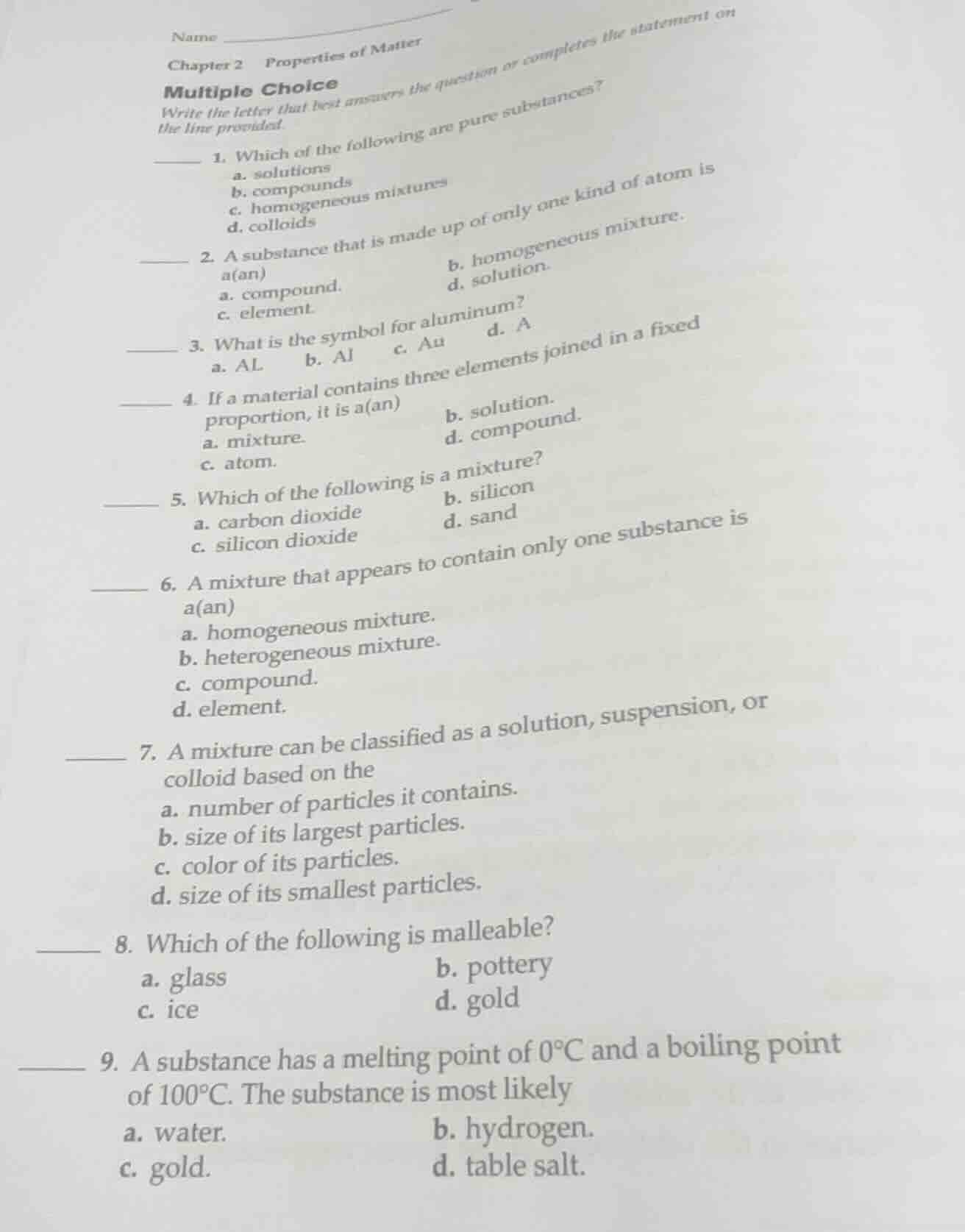
chapter 2 properties of matter
multiple choice
write the letter that best answers the question or completes the statement on the line provided.
- which of the following are pure substances?
a. solutions
b. compounds
c. homogeneous mixtures
d. colloids
- a substance that is made up of only one kind of atom is a(an)
a. compound.
b. homogeneous mixture.
c. element.
d. solution.
- what is the symbol for aluminum?
a. al
b. al
c. au
d. a
- if a material contains three elements joined in a fixed proportion, it is a(an)
a. mixture.
b. solution.
c. atom.
d. compound.
- which of the following is a mixture?
a. carbon dioxide
b. silicon
c. silicon dioxide
d. sand
- a mixture that appears to contain only one substance is a(an)
a. homogeneous mixture.
b. heterogeneous mixture.
c. compound.
d. element.
- a mixture can be classified as a solution, suspension, or colloid based on the
a. number of particles it contains.
b. size of its largest particles.
c. color of its particles.
d. size of its smallest particles.
- which of the following is malleable?
a. glass
b. pottery
c. ice
d. gold
- a substance has a melting point of \\(0^\circ\text{c}\\) and a boiling point of \\(100^\circ\text{c}\\). the substance is most likely
a. water.
b. hydrogen.
c. gold.
d. table salt.
Classify pure substances
Using the Pure Substances and Chemical Compounds knowledge points
- Pure substances have a constant composition and include elements and compounds.
- Solutions, homogeneous mixtures, and colloids are mixtures containing multiple substances.
- Therefore, compounds are pure substances.
Identify elements by composition
Using the Chemical Elements knowledge point
- An element is a pure substance consisting entirely of one type of atom.
- Compounds contain multiple types of atoms chemically bonded.
- Mixtures contain multiple substances physically combined.
Determine chemical symbols
- Chemical symbols use a standard one- or two-letter abbreviation.
- The first letter is always capitalized, and the second letter is always lowercase.
- Aluminum is represented by the symbol Al.
Define compound composition
Using the Chemical Compounds knowledge point
- A compound is a substance formed when two or more chemical elements are chemically bonded together in a fixed ratio.
- Mixtures do not have fixed proportions, and atoms are single units.
Identify mixtures
Using the Mixtures and Solutions knowledge point
- Carbon dioxide, silicon dioxide, and silicon are pure substances (compounds and an element).
- Sand is a heterogeneous mixture of various minerals, primarily quartz (silicon dioxide) and other rock fragments.
Classify homogeneous mixtures
Using the Mixtures and Solutions knowledge point
- A homogeneous mixture is so evenly blended that it appears to contain only one substance.
- Heterogeneous mixtures have visually distinguishable phases.
Classify mixtures by particle size
Using the Colloids and Suspensions knowledge point
- Mixtures are classified as solutions, suspensions, or colloids based on the size of their largest particles.
- Solutions have the smallest particles, colloids have intermediate particles, and suspensions have the largest particles.
Identify malleable materials
Using the Physical Properties knowledge point
- Malleability is the ability of a solid to be hammered or rolled into thin sheets without shattering.
- Metals like gold are highly malleable, whereas glass, pottery, and ice are brittle and shatter under stress.
Identify substance by phase change temperatures
Using the Physical Properties knowledge point
- Water has a characteristic melting point of \(0^\circ\text{C}\) and a boiling point of \(100^\circ\text{C}\) under standard atmospheric pressure.
- Hydrogen, gold, and table salt have vastly different melting and boiling points.

Snap & solve any problem in the app
Get step-by-step solutions on Sovi AI
Photo-based solutions with guided steps
Explore more problems and detailed explanations
Question 1
- a. solutions
- b. compounds (Correct answer)
- c. homogeneous mixtures
- d. colloids
Question 2
- a. compound.
- b. homogeneous mixture.
- c. element. (Correct answer)
- d. solution.
Question 3
- a. AL
- b. Al (Correct answer)
- c. Au
- d. A
Question 4
- a. mixture.
- b. solution.
- c. atom.
- d. compound. (Correct answer)
Question 5
- a. carbon dioxide
- b. silicon
- c. silicon dioxide
- d. sand (Correct answer)
Question 6
- a. homogeneous mixture. (Correct answer)
- b. heterogeneous mixture.
- c. compound.
- d. element.
Question 7
- a. number of particles it contains.
- b. size of its largest particles. (Correct answer)
- c. color of its particles.
- d. size of its smallest particles.
Question 8
- a. glass
- b. pottery
- c. ice
- d. gold (Correct answer)
Question 9
- a. water. (Correct answer)
- b. hydrogen.
- c. gold.
- d. table salt.