QUESTION IMAGE
Question
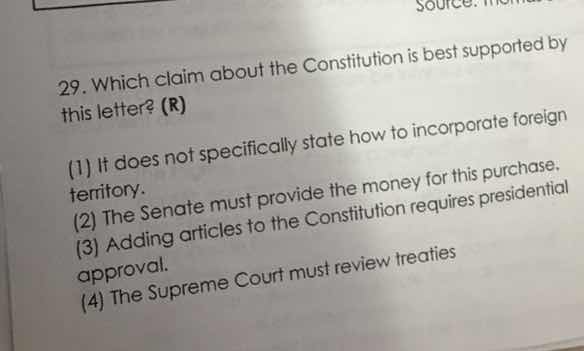
- which claim about the constitution is best supported by this letter? (r)
(1) it does not specifically state how to incorporate foreign territory.
(2) the senate must provide the money for this purchase.
(3) adding articles to the constitution requires presidential approval.
(4) the supreme court must review treaties
<pre_analysis>
{
"quality": "clear",
"question_count": 1,
"skills_matched": [
"direct_cot",
"multiple_choice_formatter",
"explain_then_answer",
"quick"
],
"needs_drawing": false,
"concepts_used": [],
"new_concepts": [
"Louisiana Purchase Constitutional Debate",
"Treaty-Making Power"
],
"current_concepts": [
"US Territorial Acquisition",
"Louisiana Purchase Constitutional Debate",
"Treaty-Making Power"
]
}
</pre_analysis>
<reasoning>
Analyze the historical context of the question
The question asks which claim about the Constitution is best supported by a letter (written by Thomas Jefferson, as indicated by the cropped "Source: Thomas..." at the top right). This letter historically refers to the debate surrounding the Louisiana Purchase in 1803. Jefferson, a strict constructionist, was concerned because the Constitution does not explicitly grant the federal government the power to acquire new foreign territory and incorporate it into the Union.
Evaluate the given options
- Option (1) states: "It does not specifically state how to incorporate foreign territory." This aligns directly with Jefferson's constitutional dilemma regarding the Louisiana Purchase, as he believed an amendment might be necessary because the Constitution was silent on acquiring and incorporating foreign lands.
- Option (2) is incorrect because the House of Representatives, not just the Senate, is responsible for appropriating funds, and this is not the primary constitutional claim supported by his letters on the purchase.
- Option (3) is incorrect because adding articles (amendments) requires ratification by the states, not just presidential approval.
- Option (4) is incorrect because judicial review of treaties by the Supreme Court is not a claim supported by Jefferson's correspondence regarding the purchase.
Formulate the final conclusion
Option (1) is the correct choice, reflecting the constitutional debate over the lack of explicit provisions for territorial acquisition and incorporation.
</reasoning>
<answer>
<mcq-correct>(1) It does not specifically state how to incorporate foreign territory.</mcq-correct>
<mcq-option>(2) The Senate must provide the money for this purchase.</mcq-option>
<mcq-option>(3) Adding articles to the Constitution requires presidential approval.</mcq-option>
<mcq-option>(4) The Supreme Court must review treaties</mcq-option>
</answer>
<post_analysis>
{
"subject": "Social Science",
"question_type": "Multiple Choice",
"knowledge_point": [
"Social Science",
"US History",
"Louisiana Purchase Constitutional Debate"
]
}
</post_analysis>
Snap & solve any problem in the app
Get step-by-step solutions on Sovi AI
Photo-based solutions with guided steps
Explore more problems and detailed explanations
<pre_analysis>
{
"quality": "clear",
"question_count": 1,
"skills_matched": [
"direct_cot",
"multiple_choice_formatter",
"explain_then_answer",
"quick"
],
"needs_drawing": false,
"concepts_used": [],
"new_concepts": [
"Louisiana Purchase Constitutional Debate",
"Treaty-Making Power"
],
"current_concepts": [
"US Territorial Acquisition",
"Louisiana Purchase Constitutional Debate",
"Treaty-Making Power"
]
}
</pre_analysis>
<reasoning>
Analyze the historical context of the question
The question asks which claim about the Constitution is best supported by a letter (written by Thomas Jefferson, as indicated by the cropped "Source: Thomas..." at the top right). This letter historically refers to the debate surrounding the Louisiana Purchase in 1803. Jefferson, a strict constructionist, was concerned because the Constitution does not explicitly grant the federal government the power to acquire new foreign territory and incorporate it into the Union.
Evaluate the given options
- Option (1) states: "It does not specifically state how to incorporate foreign territory." This aligns directly with Jefferson's constitutional dilemma regarding the Louisiana Purchase, as he believed an amendment might be necessary because the Constitution was silent on acquiring and incorporating foreign lands.
- Option (2) is incorrect because the House of Representatives, not just the Senate, is responsible for appropriating funds, and this is not the primary constitutional claim supported by his letters on the purchase.
- Option (3) is incorrect because adding articles (amendments) requires ratification by the states, not just presidential approval.
- Option (4) is incorrect because judicial review of treaties by the Supreme Court is not a claim supported by Jefferson's correspondence regarding the purchase.
Formulate the final conclusion
Option (1) is the correct choice, reflecting the constitutional debate over the lack of explicit provisions for territorial acquisition and incorporation.
</reasoning>
<answer>
<mcq-correct>(1) It does not specifically state how to incorporate foreign territory.</mcq-correct>
<mcq-option>(2) The Senate must provide the money for this purchase.</mcq-option>
<mcq-option>(3) Adding articles to the Constitution requires presidential approval.</mcq-option>
<mcq-option>(4) The Supreme Court must review treaties</mcq-option>
</answer>
<post_analysis>
{
"subject": "Social Science",
"question_type": "Multiple Choice",
"knowledge_point": [
"Social Science",
"US History",
"Louisiana Purchase Constitutional Debate"
]
}
</post_analysis>