QUESTION IMAGE
Question
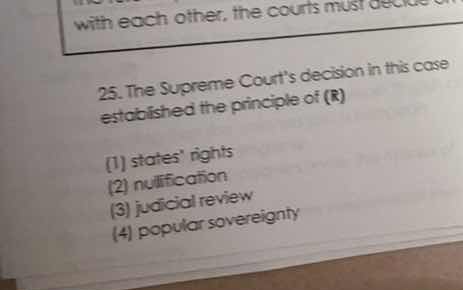
- the supreme courts decision in this case established the principle of (r)
(1) states rights
(2) nullification
(3) judicial review
(4) popular sovereignty
<pre_analysis>
{
"quality": "clear",
"question_count": 1,
"skills_matched": [
"direct_cot",
"multiple_choice_formatter",
"explain_then_answer",
"tutor"
],
"needs_drawing": false,
"concepts_used": [
"Early American Government",
"Separation of Powers"
],
"new_concepts": [
"Judicial Review",
"Marbury v. Madison"
],
"current_concepts": [
"Early American Government",
"Separation of Powers",
"Judicial Review"
]
}
</pre_analysis>
<reasoning>
Analyze the source text fragment
The visible text snippet at the top reads: "...with each other, the courts must decide on...". This refers to the classic constitutional argument from Alexander Hamilton's Federalist No. 78, which explains that when a legislative act conflicts with the Constitution, the courts must resolve the conflict. This is the foundation of the landmark Supreme Court case Marbury v. Madison (1803).
Connect to early government principles
In Early American Government, the balance of power among the branches was a central debate. The idea that the judiciary has the power to declare laws unconstitutional is a key component of the Separation of Powers and checks and balances.
Identify the established principle
The power of the Supreme Court to determine the constitutionality of laws is known as judicial review. This principle was formally established in American jurisprudence by Chief Justice John Marshall in the Marbury v. Madison decision.
Evaluate the given options
- (1) "states' rights" refers to state sovereignty, not judicial power.
- (2) "nullification" is a state-level doctrine, not a federal court power.
- (3) "judicial review" is the correct term for the court's power to declare laws unconstitutional.
- (4) "popular sovereignty" means political power rests with the people.
Therefore, option (3) is the correct choice.
</reasoning>
<answer>
<mcq-option>(1) states' rights</mcq-option>
<mcq-option>(2) nullification</mcq-option>
<mcq-correct>(3) judicial review</mcq-correct>
<mcq-option>(4) popular sovereignty</mcq-option>
</answer>
<post_analysis>
{
"subject": "Social Science",
"question_type": "Multiple Choice",
"knowledge_point": [
"Social Science",
"US History",
"Judicial Review"
]
}
</post_analysis>
Snap & solve any problem in the app
Get step-by-step solutions on Sovi AI
Photo-based solutions with guided steps
Explore more problems and detailed explanations
<pre_analysis>
{
"quality": "clear",
"question_count": 1,
"skills_matched": [
"direct_cot",
"multiple_choice_formatter",
"explain_then_answer",
"tutor"
],
"needs_drawing": false,
"concepts_used": [
"Early American Government",
"Separation of Powers"
],
"new_concepts": [
"Judicial Review",
"Marbury v. Madison"
],
"current_concepts": [
"Early American Government",
"Separation of Powers",
"Judicial Review"
]
}
</pre_analysis>
<reasoning>
Analyze the source text fragment
The visible text snippet at the top reads: "...with each other, the courts must decide on...". This refers to the classic constitutional argument from Alexander Hamilton's Federalist No. 78, which explains that when a legislative act conflicts with the Constitution, the courts must resolve the conflict. This is the foundation of the landmark Supreme Court case Marbury v. Madison (1803).
Connect to early government principles
In Early American Government, the balance of power among the branches was a central debate. The idea that the judiciary has the power to declare laws unconstitutional is a key component of the Separation of Powers and checks and balances.
Identify the established principle
The power of the Supreme Court to determine the constitutionality of laws is known as judicial review. This principle was formally established in American jurisprudence by Chief Justice John Marshall in the Marbury v. Madison decision.
Evaluate the given options
- (1) "states' rights" refers to state sovereignty, not judicial power.
- (2) "nullification" is a state-level doctrine, not a federal court power.
- (3) "judicial review" is the correct term for the court's power to declare laws unconstitutional.
- (4) "popular sovereignty" means political power rests with the people.
Therefore, option (3) is the correct choice.
</reasoning>
<answer>
<mcq-option>(1) states' rights</mcq-option>
<mcq-option>(2) nullification</mcq-option>
<mcq-correct>(3) judicial review</mcq-correct>
<mcq-option>(4) popular sovereignty</mcq-option>
</answer>
<post_analysis>
{
"subject": "Social Science",
"question_type": "Multiple Choice",
"knowledge_point": [
"Social Science",
"US History",
"Judicial Review"
]
}
</post_analysis>