QUESTION IMAGE
Question
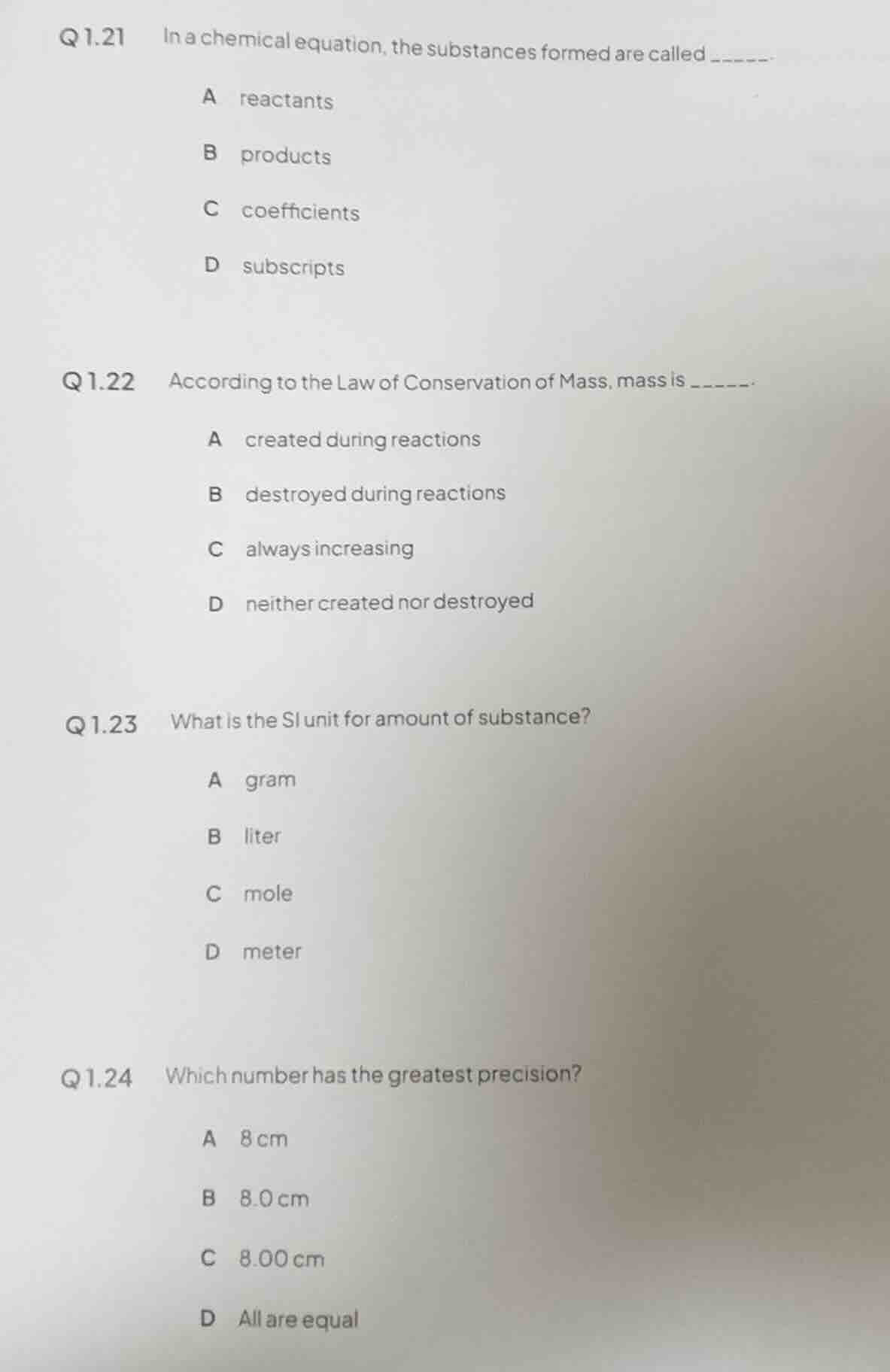
q 1.21 in a chemical equation, the substances formed are called _____
a reactants
b products
c coefficients
d subscripts
q 1.22 according to the law of conservation of mass, mass is _____
a created during reactions
b destroyed during reactions
c always increasing
d neither created nor destroyed
q 1.23 what is the si unit for amount of substance?
a gram
b liter
c mole
d meter
q 1.24 which number has the greatest precision?
a 8 cm
b 8.0 cm
c 8.00 cm
d all are equal
Identify substances formed in chemical equations
In a chemical reaction, starting substances are reactants. The new substances formed are products. This relates to Chemical Reactions.
- Option A: Reactants are starting materials.
- Option B: Products are the formed substances.
- Option C: Coefficients show molecule ratios.
- Option D: Subscripts show atom ratios.
Analyze the Law of Conservation of Mass
The Law of Conservation of Mass states mass is conserved.
- Mass cannot be created or destroyed in a chemical reaction.
- Therefore, option D is correct.
Determine the SI unit for amount of substance
We look at standard SI base units:
- Gram is for mass (though kilogram is the SI base unit).
- Liter is a unit of volume.
- Mole is the SI base unit for amount of substance.
- Meter is for length.
- Therefore, option C is correct.
Compare the precision of the measurements
Precision is indicated by the number of decimal places or significant figures.
- \(8\text{ cm}\) is precise to the nearest \(1\text{ cm}\).
- \(8.0\text{ cm}\) is precise to the nearest \(0.1\text{ cm}\).
- \(8.00\text{ cm}\) is precise to the nearest \(0.01\text{ cm}\).
- Therefore, \(8.00\text{ cm}\) has the greatest precision (Option C).

Snap & solve any problem in the app
Get step-by-step solutions on Sovi AI
Photo-based solutions with guided steps
Explore more problems and detailed explanations
Question 1.21
- A reactants
- B products (Correct answer)
- C coefficients
- D subscripts
Question 1.22
- A created during reactions
- B destroyed during reactions
- C always increasing
- D neither created nor destroyed (Correct answer)
Question 1.23
- A gram
- B liter
- C mole (Correct answer)
- D meter
Question 1.24
- A 8 cm
- B 8.0 cm
- C 8.00 cm (Correct answer)
- D All are equal