QUESTION IMAGE
Question
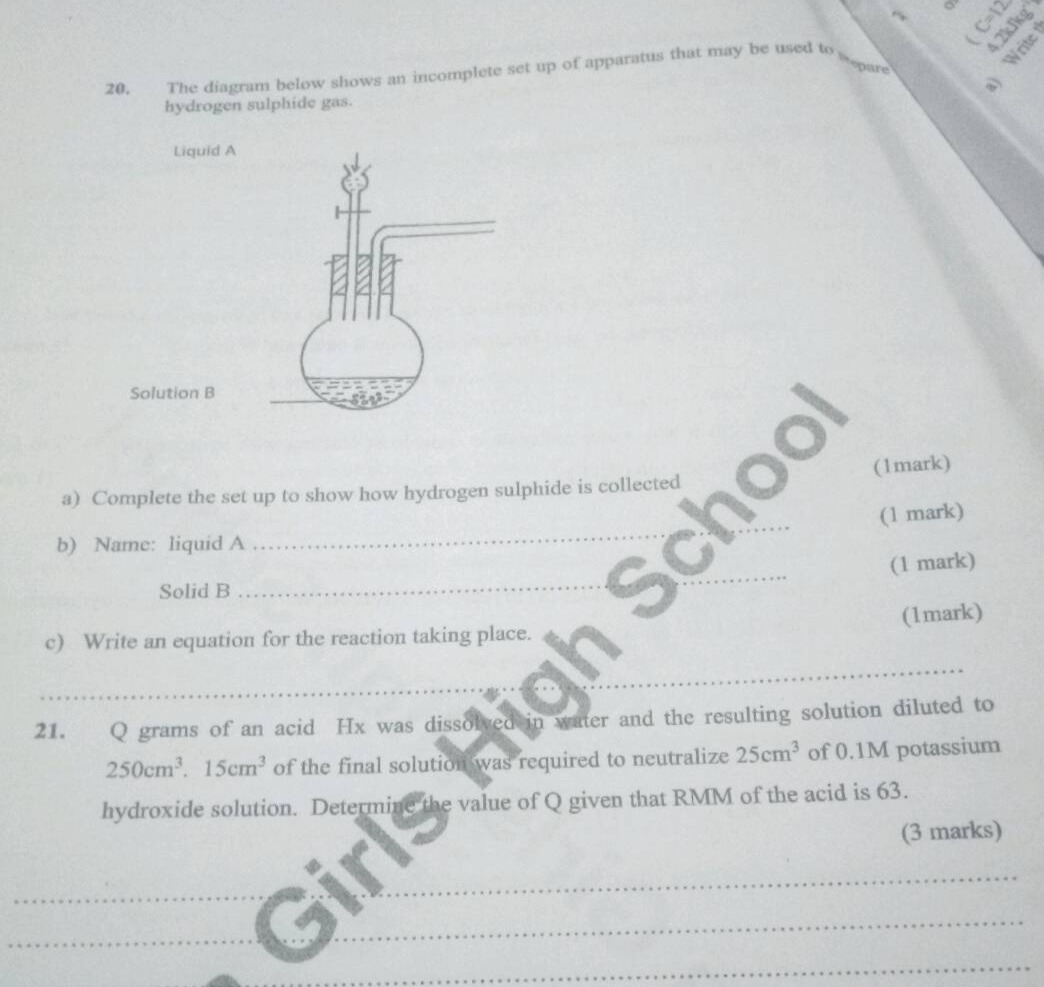
- the diagram below shows an incomplete set up of apparatus that may be used to prepare hydrogen sulphide gas.
liquid a
solution b
a) complete the set up to show how hydrogen sulphide is collected (1 mark)
b) name: liquid a (1 mark)
solid b (1 mark)
c) write an equation for the reaction taking place. (1 mark)
- q grams of an acid \\( hx \\) was dissolved in water and the resulting solution diluted to \\( 250\text{cm}^3 \\). \\( 15\text{cm}^3 \\) of the final solution was required to neutralize \\( 25\text{cm}^3 \\) of \\( 0.1\text{m} \\) potassium hydroxide solution. determine the value of q given that rmm of the acid is 63. (3 marks)
🆕 New Concept Discovered: Laboratory Preparation of Gases and Volumetric Analysis
Methods for preparing and collecting gases, and calculating solution concentrations during neutralization.
Step 1: Complete the Gas Collection Setup
Hydrogen sulfide (\(\text{H}_2\text{S}\)) is a gas that is denser than air and highly soluble in water. Because it is denser than air, it is collected by upward displacement of air (also known as downward delivery).
To complete the diagram:
- Draw a delivery tube extending from the flask's outlet into a gas jar.
- The delivery tube must go down near the bottom of an upright gas jar so that the denser \(\text{H}_2\text{S}\) gas fills the jar from the bottom up, displacing the lighter air upwards.
Step 2: Identify Liquid A and Solid B
Hydrogen sulfide gas is prepared in the laboratory by reacting a metal sulfide with a dilute acid at room temperature.
- Liquid A (poured through the thistle funnel): Dilute hydrochloric acid (\(\text{HCl}\)) or dilute sulfuric acid (\(\text{H}_2\text{SO}_4\)).
- Solid B (placed in the flask): Iron(II) sulfide (\(\text{FeS}\)).
(Note: The question paper has a typo where it labels the flask contents as "Solution B" in the diagram but asks for "Solid B" in the question text. The reactant in the flask is indeed solid iron(II) sulfide).
Step 3: Write the Chemical Equation
The reaction between iron(II) sulfide and dilute hydrochloric acid produces iron(II) chloride and hydrogen sulfide gas:
*(Alternatively, if dilute sulfuric acid is used: \(\text{FeS (s)} + \text{H}_2\text{SO}_4\text{ (aq)}
ightarrow \text{FeSO}_4\text{ (aq)} + \text{H}_2\text{S (g)}\))*
Step 4: Calculate Moles of Base Used in Neutralization
For Question 21, we start by calculating the number of moles of potassium hydroxide (\(\text{KOH}\)) used in the titration:
Step 5: Determine Moles of Acid in the Titration Sample
The acid is monoprotic, represented as \(\text{HX}\). The neutralization reaction with \(\text{KOH}\) is:
The reacting mole ratio of \(\text{HX} : \text{KOH}\) is \(1:1\). Therefore:
Step 6: Calculate Total Moles of Acid in the Original Solution
The \(15\text{ cm}^3\) sample was taken from a total volume of \(250\text{ cm}^3\). We scale up to find the total moles of \(\text{HX}\) in the original flask:
Step 7: Calculate the Mass Q of the Acid
Using the relative molecular mass (\(\text{RMM} = 63\)) of the acid:

Snap & solve any problem in the app
Get step-by-step solutions on Sovi AI
Photo-based solutions with guided steps
Explore more problems and detailed explanations
Question 20
- a) Gas Collection Setup: Draw a delivery tube leading from the flask into an upright gas jar, with the tube extending near to the bottom of the jar (upward displacement of air / downward delivery).
- b) Reagents:
- Liquid A: Dilute hydrochloric acid (or dilute sulfuric acid)
- Solid B: Iron(II) sulfide
- c) Chemical Equation:
---
Question 21
The value of \(Q\) is \(2.625\text{ g}\) (or \(\frac{21}{8}\text{ g}\)).