QUESTION IMAGE
Question
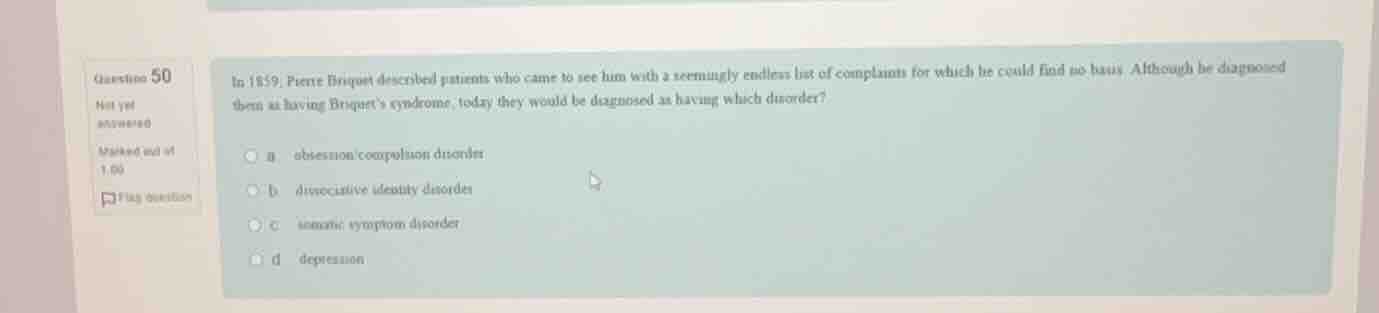
in 1859, pierre briquet described patients who came to see him with a seemingly endless list of complaints for which he could find no basis. although he diagnosed them as having briquets syndrome, today they would be diagnosed as having which disorder?
a. obsession/compulsion disorder
b. dissociative identity disorder
c. somatic symptom disorder
d. depression
<pre_analysis>
{
"quality": "clear",
"question_count": 1,
"skills_matched": [
"direct_cot",
"multiple_choice_formatter",
"explain_then_answer",
"quick"
],
"needs_drawing": false,
"concepts_used": [
"Somatic Symptom Disorder"
],
"new_concepts": [],
"current_concepts": [
"Somatic Symptom Disorder",
"Briquet's Syndrome"
]
}
</pre_analysis>
<reasoning>
Identify the historical context of Briquet's syndrome
In 1859, Pierre Briquet described a somatic condition characterized by a history of multiple physical complaints that cannot be fully explained by any known general medical condition. This clinical presentation was historically referred to as Briquet's syndrome.
Map Briquet's syndrome to modern DSM-5 classification
In modern psychiatric nomenclature (specifically DSM-5), Briquet's syndrome (previously classified as somatization disorder in DSM-IV) is classified under somatic symptom disorder.
Evaluate the given multiple-choice options
- Option a (obsession/compulsion disorder) is incorrect as it relates to intrusive thoughts and repetitive behaviors.
- Option b (dissociative identity disorder) is incorrect as it involves disruptions of identity and memory.
- Option c (somatic symptom disorder) is correct because it is characterized by multiple, clinically significant somatic complaints without an organic basis, matching Briquet's syndrome.
- Option d (depression) is incorrect as it is a mood disorder.
</reasoning>
<answer>
<mcq-option>a. obsession/compulsion disorder</mcq-option>
<mcq-option>b. dissociative identity disorder</mcq-option>
<mcq-correct>c. somatic symptom disorder</mcq-correct>
<mcq-option>d. depression</mcq-option>
</answer>
<post_analysis>
{
"subject": "Natural Science",
"question_type": "Multiple Choice",
"knowledge_point": [
"Natural Science",
"Psychiatry",
"Somatic Symptom Disorder"
]
}
</post_analysis>
Snap & solve any problem in the app
Get step-by-step solutions on Sovi AI
Photo-based solutions with guided steps
Explore more problems and detailed explanations
<pre_analysis>
{
"quality": "clear",
"question_count": 1,
"skills_matched": [
"direct_cot",
"multiple_choice_formatter",
"explain_then_answer",
"quick"
],
"needs_drawing": false,
"concepts_used": [
"Somatic Symptom Disorder"
],
"new_concepts": [],
"current_concepts": [
"Somatic Symptom Disorder",
"Briquet's Syndrome"
]
}
</pre_analysis>
<reasoning>
Identify the historical context of Briquet's syndrome
In 1859, Pierre Briquet described a somatic condition characterized by a history of multiple physical complaints that cannot be fully explained by any known general medical condition. This clinical presentation was historically referred to as Briquet's syndrome.
Map Briquet's syndrome to modern DSM-5 classification
In modern psychiatric nomenclature (specifically DSM-5), Briquet's syndrome (previously classified as somatization disorder in DSM-IV) is classified under somatic symptom disorder.
Evaluate the given multiple-choice options
- Option a (obsession/compulsion disorder) is incorrect as it relates to intrusive thoughts and repetitive behaviors.
- Option b (dissociative identity disorder) is incorrect as it involves disruptions of identity and memory.
- Option c (somatic symptom disorder) is correct because it is characterized by multiple, clinically significant somatic complaints without an organic basis, matching Briquet's syndrome.
- Option d (depression) is incorrect as it is a mood disorder.
</reasoning>
<answer>
<mcq-option>a. obsession/compulsion disorder</mcq-option>
<mcq-option>b. dissociative identity disorder</mcq-option>
<mcq-correct>c. somatic symptom disorder</mcq-correct>
<mcq-option>d. depression</mcq-option>
</answer>
<post_analysis>
{
"subject": "Natural Science",
"question_type": "Multiple Choice",
"knowledge_point": [
"Natural Science",
"Psychiatry",
"Somatic Symptom Disorder"
]
}
</post_analysis>