Sovi.AI - AI Math Tutor

Scan to solve math questions

QUESTION IMAGE

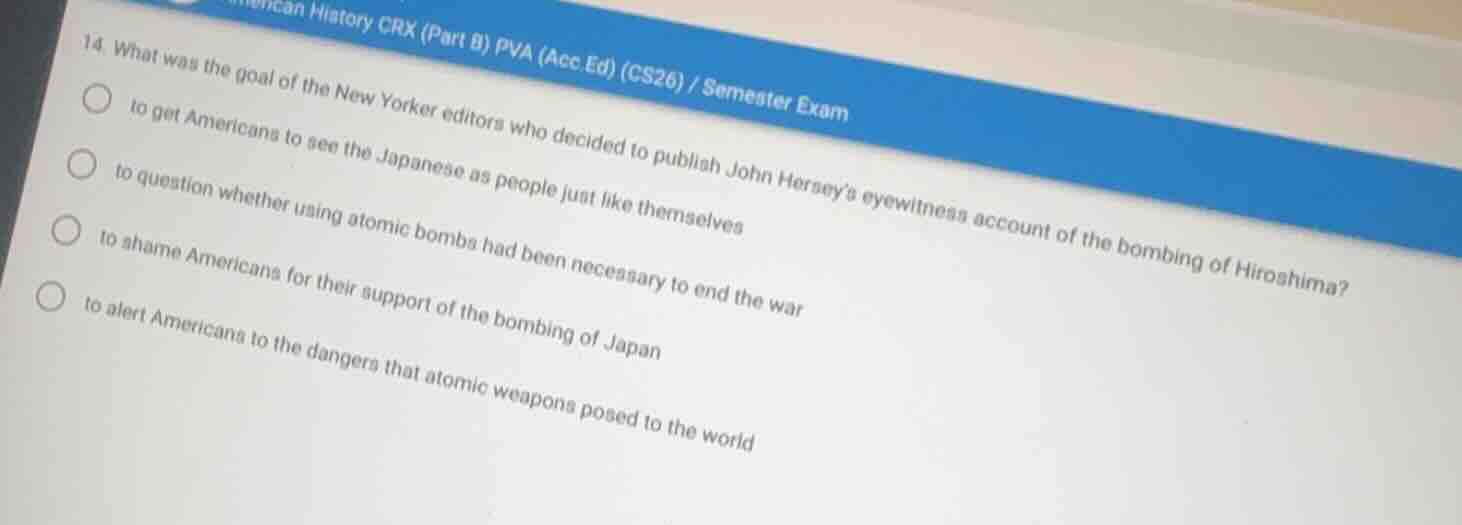
14. what was the goal of the new yorker editors who decided to publish …

Question

  1. what was the goal of the new yorker editors who decided to publish john herseys eyewitness account of the bombing of hiroshima?

to get americans to see the japanese as people just like themselves
to question whether using atomic bombs had been necessary to end the war
to shame americans for their support of the bombing of japan
to alert americans to the dangers that atomic weapons posed to the world

Explanation:

Response

<pre_analysis>
{
"quality": "clear",
"question_count": 1,
"skills_matched": [
"direct_cot",
"multiple_choice_formatter",
"explain_then_answer",
"tutor"
],
"needs_drawing": false,
"concepts_used": [],
"new_concepts": [
"Hiroshima Journalism",
"John Hersey",
"Post-WWII Media"
],
"current_concepts": [
"Hiroshima Journalism",
"John Hersey",
"Post-WWII Media"
]
}
</pre_analysis>

<reasoning>

Identify the historical context

John Hersey's article "Hiroshima" was published in The New Yorker in August 1946. It detailed the lived experiences of six survivors of the atomic bomb.

Analyze the editorial intent

During WWII, American media often depicted the Japanese through highly dehumanized wartime propaganda. The editors wanted to counter this.

Evaluate the options

The article focused deeply on the ordinary, human lives of the survivors before, during, and after the blast. This humanized them for the American public.

Formulate the conclusion

The primary goal was to make Americans see the Japanese as human beings just like themselves, rather than abstract wartime enemies.
</reasoning>

<answer>
<mcq-correct>(A) to get Americans to see the Japanese as people just like themselves</mcq-correct>
<mcq-option>(B) to question whether using atomic bombs had been necessary to end the war</mcq-option>
<mcq-option>(C) to shame Americans for their support of the bombing of Japan</mcq-option>
<mcq-option>(D) to alert Americans to the dangers that atomic weapons posed to the world</mcq-option>
</answer>

<post_analysis>
{
"subject": "Social Science",
"question_type": "Multiple Choice",
"knowledge_point": [
"Social Science",
"History",
"Post-WWII Media"
]
}
</post_analysis>

Answer:

<pre_analysis>
{
"quality": "clear",
"question_count": 1,
"skills_matched": [
"direct_cot",
"multiple_choice_formatter",
"explain_then_answer",
"tutor"
],
"needs_drawing": false,
"concepts_used": [],
"new_concepts": [
"Hiroshima Journalism",
"John Hersey",
"Post-WWII Media"
],
"current_concepts": [
"Hiroshima Journalism",
"John Hersey",
"Post-WWII Media"
]
}
</pre_analysis>

<reasoning>

Identify the historical context

John Hersey's article "Hiroshima" was published in The New Yorker in August 1946. It detailed the lived experiences of six survivors of the atomic bomb.

Analyze the editorial intent

During WWII, American media often depicted the Japanese through highly dehumanized wartime propaganda. The editors wanted to counter this.

Evaluate the options

The article focused deeply on the ordinary, human lives of the survivors before, during, and after the blast. This humanized them for the American public.

Formulate the conclusion

The primary goal was to make Americans see the Japanese as human beings just like themselves, rather than abstract wartime enemies.
</reasoning>

<answer>
<mcq-correct>(A) to get Americans to see the Japanese as people just like themselves</mcq-correct>
<mcq-option>(B) to question whether using atomic bombs had been necessary to end the war</mcq-option>
<mcq-option>(C) to shame Americans for their support of the bombing of Japan</mcq-option>
<mcq-option>(D) to alert Americans to the dangers that atomic weapons posed to the world</mcq-option>
</answer>

<post_analysis>
{
"subject": "Social Science",
"question_type": "Multiple Choice",
"knowledge_point": [
"Social Science",
"History",
"Post-WWII Media"
]
}
</post_analysis>