Sovi.AI - AI Math Tutor

Scan to solve math questions

QUESTION IMAGE

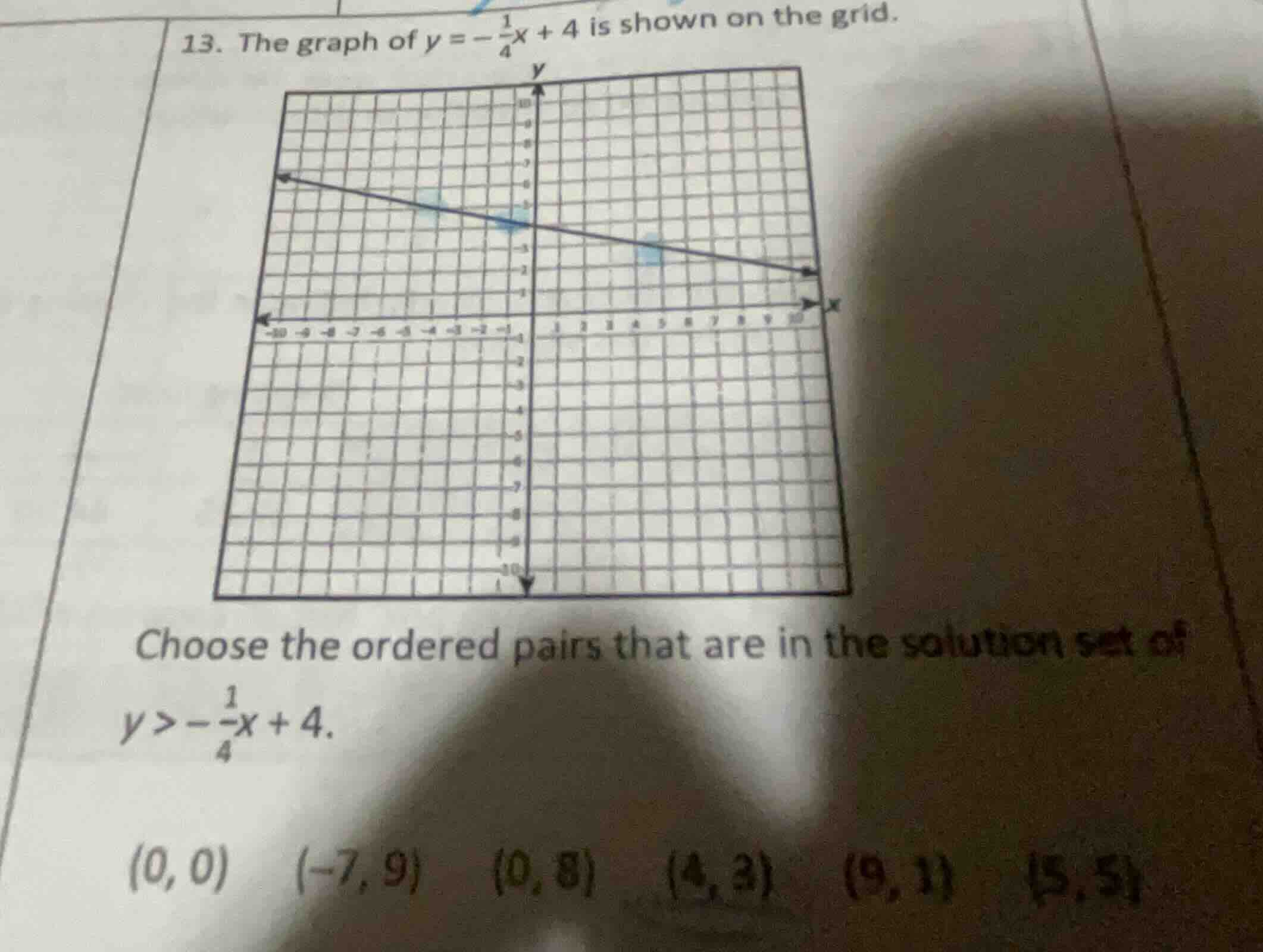
13. the graph of (y = -\\frac{1}{4}x + 4) is shown on the grid. choose …

Question

  1. the graph of (y = -\frac{1}{4}x + 4) is shown on the grid.

choose the ordered pairs that are in the solution set of (y > -\frac{1}{4}x + 4).

((0, 0)) ((-7, 9)) ((0, 8)) ((4, 3)) ((9, 1)) ((5, 5))

Explanation:

Response

<pre_analysis>
{
"quality": "clear",
"question_count": 1,
"skills_matched": [
"step_cot",
"explain_then_answer",
"tutor"
],
"needs_drawing": true,
"concepts_used": [
"Linear Inequalities",
"Ordered Pairs"
],
"new_concepts": [],
"current_concepts": [
"Linear Inequalities",
"Ordered Pairs"
]
}
</pre_analysis>

<reasoning>

Define the inequality

The given inequality is:
\[y > -\frac{1}{4}x + 4\]

Test the ordered pair (0, 0)

Using the Linear Inequalities and Ordered Pairs knowledge points:
\[0 > -\frac{1}{4}(0) + 4 \implies 0 > 4 \quad (\text{False})\]

Test the ordered pair (-7, 9)

Using the Linear Inequalities and Ordered Pairs knowledge points:
\[9 > -\frac{1}{4}(-7) + 4 \implies 9 > 1.75 + 4 \implies 9 > 5.75 \quad (\text{True})\]

Test the ordered pair (0, 8)

Using the Linear Inequalities and Ordered Pairs knowledge points:
\[8 > -\frac{1}{4}(0) + 4 \implies 8 > 4 \quad (\text{True})\]

Test the ordered pairs (4, 3), (9, 1), and (5, 5)

Using the Linear Inequalities and Ordered Pairs knowledge points:
For \((4, 3)\):
\[3 > -\frac{1}{4}(4) + 4 \implies 3 > -1 + 4 \implies 3 > 3 \quad (\text{False})\]

For \((9, 1)\):
\[1 > -\frac{1}{4}(9) + 4 \implies 1 > -2.25 + 4 \implies 1 > 1.75 \quad (\text{False})\]

For \((5, 5)\):
\[5 > -\frac{1}{4}(5) + 4 \implies 5 > -1.25 + 4 \implies 5 > 2.75 \quad (\text{True})\]
</reasoning>

<answer>
\((-7, 9)\), \((0, 8)\), and \((5, 5)\)
</answer>

<plot>
{
"elements": [
{
"type": "inequality",
"params": [
{
"js": "-0.25*x + 4",
"latex": "y > -\frac{1}{4}x + 4"
},
[0, 6]
],
"properties": {
"inverse": true,
"strict": true,
"strokeColor": "#8C55F2",
"strokeWidth": 2,
"fillColor": "rgba(140, 85, 242, 0.2)"
}
},
{
"type": "point",
"params": [[0, 0]],
"properties": {
"name": "(0,0) False",
"color": "#F2557F",
"size": 3
}
},
{
"type": "point",
"params": [[-7, 9]],
"properties": {
"name": "(-7,9) True",
"color": "#5583F2",
"size": 3
}
},
{
"type": "point",
"params": [[0, 8]],
"properties": {
"name": "(0,8) True",
"color": "#5583F2",
"size": 3
}
},
{
"type": "point",
"params": [[4, 3]],
"properties": {
"name": "(4,3) False",
"color": "#F2557F",
"size": 3
}
},
{
"type": "point",
"params": [[9, 1]],
"properties": {
"name": "(9,1) False",
"color": "#F2557F",
"size": 3
}
},
{
"type": "point",
"params": [[5, 5]],
"properties": {
"name": "(5,5) True",
"color": "#5583F2",
"size": 3
}
}
]
}
</plot>

<post_analysis>
{
"subject": "Mathematics",
"question_type": "Free Response",
"knowledge_point": [
"Mathematics",
"Algebra",
"Linear Inequalities"
]
}
</post_analysis>

Answer:

<pre_analysis>
{
"quality": "clear",
"question_count": 1,
"skills_matched": [
"step_cot",
"explain_then_answer",
"tutor"
],
"needs_drawing": true,
"concepts_used": [
"Linear Inequalities",
"Ordered Pairs"
],
"new_concepts": [],
"current_concepts": [
"Linear Inequalities",
"Ordered Pairs"
]
}
</pre_analysis>

<reasoning>

Define the inequality

The given inequality is:
\[y > -\frac{1}{4}x + 4\]

Test the ordered pair (0, 0)

Using the Linear Inequalities and Ordered Pairs knowledge points:
\[0 > -\frac{1}{4}(0) + 4 \implies 0 > 4 \quad (\text{False})\]

Test the ordered pair (-7, 9)

Using the Linear Inequalities and Ordered Pairs knowledge points:
\[9 > -\frac{1}{4}(-7) + 4 \implies 9 > 1.75 + 4 \implies 9 > 5.75 \quad (\text{True})\]

Test the ordered pair (0, 8)

Using the Linear Inequalities and Ordered Pairs knowledge points:
\[8 > -\frac{1}{4}(0) + 4 \implies 8 > 4 \quad (\text{True})\]

Test the ordered pairs (4, 3), (9, 1), and (5, 5)

Using the Linear Inequalities and Ordered Pairs knowledge points:
For \((4, 3)\):
\[3 > -\frac{1}{4}(4) + 4 \implies 3 > -1 + 4 \implies 3 > 3 \quad (\text{False})\]

For \((9, 1)\):
\[1 > -\frac{1}{4}(9) + 4 \implies 1 > -2.25 + 4 \implies 1 > 1.75 \quad (\text{False})\]

For \((5, 5)\):
\[5 > -\frac{1}{4}(5) + 4 \implies 5 > -1.25 + 4 \implies 5 > 2.75 \quad (\text{True})\]
</reasoning>

<answer>
\((-7, 9)\), \((0, 8)\), and \((5, 5)\)
</answer>

<plot>
{
"elements": [
{
"type": "inequality",
"params": [
{
"js": "-0.25*x + 4",
"latex": "y > -\frac{1}{4}x + 4"
},
[0, 6]
],
"properties": {
"inverse": true,
"strict": true,
"strokeColor": "#8C55F2",
"strokeWidth": 2,
"fillColor": "rgba(140, 85, 242, 0.2)"
}
},
{
"type": "point",
"params": [[0, 0]],
"properties": {
"name": "(0,0) False",
"color": "#F2557F",
"size": 3
}
},
{
"type": "point",
"params": [[-7, 9]],
"properties": {
"name": "(-7,9) True",
"color": "#5583F2",
"size": 3
}
},
{
"type": "point",
"params": [[0, 8]],
"properties": {
"name": "(0,8) True",
"color": "#5583F2",
"size": 3
}
},
{
"type": "point",
"params": [[4, 3]],
"properties": {
"name": "(4,3) False",
"color": "#F2557F",
"size": 3
}
},
{
"type": "point",
"params": [[9, 1]],
"properties": {
"name": "(9,1) False",
"color": "#F2557F",
"size": 3
}
},
{
"type": "point",
"params": [[5, 5]],
"properties": {
"name": "(5,5) True",
"color": "#5583F2",
"size": 3
}
}
]
}
</plot>

<post_analysis>
{
"subject": "Mathematics",
"question_type": "Free Response",
"knowledge_point": [
"Mathematics",
"Algebra",
"Linear Inequalities"
]
}
</post_analysis>