QUESTION IMAGE
Question
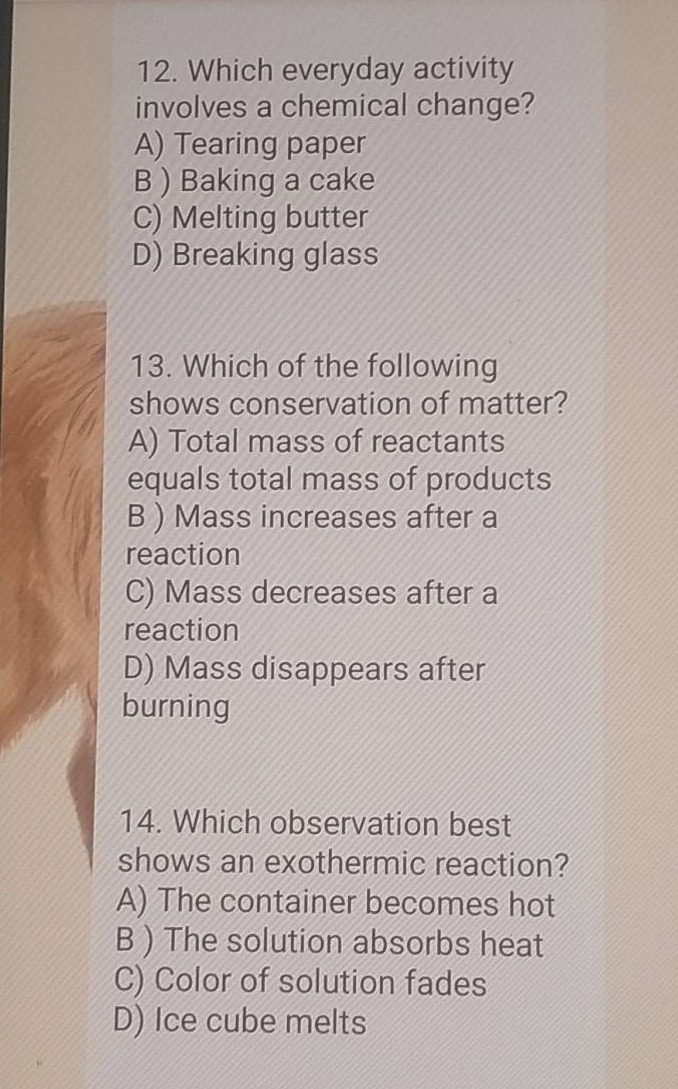
- which everyday activity involves a chemical change?
a) tearing paper
b) baking a cake
c) melting butter
d) breaking glass
- which of the following shows conservation of matter?
a) total mass of reactants equals total mass of products
b) mass increases after a reaction
c) mass decreases after a reaction
d) mass disappears after burning
- which observation best shows an exothermic reaction?
a) the container becomes hot
b) the solution absorbs heat
c) color of solution fades
d) ice cube melts
🆕 New Concept Discovered: Chemical vs. Physical Changes
New substances form during chemical changes.
🆕 New Concept Discovered: Conservation of Matter
Matter cannot be created or destroyed.
🆕 New Concept Discovered: Exothermic vs. Endothermic
Exothermic reactions release heat to their surroundings.
Step 1: Analyze Question 12 (Chemical vs. Physical Changes)
A physical change alters the form or appearance of a substance without changing its chemical identity (e.g., tearing, breaking, or changing state like melting). A chemical change occurs when substances react to form entirely new substances with different chemical properties.
- A) Tearing paper: Only changes the size and shape (physical change).
- B) Baking a cake: Heat causes chemical reactions between ingredients (like baking powder reacting to release gas, and proteins/sugars bonding), creating a new substance that cannot be easily reversed (chemical change).
- C) Melting butter: A change of state from solid to liquid (physical change).
- D) Breaking glass: Only changes the shape and size (physical change).
Therefore, the correct option is B.
Step 2: Analyze Question 13 (Conservation of Matter)
The Law of Conservation of Mass (or Matter) states that in a closed system, matter cannot be created or destroyed during a chemical reaction.
- This means the total mass of the starting materials (reactants) must be exactly equal to the total mass of the resulting substances (products).
Therefore, the correct option is A.
Step 3: Analyze Question 14 (Exothermic vs. Endothermic)
An exothermic reaction is a chemical process that releases energy in the form of heat to its surroundings.
- When heat is released into the surroundings, the temperature of the reaction container rises, making it feel hot to the touch.
- Absorbing heat (option B) and melting ice (option D) are endothermic processes (they absorb heat from the surroundings).
Therefore, the correct option is A.

Snap & solve any problem in the app
Get step-by-step solutions on Sovi AI
Photo-based solutions with guided steps
Explore more problems and detailed explanations
- 12: B) Baking a cake
- 13: A) Total mass of reactants equals total mass of products
- 14: A) The container becomes hot