Sovi.AI - AI Math Tutor

Scan to solve math questions

QUESTION IMAGE

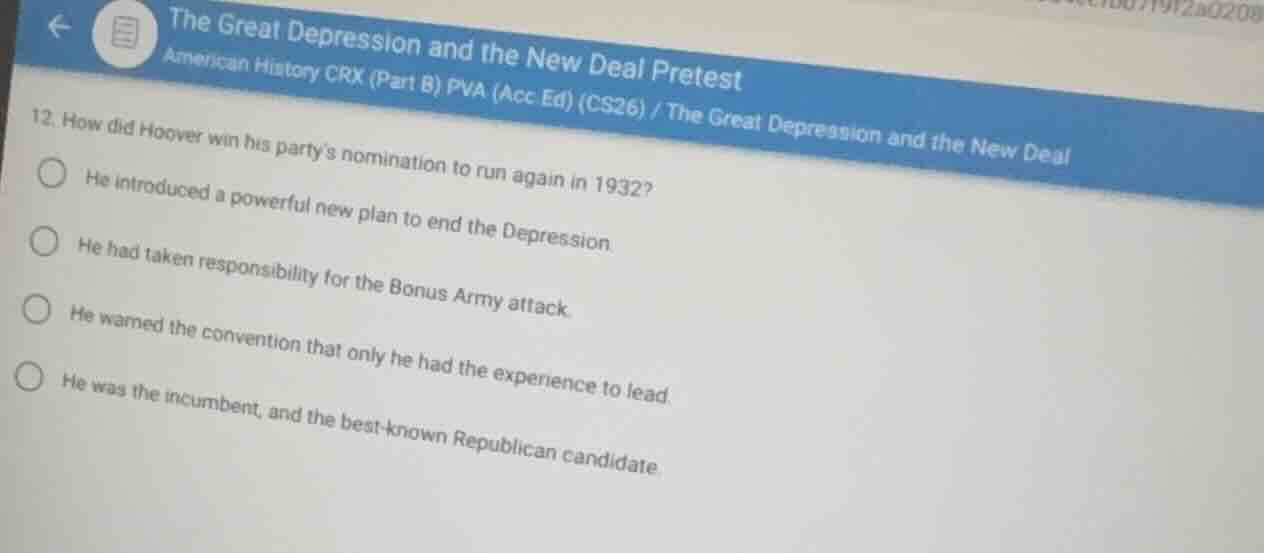
12. how did hoover win his partys nomination to run again in 1932? he i…

Question

  1. how did hoover win his partys nomination to run again in 1932?

he introduced a powerful new plan to end the depression.
he had taken responsibility for the bonus army attack.
he warned the convention that only he had the experience to lead.
he was the incumbent, and the best-known republican candidate.

Explanation:

Response

<pre_analysis>
{
"quality": "clear",
"question_count": 1,
"skills_matched": [
"direct_cot",
"multiple_choice_formatter",
"explain_then_answer",
"tutor",
"mastery_adaptive_brevity"
],
"needs_drawing": false,
"concepts_used": [
"Herbert Hoover Presidency"
],
"new_concepts": [
"1932 Election",
"Incumbency Advantage"
],
"current_concepts": [
"Herbert Hoover Presidency",
"1932 Election",
"Incumbency Advantage"
]
}
</pre_analysis>

<reasoning>

Analyze the historical context of the 1932 election

Using the Herbert Hoover Presidency knowledge point
By 1932, the United States was in the depths of the Great Depression, and President Herbert Hoover was highly unpopular due to his perceived inability to address the economic crisis. Despite his low approval ratings and public discontent, political parties historically tend to renominate sitting presidents.

Evaluate the Republican nomination process in 1932

As the sitting president, Hoover held the power of incumbency. He controlled the party machinery and patronage, making it virtually impossible for any challenger within the Republican Party to mount a successful campaign against him at the national convention. He was the most prominent and established figure in the party.

Assess the incorrect options

  • "He introduced a powerful new plan to end the Depression": Hoover did not introduce a major new plan that successfully rallied the public; his policies remained largely unpopular and conservative.
  • "He had taken responsibility for the Bonus Army attack": The handling of the Bonus Army was a public relations disaster that severely damaged his reputation, not a reason for his nomination.
  • "He warned the convention that only he had the experience to lead": While experience was a talking point, it was not the primary structural reason he secured the nomination.

Determine the correct choice

The primary reason Hoover secured the nomination was his status as the sitting president. He was the incumbent and the most widely recognized Republican candidate, which allowed him to easily secure the delegates needed for renomination.
</reasoning>

<answer>
<mcq-option>He introduced a powerful new plan to end the Depression</mcq-option>
<mcq-option>He had taken responsibility for the Bonus Army attack</mcq-option>
<mcq-option>He warned the convention that only he had the experience to lead</mcq-option>
<mcq-correct>He was the incumbent, and the best-known Republican candidate</mcq-correct>
</answer>

<post_analysis>
{
"subject": "Social Science",
"question_type": "Multiple Choice",
"knowledge_point": [
"Social Science",
"U.S. History",
"Great Depression and New Deal"
]
}
</post_analysis>

Answer:

<pre_analysis>
{
"quality": "clear",
"question_count": 1,
"skills_matched": [
"direct_cot",
"multiple_choice_formatter",
"explain_then_answer",
"tutor",
"mastery_adaptive_brevity"
],
"needs_drawing": false,
"concepts_used": [
"Herbert Hoover Presidency"
],
"new_concepts": [
"1932 Election",
"Incumbency Advantage"
],
"current_concepts": [
"Herbert Hoover Presidency",
"1932 Election",
"Incumbency Advantage"
]
}
</pre_analysis>

<reasoning>

Analyze the historical context of the 1932 election

Using the Herbert Hoover Presidency knowledge point
By 1932, the United States was in the depths of the Great Depression, and President Herbert Hoover was highly unpopular due to his perceived inability to address the economic crisis. Despite his low approval ratings and public discontent, political parties historically tend to renominate sitting presidents.

Evaluate the Republican nomination process in 1932

As the sitting president, Hoover held the power of incumbency. He controlled the party machinery and patronage, making it virtually impossible for any challenger within the Republican Party to mount a successful campaign against him at the national convention. He was the most prominent and established figure in the party.

Assess the incorrect options

  • "He introduced a powerful new plan to end the Depression": Hoover did not introduce a major new plan that successfully rallied the public; his policies remained largely unpopular and conservative.
  • "He had taken responsibility for the Bonus Army attack": The handling of the Bonus Army was a public relations disaster that severely damaged his reputation, not a reason for his nomination.
  • "He warned the convention that only he had the experience to lead": While experience was a talking point, it was not the primary structural reason he secured the nomination.

Determine the correct choice

The primary reason Hoover secured the nomination was his status as the sitting president. He was the incumbent and the most widely recognized Republican candidate, which allowed him to easily secure the delegates needed for renomination.
</reasoning>

<answer>
<mcq-option>He introduced a powerful new plan to end the Depression</mcq-option>
<mcq-option>He had taken responsibility for the Bonus Army attack</mcq-option>
<mcq-option>He warned the convention that only he had the experience to lead</mcq-option>
<mcq-correct>He was the incumbent, and the best-known Republican candidate</mcq-correct>
</answer>

<post_analysis>
{
"subject": "Social Science",
"question_type": "Multiple Choice",
"knowledge_point": [
"Social Science",
"U.S. History",
"Great Depression and New Deal"
]
}
</post_analysis>