QUESTION IMAGE
Question
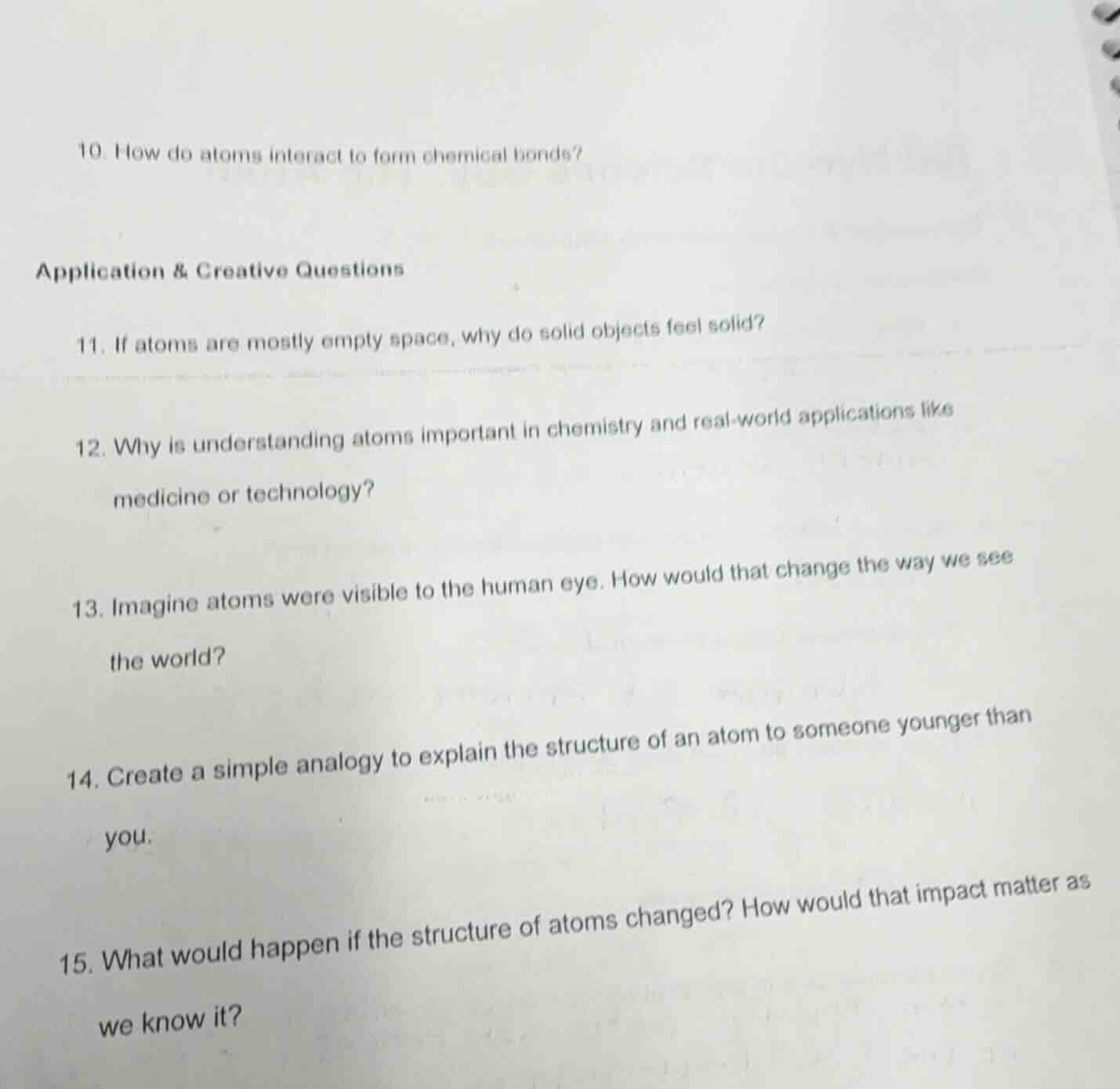
- how do atoms interact to form chemical bonds?
application & creative questions
- if atoms are mostly empty space, why do solid objects feel solid?
- why is understanding atoms important in chemistry and real-world applications like medicine or technology?
- imagine atoms were visible to the human eye. how would that change the way we see the world?
- create a simple analogy to explain the structure of an atom to someone younger than you.
- what would happen if the structure of atoms changed? how would that impact matter as we know it?
Explain chemical bond formation
Atoms interact to achieve stability. Using the Chemical Bonding knowledge point, atoms share, gain, or lose valence electrons to complete their outermost shells, minimizing potential energy.
Explain why solids feel solid
Although atoms are mostly empty space, solid objects feel solid due to electrostatic forces. The negatively charged electron clouds of atoms in your hand repel the electron clouds of atoms in the object.
Explain importance of atomic understanding
Understanding atoms is vital because chemical properties depend on atomic structure. Using the Atomic Structure knowledge point, this knowledge allows scientists to design targeted medicines and engineer advanced materials like semiconductors.
Describe seeing visible atoms
If atoms were visible, the world would lose its smooth, continuous appearance. We would see vibrating, discrete particles, fuzzy electron clouds, and empty space instead of solid surfaces.
Create a simple atomic analogy
An atom is like a massive sports stadium. The nucleus is a tiny marble on the 50-yard line, while the electrons are gnats buzzing around the outer nosebleed seats.
Analyze altered atomic structures
If atomic structures changed, the fundamental properties of matter would collapse. Altering electron configurations or nuclear stability would prevent stable chemical bonds, changing or destroying all physical matter.

Snap & solve any problem in the app
Get step-by-step solutions on Sovi AI
Photo-based solutions with guided steps
Explore more problems and detailed explanations
Question 10
Atoms interact by sharing, gaining, or losing valence electrons to achieve a stable, full outer electron shell, which lowers their overall potential energy and binds them together.
Question 11
Solid objects feel solid because of the strong electrostatic repulsion between the negatively charged electron clouds of the atoms in the object and the atoms in your hand when they get close.
Question 12
Understanding atoms allows us to predict chemical reactions, design effective pharmaceuticals that target specific molecular receptors, and develop new technologies like microchips and nanomaterials.
Question 13
If atoms were visible, the world would look like a vibrating swarm of tiny, fuzzy spheres separated by vast empty spaces, rather than continuous, smooth, and solid surfaces.
Question 14
An atom is like a giant, empty sports stadium: the nucleus is a tiny marble sitting right in the center of the field, and the electrons are like tiny gnats buzzing around the very top rows of seats.
Question 15
If the structure of atoms changed, the chemical and physical properties of all matter would be disrupted. Elements would lose their identity, molecules would fall apart, and stable matter as we know it would cease to exist.