QUESTION IMAGE
Question
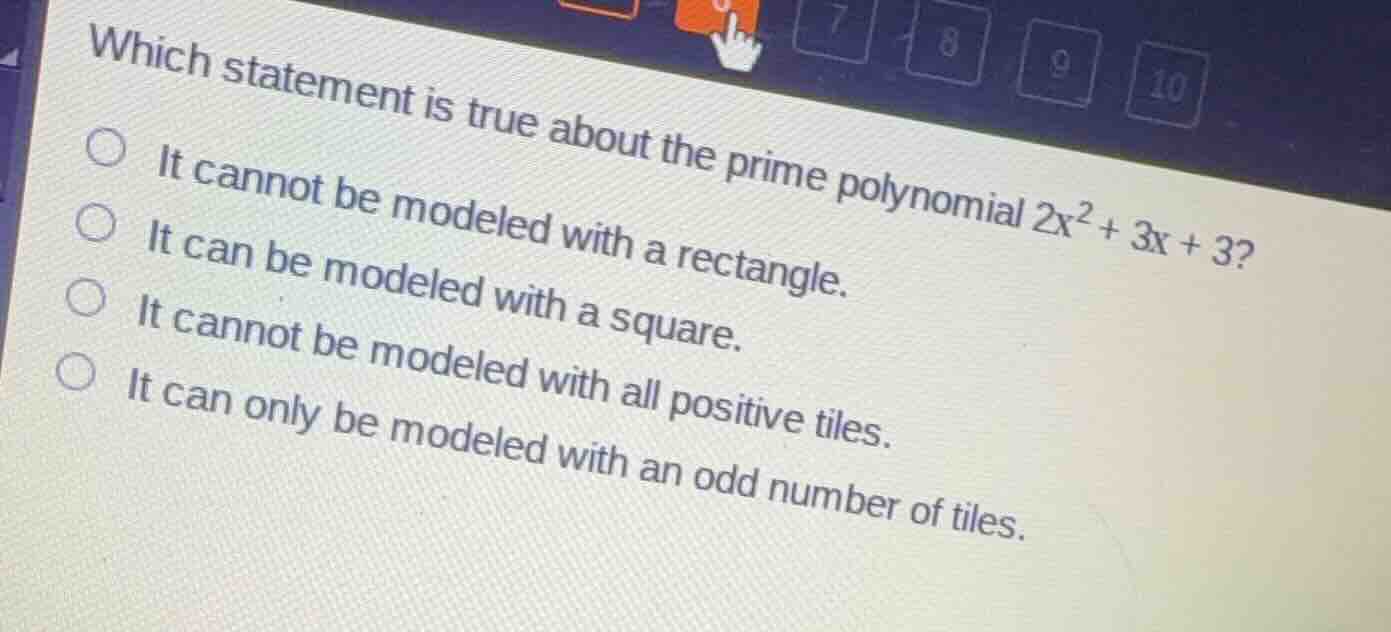
which statement is true about the prime polynomial \\(2x^2 + 3x + 3\\)?
it cannot be modeled with a rectangle.
it can be modeled with a square.
it cannot be modeled with all positive tiles.
it can only be modeled with an odd number of tiles.
<pre_analysis>
{
"quality": "clear",
"question_count": 1,
"skills_matched": [
"direct_cot",
"multiple_choice_formatter",
"explain_then_answer",
"tutor"
],
"needs_drawing": false,
"concepts_used": [
"Algebra Tiles",
"Prime Polynomials"
],
"new_concepts": [],
"current_concepts": [
"Algebra Tiles",
"Prime Polynomials"
]
}
</pre_analysis>
<reasoning>
Analyze the polynomial and algebra tiles
Using the Algebra Tiles and Prime Polynomials knowledge points, we represent the expression \(2x^2 + 3x + 3\).
- To model a polynomial with algebra tiles as a geometric area, we attempt to arrange the tiles into a complete, solid rectangle.
- The area of this rectangle corresponds to the product of its side lengths, which represent the polynomial's factors.
Evaluate the geometric modeling
Using the Prime Polynomials knowledge point, we know a prime polynomial cannot be factored into non-trivial polynomials with integer coefficients.
- Since \(2x^2 + 3x + 3\) is prime, it cannot be factored.
- Consequently, its algebra tile representation cannot form a complete rectangle.
- Thus, the statement "It cannot be modeled with a rectangle" is true.
Verify the remaining options
Using the Algebra Tiles knowledge point, we check the other choices:
- "It can be modeled with a square": Only perfect square trinomials can form a square.
- "It cannot be modeled with all positive tiles": All coefficients are positive, so it uses only positive tiles.
- "It can only be modeled with an odd number of tiles": The total number of tiles is \(2 + 3 + 3 = 8\), which is even.
</reasoning>
<answer>
<mcq-correct>(A) It cannot be modeled with a rectangle.</mcq-correct>
<mcq-option>(B) It can be modeled with a square.</mcq-option>
<mcq-option>(C) It cannot be modeled with all positive tiles.</mcq-option>
<mcq-option>(D) It can only be modeled with an odd number of tiles.</mcq-option>
</answer>
<post_analysis>
{
"subject": "Mathematics",
"question_type": "Multiple Choice",
"knowledge_point": [
"Mathematics",
"Algebra",
"Algebra Tiles"
]
}
</post_analysis>
Snap & solve any problem in the app
Get step-by-step solutions on Sovi AI
Photo-based solutions with guided steps
Explore more problems and detailed explanations
<pre_analysis>
{
"quality": "clear",
"question_count": 1,
"skills_matched": [
"direct_cot",
"multiple_choice_formatter",
"explain_then_answer",
"tutor"
],
"needs_drawing": false,
"concepts_used": [
"Algebra Tiles",
"Prime Polynomials"
],
"new_concepts": [],
"current_concepts": [
"Algebra Tiles",
"Prime Polynomials"
]
}
</pre_analysis>
<reasoning>
Analyze the polynomial and algebra tiles
Using the Algebra Tiles and Prime Polynomials knowledge points, we represent the expression \(2x^2 + 3x + 3\).
- To model a polynomial with algebra tiles as a geometric area, we attempt to arrange the tiles into a complete, solid rectangle.
- The area of this rectangle corresponds to the product of its side lengths, which represent the polynomial's factors.
Evaluate the geometric modeling
Using the Prime Polynomials knowledge point, we know a prime polynomial cannot be factored into non-trivial polynomials with integer coefficients.
- Since \(2x^2 + 3x + 3\) is prime, it cannot be factored.
- Consequently, its algebra tile representation cannot form a complete rectangle.
- Thus, the statement "It cannot be modeled with a rectangle" is true.
Verify the remaining options
Using the Algebra Tiles knowledge point, we check the other choices:
- "It can be modeled with a square": Only perfect square trinomials can form a square.
- "It cannot be modeled with all positive tiles": All coefficients are positive, so it uses only positive tiles.
- "It can only be modeled with an odd number of tiles": The total number of tiles is \(2 + 3 + 3 = 8\), which is even.
</reasoning>
<answer>
<mcq-correct>(A) It cannot be modeled with a rectangle.</mcq-correct>
<mcq-option>(B) It can be modeled with a square.</mcq-option>
<mcq-option>(C) It cannot be modeled with all positive tiles.</mcq-option>
<mcq-option>(D) It can only be modeled with an odd number of tiles.</mcq-option>
</answer>
<post_analysis>
{
"subject": "Mathematics",
"question_type": "Multiple Choice",
"knowledge_point": [
"Mathematics",
"Algebra",
"Algebra Tiles"
]
}
</post_analysis>