QUESTION IMAGE
Question
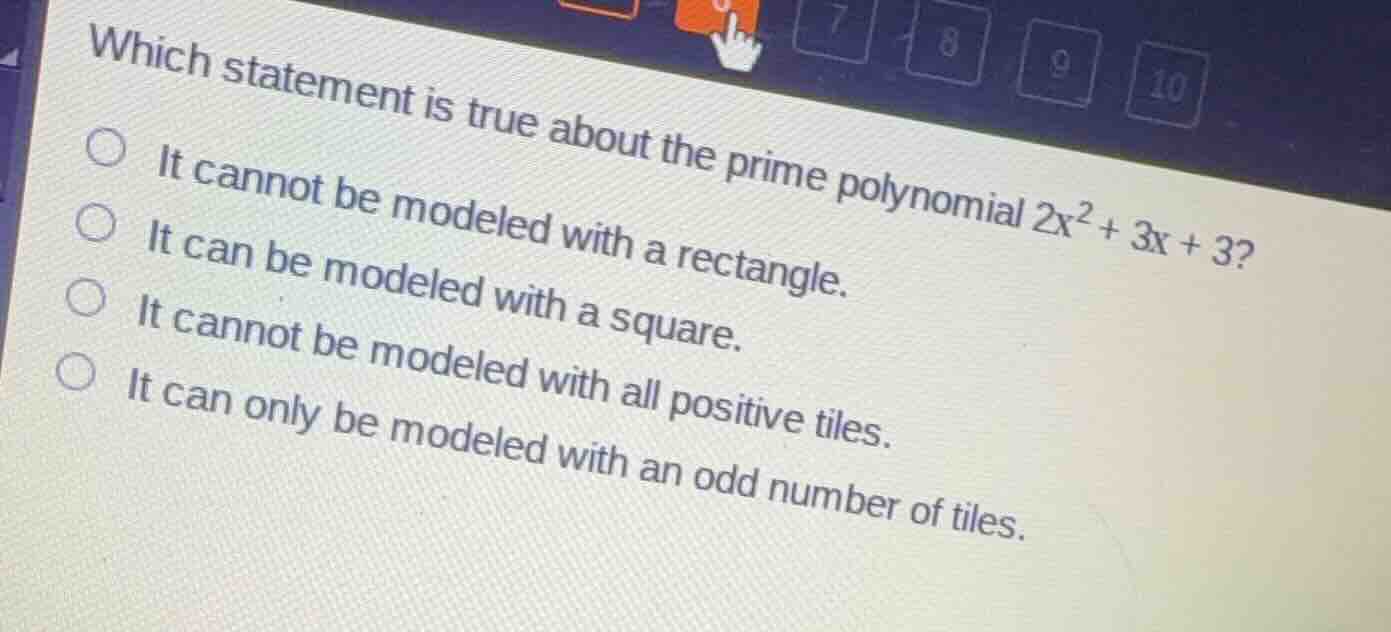
which statement is true about the prime polynomial \\(2x^2 + 3x + 3\\)?
it cannot be modeled with a rectangle.
it can be modeled with a square.
it cannot be modeled with all positive tiles.
it can only be modeled with an odd number of tiles.
Analyze the polynomial and algebra tiles
Using the Algebra Tiles and Prime Polynomials knowledge points, we represent the expression \(2x^2 + 3x + 3\).
- To model a polynomial with algebra tiles as a geometric area, we attempt to arrange the tiles into a complete, solid rectangle.
- The area of this rectangle corresponds to the product of its side lengths, which represent the polynomial's factors.
Evaluate the geometric modeling
Using the Prime Polynomials knowledge point, we know a prime polynomial cannot be factored into non-trivial polynomials with integer coefficients.
- Since \(2x^2 + 3x + 3\) is prime, it cannot be factored.
- Consequently, its algebra tile representation cannot form a complete rectangle.
- Thus, the statement "It cannot be modeled with a rectangle" is true.
Verify the remaining options
Using the Algebra Tiles knowledge point, we check the other choices:
- "It can be modeled with a square": Only perfect square trinomials can form a square.
- "It cannot be modeled with all positive tiles": All coefficients are positive, so it uses only positive tiles.
- "It can only be modeled with an odd number of tiles": The total number of tiles is \(2 + 3 + 3 = 8\), which is even.

Snap & solve any problem in the app
Get step-by-step solutions on Sovi AI
Photo-based solutions with guided steps
Explore more problems and detailed explanations
- (A) It cannot be modeled with a rectangle. (Correct answer)
- (B) It can be modeled with a square.
- (C) It cannot be modeled with all positive tiles.
- (D) It can only be modeled with an odd number of tiles.