Sovi.AI - AI Math Tutor

Scan to solve math questions

QUESTION IMAGE

which statement proves that parallelogram klmn is a rhombus? - the midp…

Question

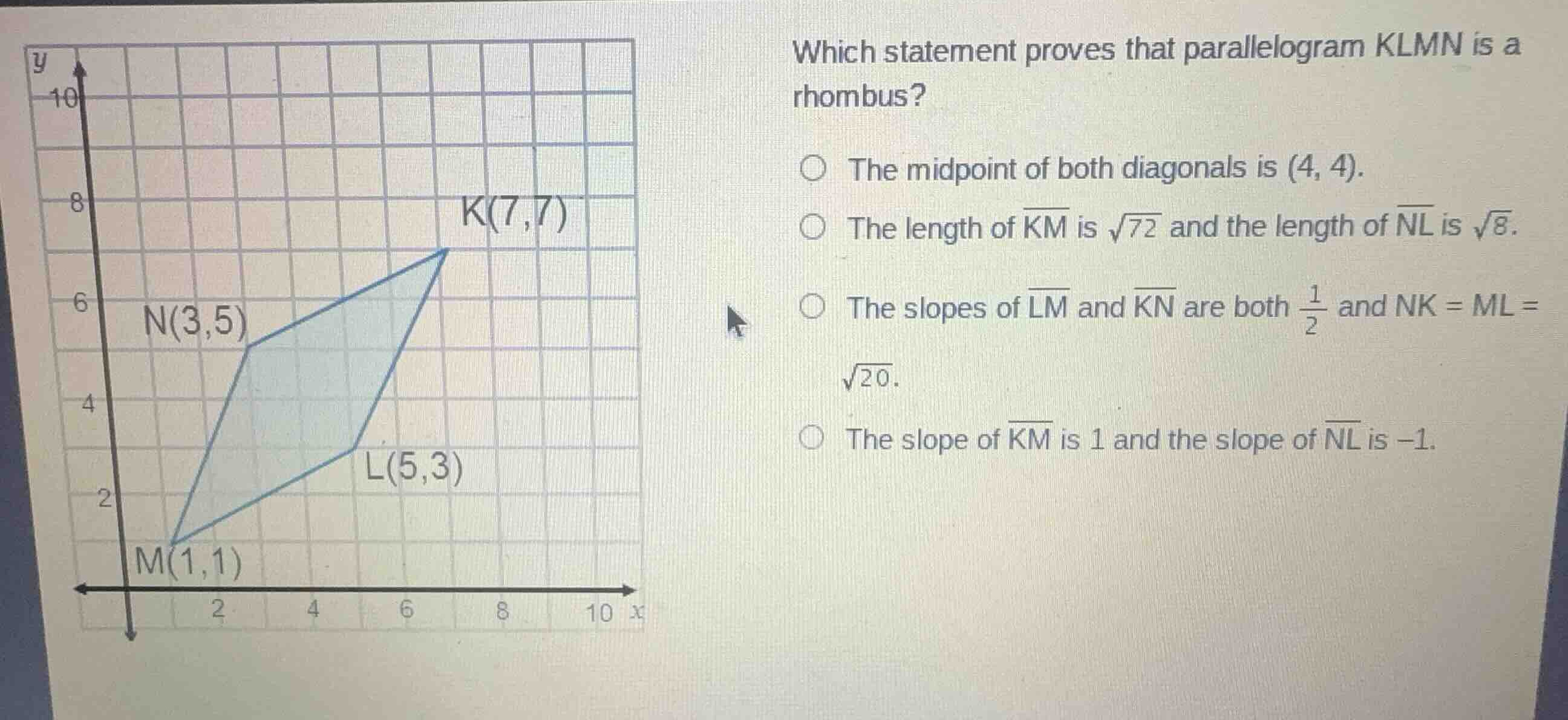
which statement proves that parallelogram klmn is a rhombus?

  • the midpoint of both diagonals is \\((4, 4)\\).
  • the length of \\(\overline{km}\\) is \\(\sqrt{72}\\) and the length of \\(\overline{nl}\\) is \\(\sqrt{8}\\).
  • the slopes of \\(\overline{lm}\\) and \\(\overline{kn}\\) are both \\(\frac{1}{2}\\) and \\(nk = ml = \sqrt{20}\\).
  • the slope of \\(\overline{km}\\) is \\(1\\) and the slope of \\(\overline{nl}\\) is \\(-1\\).

Explanation:

Response

<pre_analysis>
{
"quality": "clear",
"question_count": 1,
"skills_matched": [
"step_cot",
"multiple_choice_formatter",
"explain_then_answer",
"tutor",
"mastery_adaptive_brevity"
],
"needs_drawing": false,
"concepts_used": [
"Rhombus Properties",
"Midpoint Formula in Coordinate Plane"
],
"new_concepts": [
"Rhombus Diagonal Properties",
"Perpendicular Slopes"
],
"current_concepts": [
"Rhombus Properties",
"Midpoint Formula in Coordinate Plane",
"Rhombus Diagonal Properties",
"Perpendicular Slopes"
]
}
</pre_analysis>

<reasoning>

Identify the properties of a rhombus

Using the Rhombus Properties knowledge point
A rhombus is a special type of parallelogram. To prove that a given parallelogram is a rhombus, we must show that it has additional properties unique to a rhombus, such as:

  1. All four sides are congruent (or adjacent sides are congruent).
  2. The diagonals are perpendicular to each other.

Analyze the first option

Using the Midpoint Formula in Coordinate Plane knowledge point
The first option states: "The midpoint of both diagonals is \((4, 4)\)."
In any parallelogram, the diagonals bisect each other, meaning they share the same midpoint. Finding that the diagonals share a midpoint only proves that the quadrilateral is a parallelogram. It does not prove that it is a rhombus.

Analyze the second and third options

The second option states: "The length of \(\overline{KM}\) is \(\sqrt{72}\) and the length of \(\overline{NL}\) is \(\sqrt{8}\)."
Unequal diagonal lengths are true for most rhombuses, but having these specific lengths does not prove the figure is a rhombus (it could be a general parallelogram).

The third option states: "The slopes of \(\overline{LM}\) and \(\overline{KN}\) are both \(\frac{1}{2}\) and \(NK = ML = \sqrt{20}\)."
This statement shows that one pair of opposite sides is parallel and congruent, which is a property of any parallelogram, not specifically a rhombus.

Analyze the fourth option

The fourth option states: "The slope of \(\overline{KM}\) is \(1\) and the slope of \(\overline{NL}\) is \(-1\)."
The diagonals of the parallelogram are \(\overline{KM}\) and \(\overline{NL}\).
The product of their slopes is:
\[
(1) \cdot (-1) = -1
\]
Since the product of their slopes is \(-1\), the diagonals are perpendicular. A parallelogram with perpendicular diagonals is guaranteed to be a rhombus. Thus, this statement successfully proves that parallelogram \(KLMN\) is a rhombus.
</reasoning>

<answer>
<mcq-option>The midpoint of both diagonals is (4, 4).</mcq-option>
<mcq-option>The length of \(\overline{KM}\) is \(\sqrt{72}\) and the length of \(\overline{NL}\) is \(\sqrt{8}\).</mcq-option>
<mcq-option>The slopes of \(\overline{LM}\) and \(\overline{KN}\) are both \(\frac{1}{2}\) and \(NK = ML = \sqrt{20}\).</mcq-option>
<mcq-correct>The slope of \(\overline{KM}\) is 1 and the slope of \(\overline{NL}\) is -1.</mcq-correct>
</answer>

<post_analysis>
{
"subject": "Mathematics",
"question_type": "Multiple Choice",
"knowledge_point": [
"Mathematics",
"Geometry",
"Rhombus Properties"
]
}
</post_analysis>

Answer:

<pre_analysis>
{
"quality": "clear",
"question_count": 1,
"skills_matched": [
"step_cot",
"multiple_choice_formatter",
"explain_then_answer",
"tutor",
"mastery_adaptive_brevity"
],
"needs_drawing": false,
"concepts_used": [
"Rhombus Properties",
"Midpoint Formula in Coordinate Plane"
],
"new_concepts": [
"Rhombus Diagonal Properties",
"Perpendicular Slopes"
],
"current_concepts": [
"Rhombus Properties",
"Midpoint Formula in Coordinate Plane",
"Rhombus Diagonal Properties",
"Perpendicular Slopes"
]
}
</pre_analysis>

<reasoning>

Identify the properties of a rhombus

Using the Rhombus Properties knowledge point
A rhombus is a special type of parallelogram. To prove that a given parallelogram is a rhombus, we must show that it has additional properties unique to a rhombus, such as:

  1. All four sides are congruent (or adjacent sides are congruent).
  2. The diagonals are perpendicular to each other.

Analyze the first option

Using the Midpoint Formula in Coordinate Plane knowledge point
The first option states: "The midpoint of both diagonals is \((4, 4)\)."
In any parallelogram, the diagonals bisect each other, meaning they share the same midpoint. Finding that the diagonals share a midpoint only proves that the quadrilateral is a parallelogram. It does not prove that it is a rhombus.

Analyze the second and third options

The second option states: "The length of \(\overline{KM}\) is \(\sqrt{72}\) and the length of \(\overline{NL}\) is \(\sqrt{8}\)."
Unequal diagonal lengths are true for most rhombuses, but having these specific lengths does not prove the figure is a rhombus (it could be a general parallelogram).

The third option states: "The slopes of \(\overline{LM}\) and \(\overline{KN}\) are both \(\frac{1}{2}\) and \(NK = ML = \sqrt{20}\)."
This statement shows that one pair of opposite sides is parallel and congruent, which is a property of any parallelogram, not specifically a rhombus.

Analyze the fourth option

The fourth option states: "The slope of \(\overline{KM}\) is \(1\) and the slope of \(\overline{NL}\) is \(-1\)."
The diagonals of the parallelogram are \(\overline{KM}\) and \(\overline{NL}\).
The product of their slopes is:
\[
(1) \cdot (-1) = -1
\]
Since the product of their slopes is \(-1\), the diagonals are perpendicular. A parallelogram with perpendicular diagonals is guaranteed to be a rhombus. Thus, this statement successfully proves that parallelogram \(KLMN\) is a rhombus.
</reasoning>

<answer>
<mcq-option>The midpoint of both diagonals is (4, 4).</mcq-option>
<mcq-option>The length of \(\overline{KM}\) is \(\sqrt{72}\) and the length of \(\overline{NL}\) is \(\sqrt{8}\).</mcq-option>
<mcq-option>The slopes of \(\overline{LM}\) and \(\overline{KN}\) are both \(\frac{1}{2}\) and \(NK = ML = \sqrt{20}\).</mcq-option>
<mcq-correct>The slope of \(\overline{KM}\) is 1 and the slope of \(\overline{NL}\) is -1.</mcq-correct>
</answer>

<post_analysis>
{
"subject": "Mathematics",
"question_type": "Multiple Choice",
"knowledge_point": [
"Mathematics",
"Geometry",
"Rhombus Properties"
]
}
</post_analysis>