QUESTION IMAGE
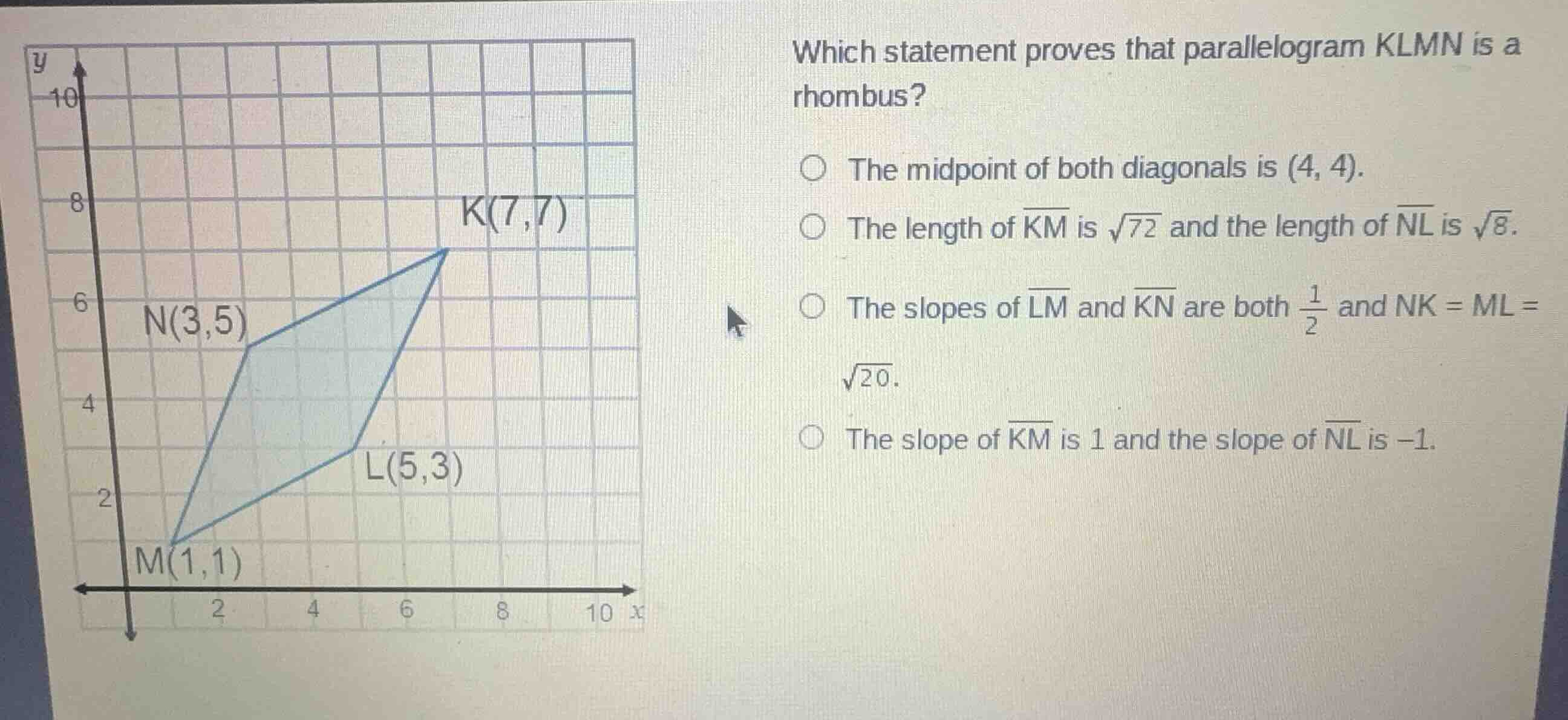
Question
which statement proves that parallelogram klmn is a rhombus?
- the midpoint of both diagonals is \\((4, 4)\\).
- the length of \\(\overline{km}\\) is \\(\sqrt{72}\\) and the length of \\(\overline{nl}\\) is \\(\sqrt{8}\\).
- the slopes of \\(\overline{lm}\\) and \\(\overline{kn}\\) are both \\(\frac{1}{2}\\) and \\(nk = ml = \sqrt{20}\\).
- the slope of \\(\overline{km}\\) is \\(1\\) and the slope of \\(\overline{nl}\\) is \\(-1\\).
Identify the properties of a rhombus
Using the Rhombus Properties knowledge point
A rhombus is a special type of parallelogram. To prove that a given parallelogram is a rhombus, we must show that it has additional properties unique to a rhombus, such as:
- All four sides are congruent (or adjacent sides are congruent).
- The diagonals are perpendicular to each other.
Analyze the first option
Using the Midpoint Formula in Coordinate Plane knowledge point
The first option states: "The midpoint of both diagonals is \((4, 4)\)."
In any parallelogram, the diagonals bisect each other, meaning they share the same midpoint. Finding that the diagonals share a midpoint only proves that the quadrilateral is a parallelogram. It does not prove that it is a rhombus.
Analyze the second and third options
The second option states: "The length of \(\overline{KM}\) is \(\sqrt{72}\) and the length of \(\overline{NL}\) is \(\sqrt{8}\)."
Unequal diagonal lengths are true for most rhombuses, but having these specific lengths does not prove the figure is a rhombus (it could be a general parallelogram).
The third option states: "The slopes of \(\overline{LM}\) and \(\overline{KN}\) are both \(\frac{1}{2}\) and \(NK = ML = \sqrt{20}\)."
This statement shows that one pair of opposite sides is parallel and congruent, which is a property of any parallelogram, not specifically a rhombus.
Analyze the fourth option
The fourth option states: "The slope of \(\overline{KM}\) is \(1\) and the slope of \(\overline{NL}\) is \(-1\)."
The diagonals of the parallelogram are \(\overline{KM}\) and \(\overline{NL}\).
The product of their slopes is:
Since the product of their slopes is \(-1\), the diagonals are perpendicular. A parallelogram with perpendicular diagonals is guaranteed to be a rhombus. Thus, this statement successfully proves that parallelogram \(KLMN\) is a rhombus.

Snap & solve any problem in the app
Get step-by-step solutions on Sovi AI
Photo-based solutions with guided steps
Explore more problems and detailed explanations
- The midpoint of both diagonals is (4, 4).
- The length of \(\overline{KM}\) is \(\sqrt{72}\) and the length of \(\overline{NL}\) is \(\sqrt{8}\).
- The slopes of \(\overline{LM}\) and \(\overline{KN}\) are both \(\frac{1}{2}\) and \(NK = ML = \sqrt{20}\).
- The slope of \(\overline{KM}\) is 1 and the slope of \(\overline{NL}\) is -1. (Correct answer)