QUESTION IMAGE
Question
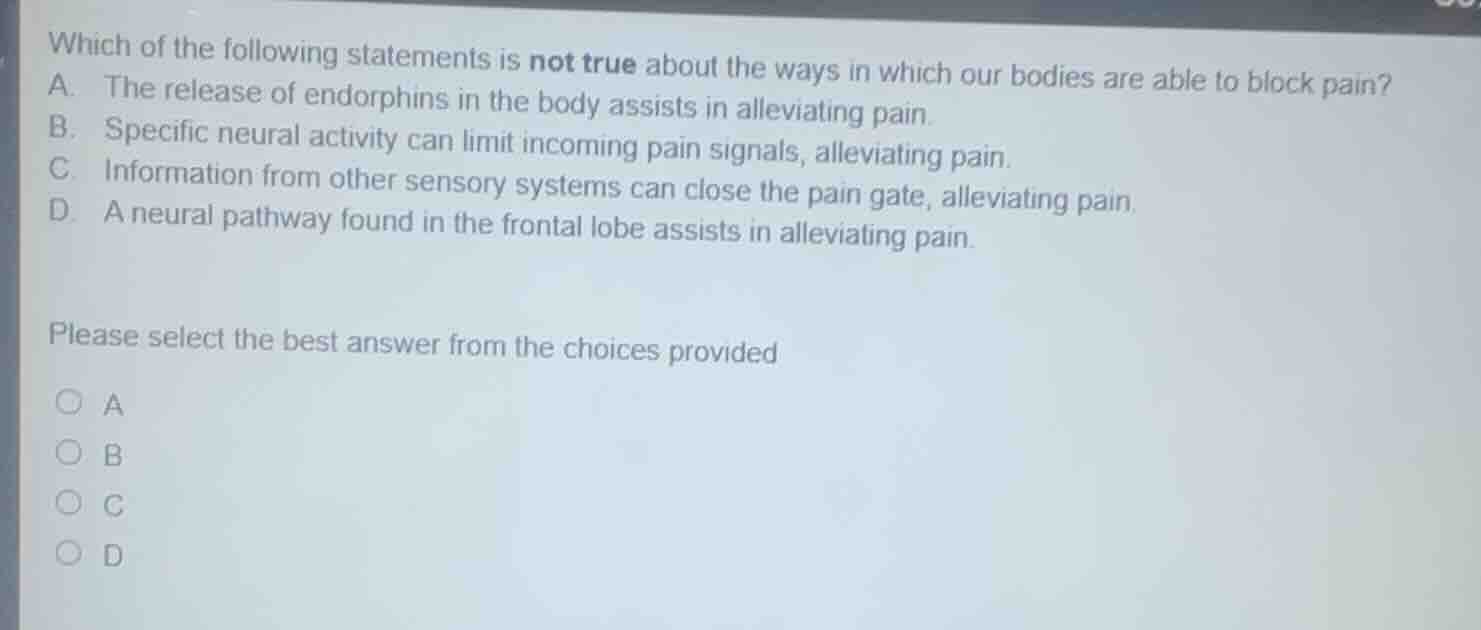
which of the following statements is not true about the ways in which our bodies are able to block pain?
a. the release of endorphins in the body assists in alleviating pain.
b. specific neural activity can limit incoming pain signals, alleviating pain.
c. information from other sensory systems can close the pain gate, alleviating pain.
d. a neural pathway found in the frontal lobe assists in alleviating pain.
please select the best answer from the choices provided
a
b
c
d
Analyze the physiological mechanisms of pain blocking
- Endorphins act as natural painkillers by binding to opioid receptors in the brain and spinal cord, reducing the perception of pain (Statement A is true).
- Gate control theory states that non-painful sensory input (like rubbing a stubbed toe) closes the "gates" to painful input, preventing pain signals from traveling to the central nervous system (Statements B and C are true).
Evaluate the false statement
- The descending pain-modulation pathways that block or alleviate pain signals primarily originate in the midbrain (specifically the periaqueductal gray) and the medulla, traveling down the spinal cord to inhibit incoming pain signals.
- There is no primary pain-blocking neural pathway located in the frontal lobe (Statement D is false).

Snap & solve any problem in the app
Get step-by-step solutions on Sovi AI
Photo-based solutions with guided steps
Explore more problems and detailed explanations
- A. The release of endorphins in the body assists in alleviating pain.
- B. Specific neural activity can limit incoming pain signals, alleviating pain.
- C. Information from other sensory systems can close the pain gate, alleviating pain.
- D. A neural pathway found in the frontal lobe assists in alleviating pain. (Correct answer)