QUESTION IMAGE
Question
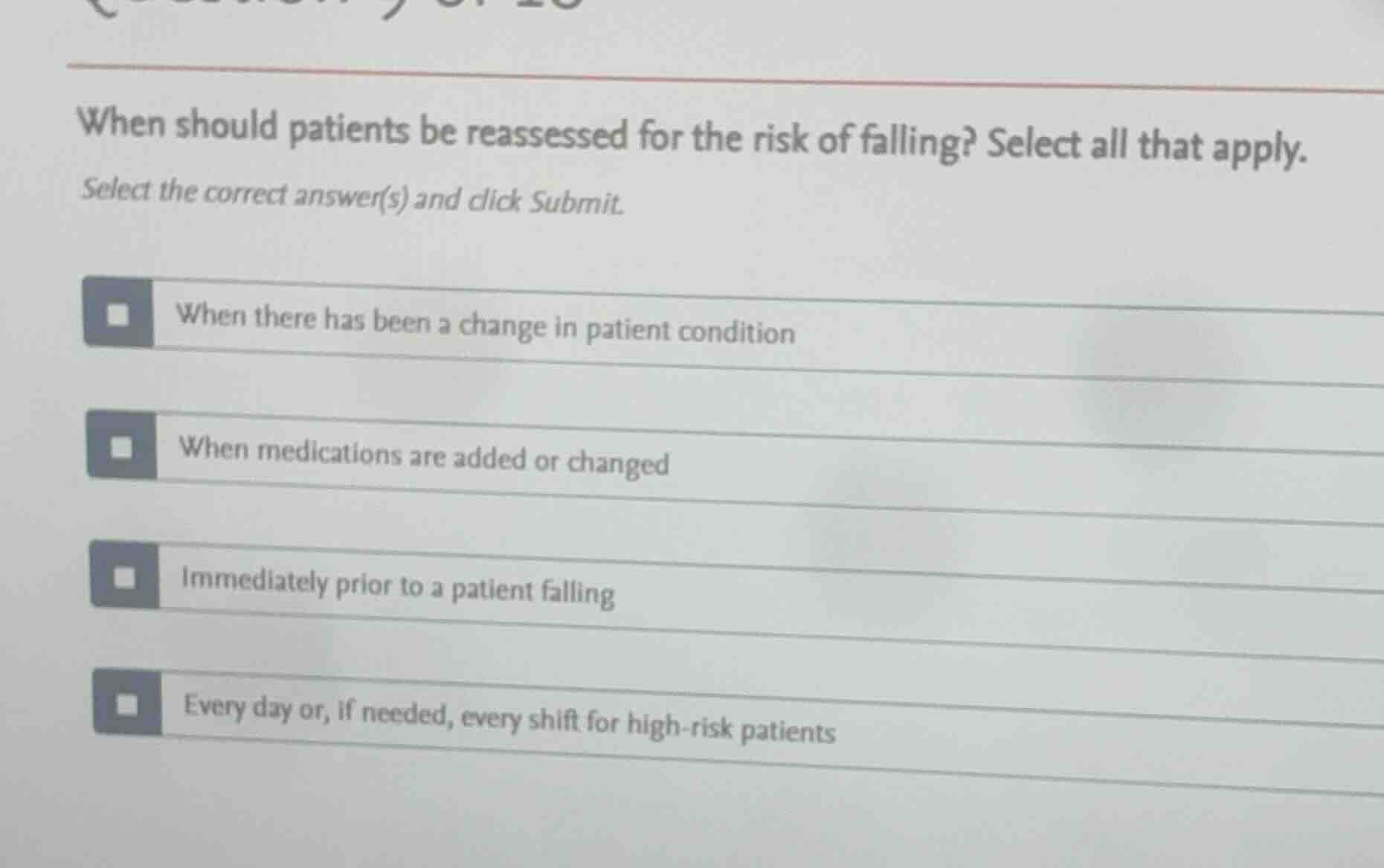
when should patients be reassessed for the risk of falling? select all that apply.
select the correct answer(s) and click submit.
- when there has been a change in patient condition
- when medications are added or changed
- immediately prior to a patient falling
- every day or, if needed, every shift for high-risk patients
<pre_analysis>
{
"quality": "clear",
"question_count": 1,
"skills_matched": [
"direct_cot",
"multiple_choice_formatter",
"explain_then_answer",
"quick"
],
"needs_drawing": false,
"concepts_used": [
"Fall Risk Factors",
"Post-Fall Assessment Protocols"
],
"new_concepts": [],
"current_concepts": [
"Fall Risk Factors",
"Post-Fall Assessment Protocols",
"Patient Safety Priorities"
]
}
</pre_analysis>
<reasoning>
Analyze clinical fall risk reassessment triggers
Reassessment of fall risk is a dynamic clinical process triggered by changes in patient status, treatment plans, or routine intervals:
- Change in patient condition: Directly alters physical or cognitive stability, requiring immediate reassessment.
- Medications added or changed: Many medications (e.g., sedatives, antihypertensives) increase fall risk, necessitating reassessment.
- Immediately prior to a patient falling: Logically impossible to predict and assess immediately before an accidental event occurs (reassessment occurs after a fall).
- Every day or, if needed, every shift for high-risk patients: Standard clinical protocol for routine monitoring of vulnerable patients.
</reasoning>
<answer>
<mcq-correct>When there has been a change in patient condition</mcq-correct>
<mcq-correct>When medications are added or changed</mcq-correct>
<mcq-option>Immediately prior to a patient falling</mcq-option>
<mcq-correct>Every day or, if needed, every shift for high-risk patients</mcq-correct>
</answer>
<post_analysis>
{
"subject": "Natural Science",
"question_type": "Multiple Choice",
"knowledge_point": [
"Natural Science",
"Medicine and Health Sciences",
"Patient Safety Priorities"
]
}
</post_analysis>
Snap & solve any problem in the app
Get step-by-step solutions on Sovi AI
Photo-based solutions with guided steps
Explore more problems and detailed explanations
<pre_analysis>
{
"quality": "clear",
"question_count": 1,
"skills_matched": [
"direct_cot",
"multiple_choice_formatter",
"explain_then_answer",
"quick"
],
"needs_drawing": false,
"concepts_used": [
"Fall Risk Factors",
"Post-Fall Assessment Protocols"
],
"new_concepts": [],
"current_concepts": [
"Fall Risk Factors",
"Post-Fall Assessment Protocols",
"Patient Safety Priorities"
]
}
</pre_analysis>
<reasoning>
Analyze clinical fall risk reassessment triggers
Reassessment of fall risk is a dynamic clinical process triggered by changes in patient status, treatment plans, or routine intervals:
- Change in patient condition: Directly alters physical or cognitive stability, requiring immediate reassessment.
- Medications added or changed: Many medications (e.g., sedatives, antihypertensives) increase fall risk, necessitating reassessment.
- Immediately prior to a patient falling: Logically impossible to predict and assess immediately before an accidental event occurs (reassessment occurs after a fall).
- Every day or, if needed, every shift for high-risk patients: Standard clinical protocol for routine monitoring of vulnerable patients.
</reasoning>
<answer>
<mcq-correct>When there has been a change in patient condition</mcq-correct>
<mcq-correct>When medications are added or changed</mcq-correct>
<mcq-option>Immediately prior to a patient falling</mcq-option>
<mcq-correct>Every day or, if needed, every shift for high-risk patients</mcq-correct>
</answer>
<post_analysis>
{
"subject": "Natural Science",
"question_type": "Multiple Choice",
"knowledge_point": [
"Natural Science",
"Medicine and Health Sciences",
"Patient Safety Priorities"
]
}
</post_analysis>