QUESTION IMAGE
Question
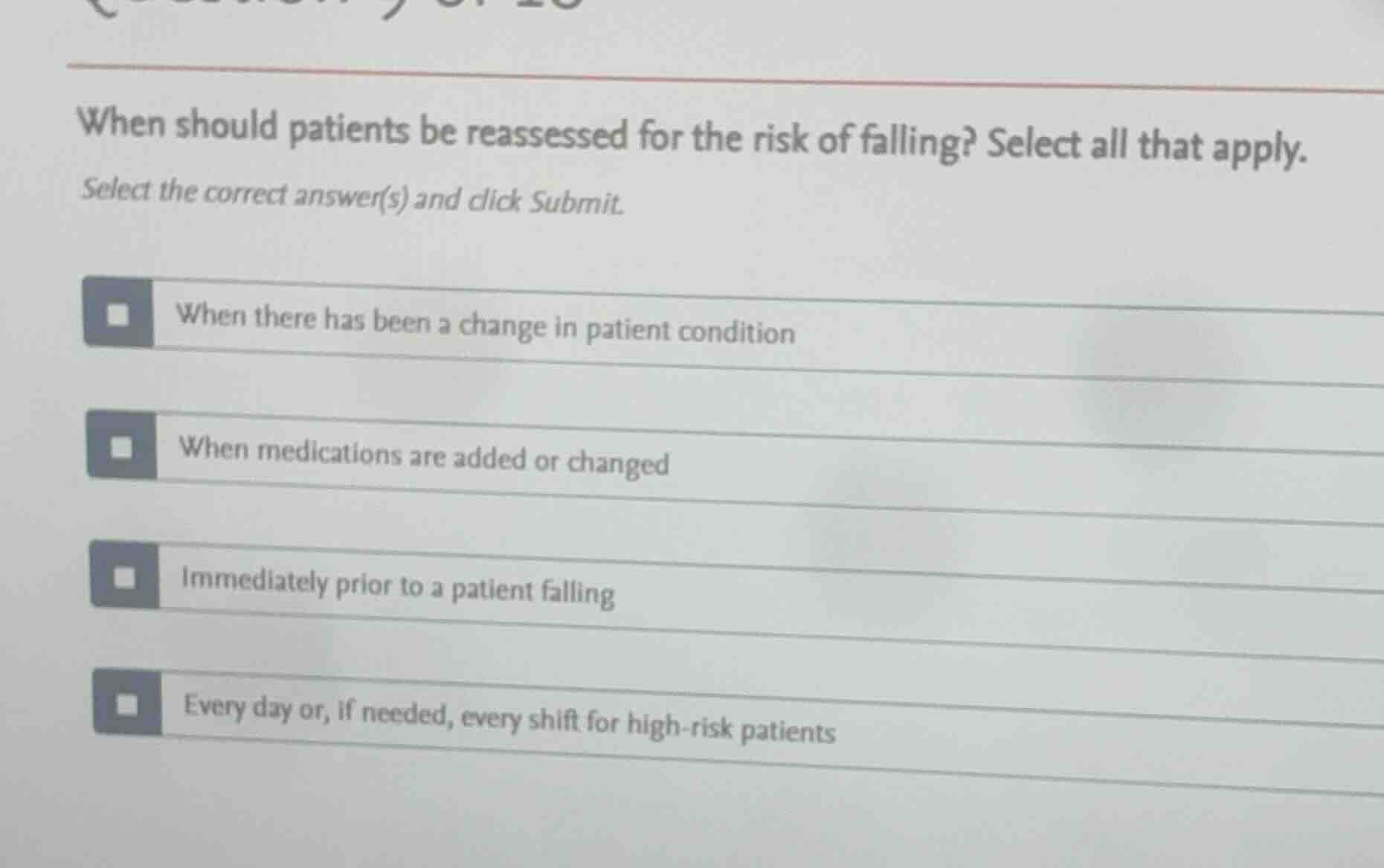
when should patients be reassessed for the risk of falling? select all that apply.
select the correct answer(s) and click submit.
- when there has been a change in patient condition
- when medications are added or changed
- immediately prior to a patient falling
- every day or, if needed, every shift for high-risk patients
Analyze clinical fall risk reassessment triggers
Reassessment of fall risk is a dynamic clinical process triggered by changes in patient status, treatment plans, or routine intervals:
- Change in patient condition: Directly alters physical or cognitive stability, requiring immediate reassessment.
- Medications added or changed: Many medications (e.g., sedatives, antihypertensives) increase fall risk, necessitating reassessment.
- Immediately prior to a patient falling: Logically impossible to predict and assess immediately before an accidental event occurs (reassessment occurs after a fall).
- Every day or, if needed, every shift for high-risk patients: Standard clinical protocol for routine monitoring of vulnerable patients.

Snap & solve any problem in the app
Get step-by-step solutions on Sovi AI
Photo-based solutions with guided steps
Explore more problems and detailed explanations
- When there has been a change in patient condition (Correct answer)
- When medications are added or changed (Correct answer)
- Immediately prior to a patient falling
- Every day or, if needed, every shift for high-risk patients (Correct answer)