QUESTION IMAGE
Question
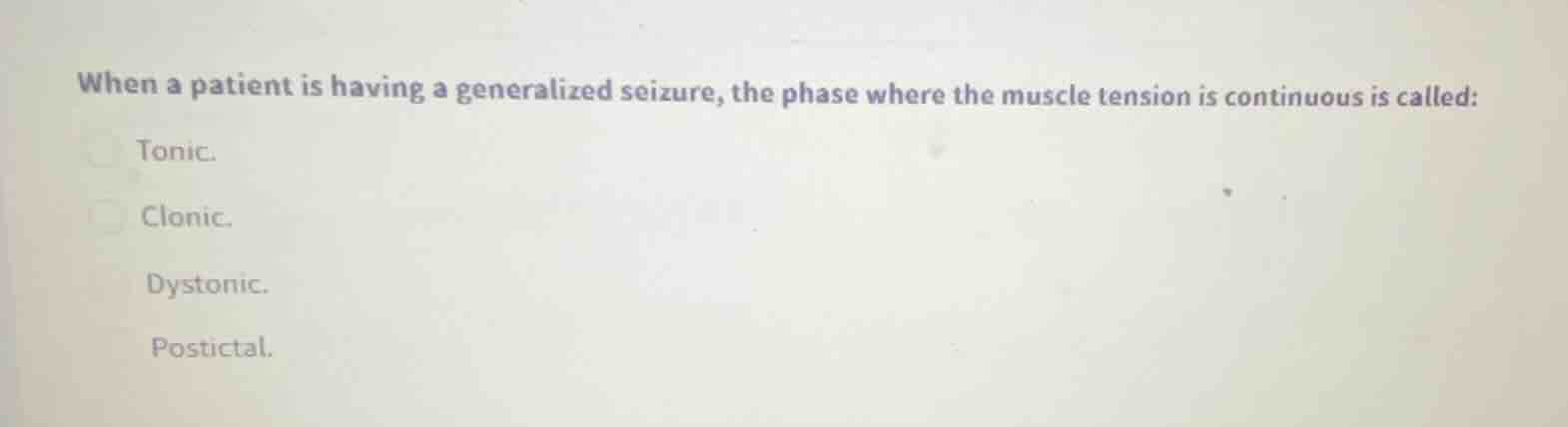
when a patient is having a generalized seizure, the phase where the muscle tension is continuous is called:
tonic.
clonic.
dystonic.
postictal.
<pre_analysis>
{
"quality": "clear",
"question_count": 1,
"skills_matched": [
"direct_cot",
"multiple_choice_formatter",
"explain_then_answer",
"quick"
],
"needs_drawing": false,
"concepts_used": [],
"new_concepts": [
"Seizure Phases"
],
"current_concepts": [
"Seizure Classification",
"Pathophysiology of Seizures",
"Seizure Phases"
]
}
</pre_analysis>
<reasoning>
Identify the phase of continuous muscle tension
During a generalized tonic-clonic seizure, the motor activity typically progresses through distinct phases:
- Tonic phase: Characterized by sudden, continuous muscle contraction and rigidity (sustained muscle tension).
- Clonic phase: Characterized by alternating muscle contraction and relaxation, presenting as rhythmic jerking.
- Postictal phase: The recovery period following the seizure, often marked by confusion, fatigue, and headache.
- Dystonic: Refers to involuntary muscle contractions causing twisting or repetitive movements, but is not a standard phase of a generalized tonic-clonic seizure.
Therefore, the phase where muscle tension is continuous is the tonic phase.
</reasoning>
<answer>
<mcq-correct>Tonic.</mcq-correct>
<mcq-option>Clonic.</mcq-option>
<mcq-option>Dystonic.</mcq-option>
<mcq-option>Postictal.</mcq-option>
</answer>
<post_analysis>
{
"subject": "Natural Science",
"question_type": "Multiple Choice",
"knowledge_point": [
"Natural Science",
"Medicine",
"Seizure Phases"
]
}
</post_analysis>
Snap & solve any problem in the app
Get step-by-step solutions on Sovi AI
Photo-based solutions with guided steps
Explore more problems and detailed explanations
<pre_analysis>
{
"quality": "clear",
"question_count": 1,
"skills_matched": [
"direct_cot",
"multiple_choice_formatter",
"explain_then_answer",
"quick"
],
"needs_drawing": false,
"concepts_used": [],
"new_concepts": [
"Seizure Phases"
],
"current_concepts": [
"Seizure Classification",
"Pathophysiology of Seizures",
"Seizure Phases"
]
}
</pre_analysis>
<reasoning>
Identify the phase of continuous muscle tension
During a generalized tonic-clonic seizure, the motor activity typically progresses through distinct phases:
- Tonic phase: Characterized by sudden, continuous muscle contraction and rigidity (sustained muscle tension).
- Clonic phase: Characterized by alternating muscle contraction and relaxation, presenting as rhythmic jerking.
- Postictal phase: The recovery period following the seizure, often marked by confusion, fatigue, and headache.
- Dystonic: Refers to involuntary muscle contractions causing twisting or repetitive movements, but is not a standard phase of a generalized tonic-clonic seizure.
Therefore, the phase where muscle tension is continuous is the tonic phase.
</reasoning>
<answer>
<mcq-correct>Tonic.</mcq-correct>
<mcq-option>Clonic.</mcq-option>
<mcq-option>Dystonic.</mcq-option>
<mcq-option>Postictal.</mcq-option>
</answer>
<post_analysis>
{
"subject": "Natural Science",
"question_type": "Multiple Choice",
"knowledge_point": [
"Natural Science",
"Medicine",
"Seizure Phases"
]
}
</post_analysis>