QUESTION IMAGE
Question
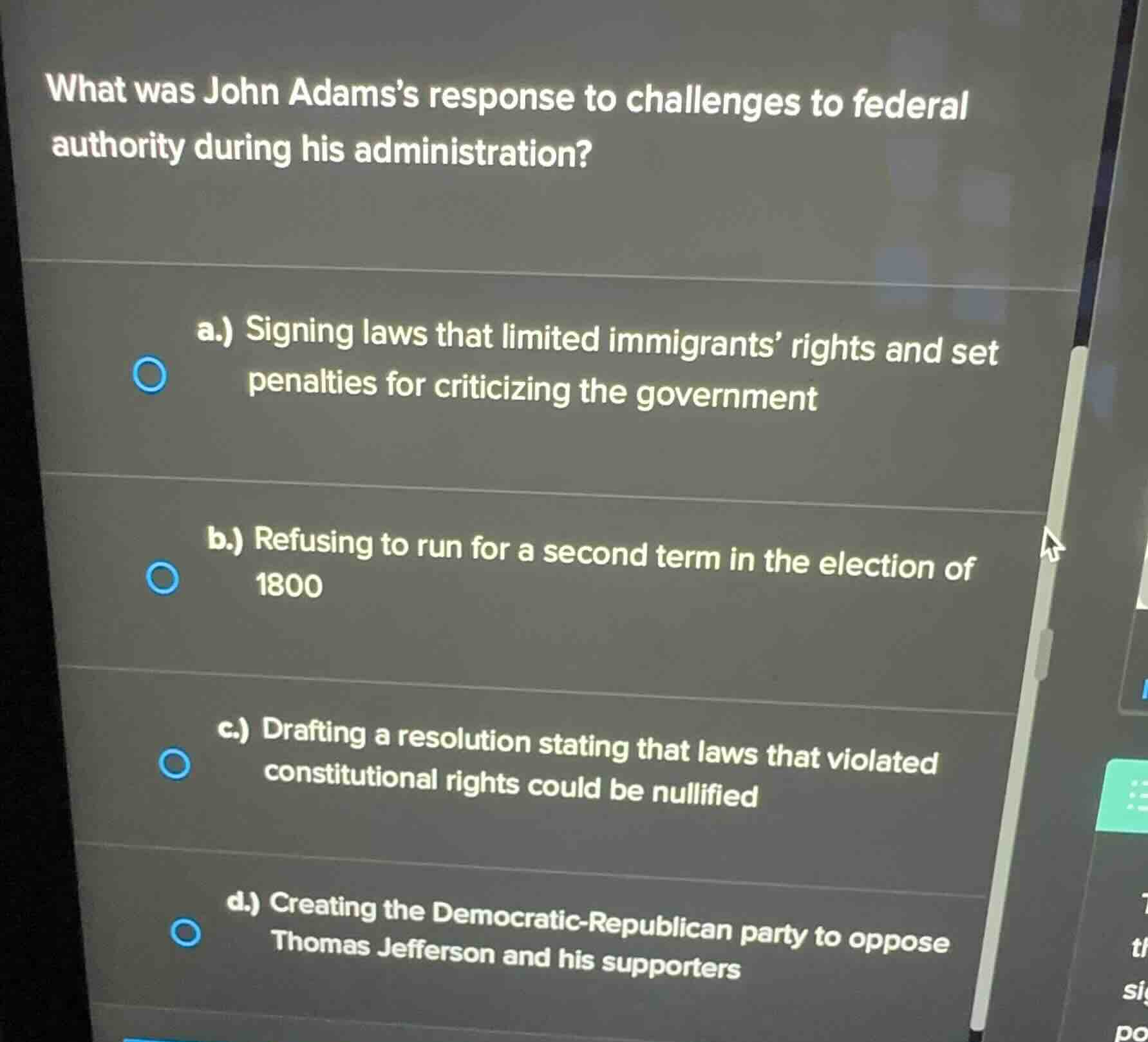
what was john adamss response to challenges to federal authority during his administration?
a.) signing laws that limited immigrants rights and set penalties for criticizing the government
b.) refusing to run for a second term in the election of 1800
c.) drafting a resolution stating that laws that violated constitutional rights could be nullified
d.) creating the democratic-republican party to oppose thomas jefferson and his supporters
Identify the historical context of John Adams's presidency
During the presidency of John Adams (1797–1801), the United States faced severe domestic political division and international tensions, particularly the Quasi-War with France. The Federalist-controlled government sought to strengthen federal authority and suppress political opposition from the Democratic-Republicans, whom they accused of sympathizing with revolutionary France.
Analyze the Alien and Sedition Acts of 1798
In response to these perceived threats and challenges to federal authority, John Adams signed the Alien and Sedition Acts of 1798. These four laws restricted the rights of immigrants (making it harder to become a citizen and allowing the president to deport non-citizens deemed dangerous) and criminalized making false or malicious statements criticizing the federal government.
Evaluate the given multiple-choice options
- Option a: This accurately describes the Alien and Sedition Acts signed by John Adams to suppress political dissent and control foreign influence.
- Option b: This is historically incorrect; Adams did run for a second term in the election of 1800 but lost to Thomas Jefferson.
- Option c: This describes the Kentucky and Virginia Resolutions, which were drafted secretly by Thomas Jefferson and James Madison to oppose the Alien and Sedition Acts, not by Adams.
- Option d: Thomas Jefferson and James Madison created the Democratic-Republican Party, whereas John Adams was a leader of the Federalist Party.

Snap & solve any problem in the app
Get step-by-step solutions on Sovi AI
Photo-based solutions with guided steps
Explore more problems and detailed explanations
- a.) Signing laws that limited immigrants' rights and set penalties for criticizing the government (Correct answer)
- b.) Refusing to run for a second term in the election of 1800
- c.) Drafting a resolution stating that laws that violated constitutional rights could be nullified
- d.) Creating the Democratic-Republican party to oppose Thomas Jefferson and his supporters