QUESTION IMAGE
Question
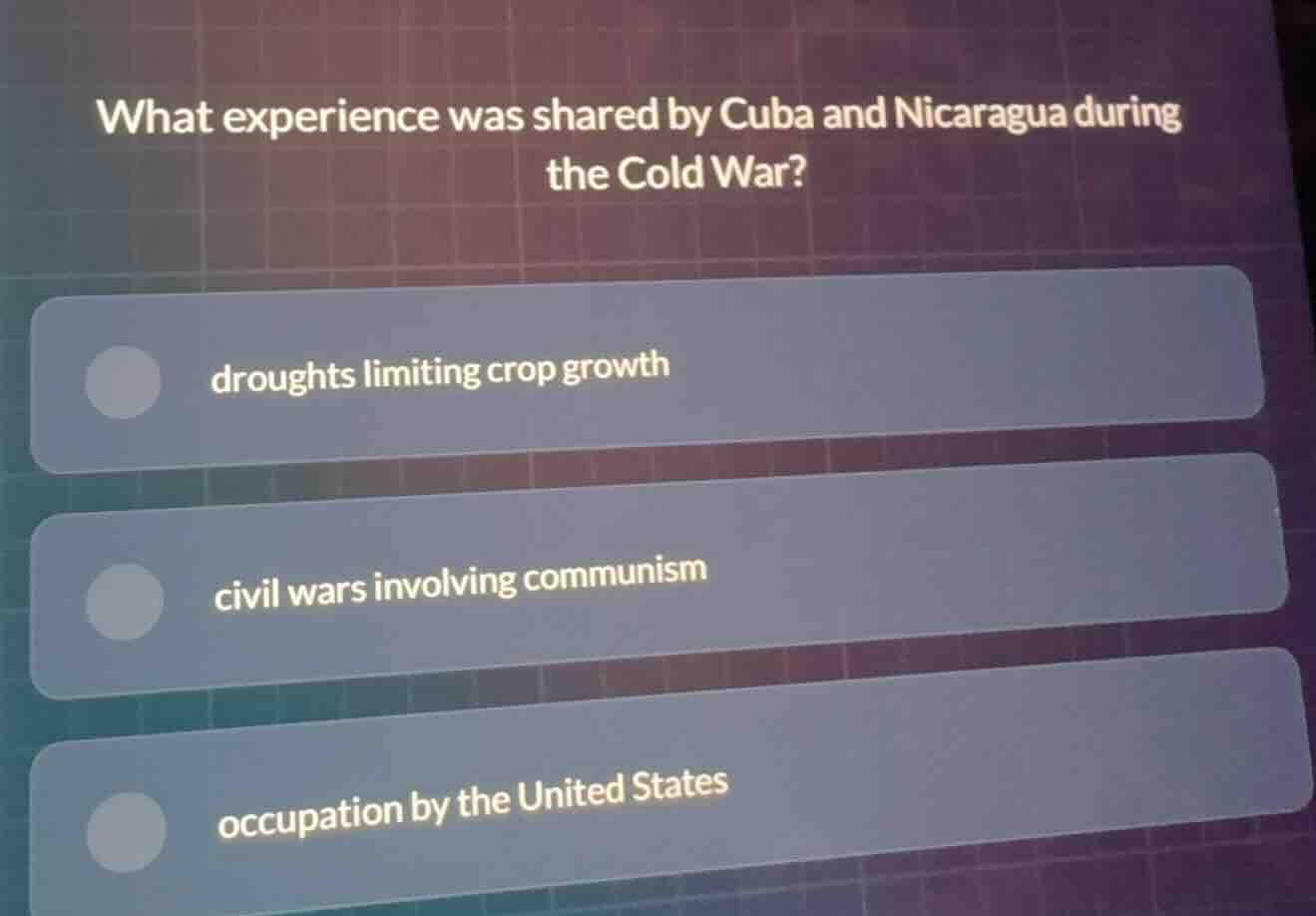
what experience was shared by cuba and nicaragua during the cold war?
droughts limiting crop growth
civil wars involving communism
occupation by the united states
🆕 New Concept Discovered: Cold War Proxy Conflicts in Latin America
Internal ideological struggles backed by global superpowers.
Step 1: Analyze the historical context of Cuba
During the Cold War, Cuba experienced a major political shift when Fidel Castro led the Cuban Revolution, overthrowing the US-backed dictator Fulgencio Batista in 1959. This established a communist government in Cuba, leading to intense internal conflict, armed resistance, and direct involvement from global superpowers (the United States and the Soviet Union).
Step 2: Analyze the historical context of Nicaragua
In Nicaragua, the socialist Sandinista National Liberation Front (FSLN) overthrew the US-backed Somoza dictatorship in 1979. This triggered a brutal civil war during the 1980s between the revolutionary Sandinista government and the "Contras," a right-wing rebel group funded and trained by the United States to prevent the spread of communism in Central America.
Step 3: Identify the shared experience
Comparing the experiences of both nations during the Cold War:
- Droughts limiting crop growth: While weather events occurred, this was not a defining political or historical experience shared by both during the Cold War.
- Occupation by the United States: Neither Cuba nor Nicaragua was directly occupied by the United States military during the Cold War (though both faced US intervention, embargoes, and covert operations).
- Civil wars involving communism: Both nations experienced intense internal armed conflicts (civil wars/revolutions) centered around the rise of communist or socialist governments and the counter-revolutionary forces fighting against them.

Snap & solve any problem in the app
Get step-by-step solutions on Sovi AI
Photo-based solutions with guided steps
Explore more problems and detailed explanations
civil wars involving communism