QUESTION IMAGE
Question
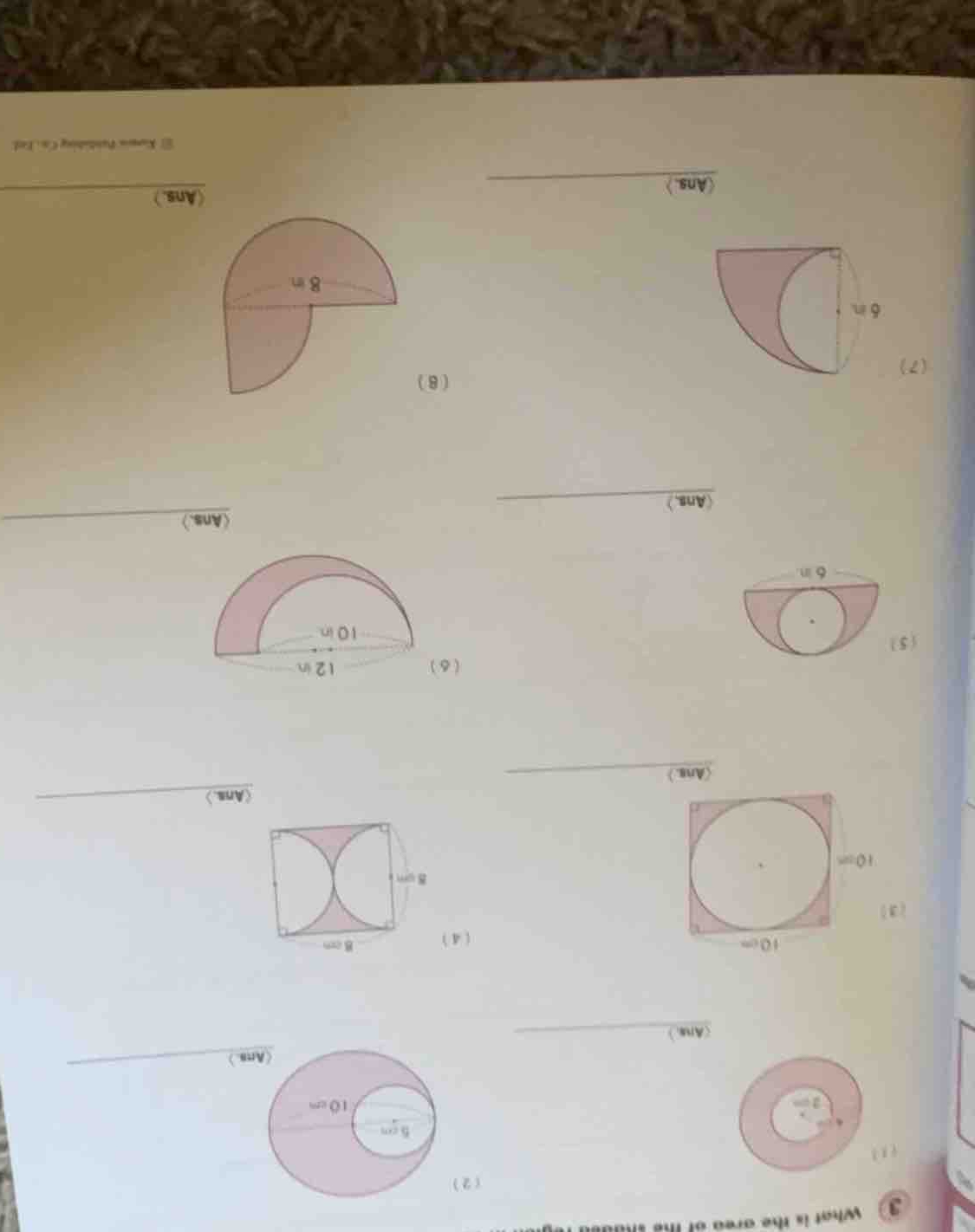
3 what is the area of the shaded region in each of the following figures?
(1)
(ans.)
(2)
(ans.)
(3)
(ans.)
(4)
(ans.)
(5)
(ans.)
(6)
(ans.)
(7)
(ans.)
(8)
(ans.)
<pre_analysis>
{
"quality": "clear",
"question_count": 8,
"skills_matched": [
"step_cot",
"table_formatter",
"explain_then_answer",
"quick"
],
"needs_drawing": false,
"concepts_used": [],
"new_concepts": [
"Composite Area",
"Shaded Area Calculation"
],
"current_concepts": [
"Area of Circle",
"Area of Semicircle",
"Area of Sector",
"Area of Annulus",
"Shaded Area Decomposition",
"Composite Area",
"Shaded Area Calculation"
]
}
</pre_analysis>
<reasoning>
Calculate area for Question 1
The figure is an annulus with outer radius \(R = 5\text{ cm}\) and inner radius \(r = 2\text{ cm}\).
\[
A = \pi R^2 - \pi r^2 = \pi (5^2 - 2^2) = 21\pi\text{ cm}^2 \approx 65.97\text{ cm}^2
\]
Calculate area for Question 2
The figure consists of a large circle of diameter \(10\text{ cm}\) (radius \(R = 5\text{ cm}\)) containing an unshaded smaller circle of diameter \(5\text{ cm}\) (radius \(r = 2.5\text{ cm}\)).
\[
A = \pi R^2 - \pi r^2 = \pi (5^2 - 2.5^2) = 18.75\pi\text{ cm}^2 \approx 58.90\text{ cm}^2
\]
Calculate area for Question 3
The figure is a square of side \(10\text{ cm}\) with an inscribed unshaded circle of diameter \(10\text{ cm}\) (radius \(r = 5\text{ cm}\)).
\[
A = s^2 - \pi r^2 = 10^2 - \pi (5^2) = 100 - 25\pi\text{ cm}^2 \approx 21.46\text{ cm}^2
\]
Calculate area for Question 4
The figure is a square of side \(8\text{ cm}\) with two unshaded semicircles on opposite sides, each of diameter \(8\text{ cm}\) (radius \(r = 4\text{ cm}\)), which combine to form one full circle.
\[
A = s^2 - \pi r^2 = 8^2 - \pi (4^2) = 64 - 16\pi\text{ cm}^2 \approx 13.73\text{ cm}^2
\]
Calculate area for Question 5
The figure is a semicircle of diameter \(6\text{ in}\) (radius \(R = 3\text{ in}\)) containing an unshaded circle of diameter \(3\text{ in}\) (radius \(r = 1.5\text{ in}\)).
\[
A = \frac{1}{2}\pi R^2 - \pi r^2 = \frac{1}{2}\pi (3^2) - \pi (1.5^2) = 4.5\pi - 2.25\pi = 2.25\pi\text{ in}^2 \approx 7.07\text{ in}^2
\]
Calculate area for Question 6
The figure is a crescent-like shape formed by a larger semicircle of diameter \(12\text{ in}\) (radius \(R = 6\text{ in}\)) and an unshaded smaller semicircle of diameter \(10\text{ in}\) (radius \(r = 5\text{ in}\)).
\[
A = \frac{1}{2}\pi R^2 - \frac{1}{2}\pi r^2 = \frac{1}{2}\pi (6^2 - 5^2) = 5.5\pi\text{ in}^2 \approx 17.28\text{ in}^2
\]
Calculate area for Question 7
The figure is a quarter circle of radius \(6\text{ in}\) with an unshaded semicircle of diameter \(6\text{ in}\) (radius \(r = 3\text{ in}\)) inside it.
\[
A = \frac{1}{4}\pi (6^2) - \frac{1}{2}\pi (3^2) = 9\pi - 4.5\pi = 4.5\pi\text{ in}^2 \approx 14.14\text{ in}^2
\]
Calculate area for Question 8
The figure consists of a quarter circle of radius \(8\text{ in}\) and a semicircle of diameter \(8\text{ in}\) (radius \(r = 4\text{ in}\)).
\[
A = \frac{1}{4}\pi (8^2) + \frac{1}{2}\pi (4^2) = 16\pi + 8\pi = 24\pi\text{ in}^2 \approx 75.40\text{ in}^2
\]
</reasoning>
<answer>
| No. | Answer (in terms of \(\pi\)) | Answer (approximate) |
|---|---|---|
| (2) | \(18.75\pi\text{ cm}^2\) | \(58.90\text{ cm}^2\) |
| (3) | \(100 - 25\pi\text{ cm}^2\) | \(21.46\text{ cm}^2\) |
| (4) | \(64 - 16\pi\text{ cm}^2\) | \(13.73\text{ cm}^2\) |
| (5) | \(2.25\pi\text{ in}^2\) | \(7.07\text{ in}^2\) |
| (6) | \(5.5\pi\text{ in}^2\) | \(17.28\text{ in}^2\) |
| (7) | \(4.5\pi\text{ in}^2\) | \(14.14\text{ in}^2\) |
| (8) | \(24\pi\text{ in}^2\) | \(75.40\text{ in}^2\) |
</answer>
<post_analysis>
{
"subje…
Snap & solve any problem in the app
Get step-by-step solutions on Sovi AI
Photo-based solutions with guided steps
Explore more problems and detailed explanations
<pre_analysis>
{
"quality": "clear",
"question_count": 8,
"skills_matched": [
"step_cot",
"table_formatter",
"explain_then_answer",
"quick"
],
"needs_drawing": false,
"concepts_used": [],
"new_concepts": [
"Composite Area",
"Shaded Area Calculation"
],
"current_concepts": [
"Area of Circle",
"Area of Semicircle",
"Area of Sector",
"Area of Annulus",
"Shaded Area Decomposition",
"Composite Area",
"Shaded Area Calculation"
]
}
</pre_analysis>
<reasoning>
Calculate area for Question 1
The figure is an annulus with outer radius \(R = 5\text{ cm}\) and inner radius \(r = 2\text{ cm}\).
\[
A = \pi R^2 - \pi r^2 = \pi (5^2 - 2^2) = 21\pi\text{ cm}^2 \approx 65.97\text{ cm}^2
\]
Calculate area for Question 2
The figure consists of a large circle of diameter \(10\text{ cm}\) (radius \(R = 5\text{ cm}\)) containing an unshaded smaller circle of diameter \(5\text{ cm}\) (radius \(r = 2.5\text{ cm}\)).
\[
A = \pi R^2 - \pi r^2 = \pi (5^2 - 2.5^2) = 18.75\pi\text{ cm}^2 \approx 58.90\text{ cm}^2
\]
Calculate area for Question 3
The figure is a square of side \(10\text{ cm}\) with an inscribed unshaded circle of diameter \(10\text{ cm}\) (radius \(r = 5\text{ cm}\)).
\[
A = s^2 - \pi r^2 = 10^2 - \pi (5^2) = 100 - 25\pi\text{ cm}^2 \approx 21.46\text{ cm}^2
\]
Calculate area for Question 4
The figure is a square of side \(8\text{ cm}\) with two unshaded semicircles on opposite sides, each of diameter \(8\text{ cm}\) (radius \(r = 4\text{ cm}\)), which combine to form one full circle.
\[
A = s^2 - \pi r^2 = 8^2 - \pi (4^2) = 64 - 16\pi\text{ cm}^2 \approx 13.73\text{ cm}^2
\]
Calculate area for Question 5
The figure is a semicircle of diameter \(6\text{ in}\) (radius \(R = 3\text{ in}\)) containing an unshaded circle of diameter \(3\text{ in}\) (radius \(r = 1.5\text{ in}\)).
\[
A = \frac{1}{2}\pi R^2 - \pi r^2 = \frac{1}{2}\pi (3^2) - \pi (1.5^2) = 4.5\pi - 2.25\pi = 2.25\pi\text{ in}^2 \approx 7.07\text{ in}^2
\]
Calculate area for Question 6
The figure is a crescent-like shape formed by a larger semicircle of diameter \(12\text{ in}\) (radius \(R = 6\text{ in}\)) and an unshaded smaller semicircle of diameter \(10\text{ in}\) (radius \(r = 5\text{ in}\)).
\[
A = \frac{1}{2}\pi R^2 - \frac{1}{2}\pi r^2 = \frac{1}{2}\pi (6^2 - 5^2) = 5.5\pi\text{ in}^2 \approx 17.28\text{ in}^2
\]
Calculate area for Question 7
The figure is a quarter circle of radius \(6\text{ in}\) with an unshaded semicircle of diameter \(6\text{ in}\) (radius \(r = 3\text{ in}\)) inside it.
\[
A = \frac{1}{4}\pi (6^2) - \frac{1}{2}\pi (3^2) = 9\pi - 4.5\pi = 4.5\pi\text{ in}^2 \approx 14.14\text{ in}^2
\]
Calculate area for Question 8
The figure consists of a quarter circle of radius \(8\text{ in}\) and a semicircle of diameter \(8\text{ in}\) (radius \(r = 4\text{ in}\)).
\[
A = \frac{1}{4}\pi (8^2) + \frac{1}{2}\pi (4^2) = 16\pi + 8\pi = 24\pi\text{ in}^2 \approx 75.40\text{ in}^2
\]
</reasoning>
<answer>
| No. | Answer (in terms of \(\pi\)) | Answer (approximate) |
|---|---|---|
| (2) | \(18.75\pi\text{ cm}^2\) | \(58.90\text{ cm}^2\) |
| (3) | \(100 - 25\pi\text{ cm}^2\) | \(21.46\text{ cm}^2\) |
| (4) | \(64 - 16\pi\text{ cm}^2\) | \(13.73\text{ cm}^2\) |
| (5) | \(2.25\pi\text{ in}^2\) | \(7.07\text{ in}^2\) |
| (6) | \(5.5\pi\text{ in}^2\) | \(17.28\text{ in}^2\) |
| (7) | \(4.5\pi\text{ in}^2\) | \(14.14\text{ in}^2\) |
| (8) | \(24\pi\text{ in}^2\) | \(75.40\text{ in}^2\) |
</answer>
<post_analysis>
{
"subject": "Mathematics",
"question_type": "Free Response",
"knowledge_point": [
"Mathematics",
"Geometry",
"Composite Area"
]
}
</post_analysis>