Sovi.AI - AI Math Tutor

Scan to solve math questions

QUESTION IMAGE

3 what is the area of the shaded region in each of the following figure…

Question

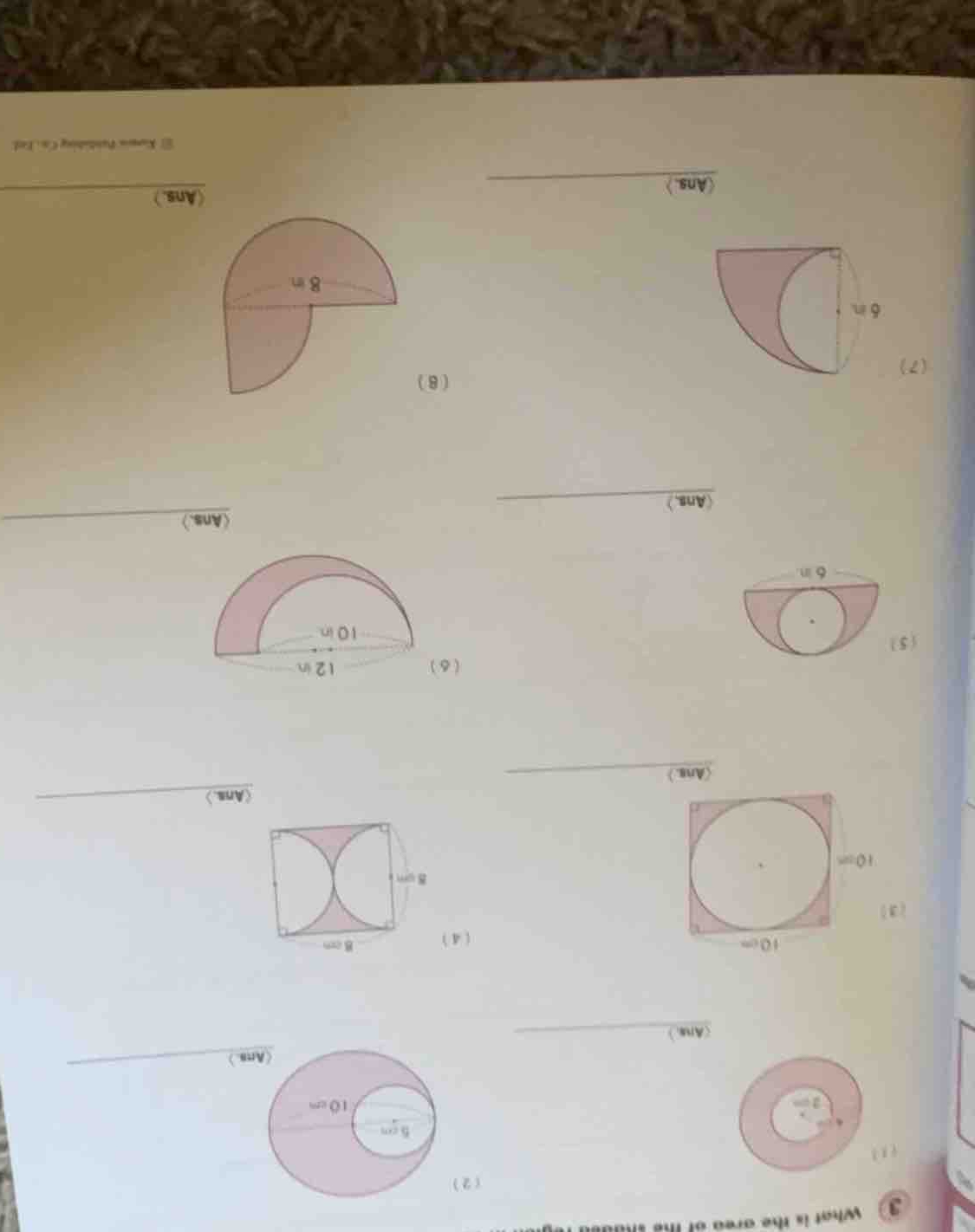
3 what is the area of the shaded region in each of the following figures?

(1)
(ans.)

(2)
(ans.)

(3)
(ans.)

(4)
(ans.)

(5)
(ans.)

(6)
(ans.)

(7)
(ans.)

(8)
(ans.)

Explanation:

Response

<pre_analysis>
{
"quality": "clear",
"question_count": 8,
"skills_matched": [
"step_cot",
"table_formatter",
"explain_then_answer",
"quick"
],
"needs_drawing": false,
"concepts_used": [],
"new_concepts": [
"Composite Area",
"Shaded Area Calculation"
],
"current_concepts": [
"Area of Circle",
"Area of Semicircle",
"Area of Sector",
"Area of Annulus",
"Shaded Area Decomposition",
"Composite Area",
"Shaded Area Calculation"
]
}
</pre_analysis>

<reasoning>

Calculate area for Question 1

The figure is an annulus with outer radius \(R = 5\text{ cm}\) and inner radius \(r = 2\text{ cm}\).
\[
A = \pi R^2 - \pi r^2 = \pi (5^2 - 2^2) = 21\pi\text{ cm}^2 \approx 65.97\text{ cm}^2
\]

Calculate area for Question 2

The figure consists of a large circle of diameter \(10\text{ cm}\) (radius \(R = 5\text{ cm}\)) containing an unshaded smaller circle of diameter \(5\text{ cm}\) (radius \(r = 2.5\text{ cm}\)).
\[
A = \pi R^2 - \pi r^2 = \pi (5^2 - 2.5^2) = 18.75\pi\text{ cm}^2 \approx 58.90\text{ cm}^2
\]

Calculate area for Question 3

The figure is a square of side \(10\text{ cm}\) with an inscribed unshaded circle of diameter \(10\text{ cm}\) (radius \(r = 5\text{ cm}\)).
\[
A = s^2 - \pi r^2 = 10^2 - \pi (5^2) = 100 - 25\pi\text{ cm}^2 \approx 21.46\text{ cm}^2
\]

Calculate area for Question 4

The figure is a square of side \(8\text{ cm}\) with two unshaded semicircles on opposite sides, each of diameter \(8\text{ cm}\) (radius \(r = 4\text{ cm}\)), which combine to form one full circle.
\[
A = s^2 - \pi r^2 = 8^2 - \pi (4^2) = 64 - 16\pi\text{ cm}^2 \approx 13.73\text{ cm}^2
\]

Calculate area for Question 5

The figure is a semicircle of diameter \(6\text{ in}\) (radius \(R = 3\text{ in}\)) containing an unshaded circle of diameter \(3\text{ in}\) (radius \(r = 1.5\text{ in}\)).
\[
A = \frac{1}{2}\pi R^2 - \pi r^2 = \frac{1}{2}\pi (3^2) - \pi (1.5^2) = 4.5\pi - 2.25\pi = 2.25\pi\text{ in}^2 \approx 7.07\text{ in}^2
\]

Calculate area for Question 6

The figure is a crescent-like shape formed by a larger semicircle of diameter \(12\text{ in}\) (radius \(R = 6\text{ in}\)) and an unshaded smaller semicircle of diameter \(10\text{ in}\) (radius \(r = 5\text{ in}\)).
\[
A = \frac{1}{2}\pi R^2 - \frac{1}{2}\pi r^2 = \frac{1}{2}\pi (6^2 - 5^2) = 5.5\pi\text{ in}^2 \approx 17.28\text{ in}^2
\]

Calculate area for Question 7

The figure is a quarter circle of radius \(6\text{ in}\) with an unshaded semicircle of diameter \(6\text{ in}\) (radius \(r = 3\text{ in}\)) inside it.
\[
A = \frac{1}{4}\pi (6^2) - \frac{1}{2}\pi (3^2) = 9\pi - 4.5\pi = 4.5\pi\text{ in}^2 \approx 14.14\text{ in}^2
\]

Calculate area for Question 8

The figure consists of a quarter circle of radius \(8\text{ in}\) and a semicircle of diameter \(8\text{ in}\) (radius \(r = 4\text{ in}\)).
\[
A = \frac{1}{4}\pi (8^2) + \frac{1}{2}\pi (4^2) = 16\pi + 8\pi = 24\pi\text{ in}^2 \approx 75.40\text{ in}^2
\]
</reasoning>

<answer>

No.Answer (in terms of \(\pi\))Answer (approximate)
(2)\(18.75\pi\text{ cm}^2\)\(58.90\text{ cm}^2\)
(3)\(100 - 25\pi\text{ cm}^2\)\(21.46\text{ cm}^2\)
(4)\(64 - 16\pi\text{ cm}^2\)\(13.73\text{ cm}^2\)
(5)\(2.25\pi\text{ in}^2\)\(7.07\text{ in}^2\)
(6)\(5.5\pi\text{ in}^2\)\(17.28\text{ in}^2\)
(7)\(4.5\pi\text{ in}^2\)\(14.14\text{ in}^2\)
(8)\(24\pi\text{ in}^2\)\(75.40\text{ in}^2\)

</answer>

<post_analysis>
{
"subje…

Answer:

<pre_analysis>
{
"quality": "clear",
"question_count": 8,
"skills_matched": [
"step_cot",
"table_formatter",
"explain_then_answer",
"quick"
],
"needs_drawing": false,
"concepts_used": [],
"new_concepts": [
"Composite Area",
"Shaded Area Calculation"
],
"current_concepts": [
"Area of Circle",
"Area of Semicircle",
"Area of Sector",
"Area of Annulus",
"Shaded Area Decomposition",
"Composite Area",
"Shaded Area Calculation"
]
}
</pre_analysis>

<reasoning>

Calculate area for Question 1

The figure is an annulus with outer radius \(R = 5\text{ cm}\) and inner radius \(r = 2\text{ cm}\).
\[
A = \pi R^2 - \pi r^2 = \pi (5^2 - 2^2) = 21\pi\text{ cm}^2 \approx 65.97\text{ cm}^2
\]

Calculate area for Question 2

The figure consists of a large circle of diameter \(10\text{ cm}\) (radius \(R = 5\text{ cm}\)) containing an unshaded smaller circle of diameter \(5\text{ cm}\) (radius \(r = 2.5\text{ cm}\)).
\[
A = \pi R^2 - \pi r^2 = \pi (5^2 - 2.5^2) = 18.75\pi\text{ cm}^2 \approx 58.90\text{ cm}^2
\]

Calculate area for Question 3

The figure is a square of side \(10\text{ cm}\) with an inscribed unshaded circle of diameter \(10\text{ cm}\) (radius \(r = 5\text{ cm}\)).
\[
A = s^2 - \pi r^2 = 10^2 - \pi (5^2) = 100 - 25\pi\text{ cm}^2 \approx 21.46\text{ cm}^2
\]

Calculate area for Question 4

The figure is a square of side \(8\text{ cm}\) with two unshaded semicircles on opposite sides, each of diameter \(8\text{ cm}\) (radius \(r = 4\text{ cm}\)), which combine to form one full circle.
\[
A = s^2 - \pi r^2 = 8^2 - \pi (4^2) = 64 - 16\pi\text{ cm}^2 \approx 13.73\text{ cm}^2
\]

Calculate area for Question 5

The figure is a semicircle of diameter \(6\text{ in}\) (radius \(R = 3\text{ in}\)) containing an unshaded circle of diameter \(3\text{ in}\) (radius \(r = 1.5\text{ in}\)).
\[
A = \frac{1}{2}\pi R^2 - \pi r^2 = \frac{1}{2}\pi (3^2) - \pi (1.5^2) = 4.5\pi - 2.25\pi = 2.25\pi\text{ in}^2 \approx 7.07\text{ in}^2
\]

Calculate area for Question 6

The figure is a crescent-like shape formed by a larger semicircle of diameter \(12\text{ in}\) (radius \(R = 6\text{ in}\)) and an unshaded smaller semicircle of diameter \(10\text{ in}\) (radius \(r = 5\text{ in}\)).
\[
A = \frac{1}{2}\pi R^2 - \frac{1}{2}\pi r^2 = \frac{1}{2}\pi (6^2 - 5^2) = 5.5\pi\text{ in}^2 \approx 17.28\text{ in}^2
\]

Calculate area for Question 7

The figure is a quarter circle of radius \(6\text{ in}\) with an unshaded semicircle of diameter \(6\text{ in}\) (radius \(r = 3\text{ in}\)) inside it.
\[
A = \frac{1}{4}\pi (6^2) - \frac{1}{2}\pi (3^2) = 9\pi - 4.5\pi = 4.5\pi\text{ in}^2 \approx 14.14\text{ in}^2
\]

Calculate area for Question 8

The figure consists of a quarter circle of radius \(8\text{ in}\) and a semicircle of diameter \(8\text{ in}\) (radius \(r = 4\text{ in}\)).
\[
A = \frac{1}{4}\pi (8^2) + \frac{1}{2}\pi (4^2) = 16\pi + 8\pi = 24\pi\text{ in}^2 \approx 75.40\text{ in}^2
\]
</reasoning>

<answer>

No.Answer (in terms of \(\pi\))Answer (approximate)
(2)\(18.75\pi\text{ cm}^2\)\(58.90\text{ cm}^2\)
(3)\(100 - 25\pi\text{ cm}^2\)\(21.46\text{ cm}^2\)
(4)\(64 - 16\pi\text{ cm}^2\)\(13.73\text{ cm}^2\)
(5)\(2.25\pi\text{ in}^2\)\(7.07\text{ in}^2\)
(6)\(5.5\pi\text{ in}^2\)\(17.28\text{ in}^2\)
(7)\(4.5\pi\text{ in}^2\)\(14.14\text{ in}^2\)
(8)\(24\pi\text{ in}^2\)\(75.40\text{ in}^2\)

</answer>

<post_analysis>
{
"subject": "Mathematics",
"question_type": "Free Response",
"knowledge_point": [
"Mathematics",
"Geometry",
"Composite Area"
]
}
</post_analysis>