QUESTION IMAGE
Question
wblm-tema ii gramática 3.3 práctica 2. ¿qué hacemos hoy?
tema ii: el tiempo libre
gramática
3.3 more stem-changing verbs
práctica 2. ¿qué hacemos hoy?
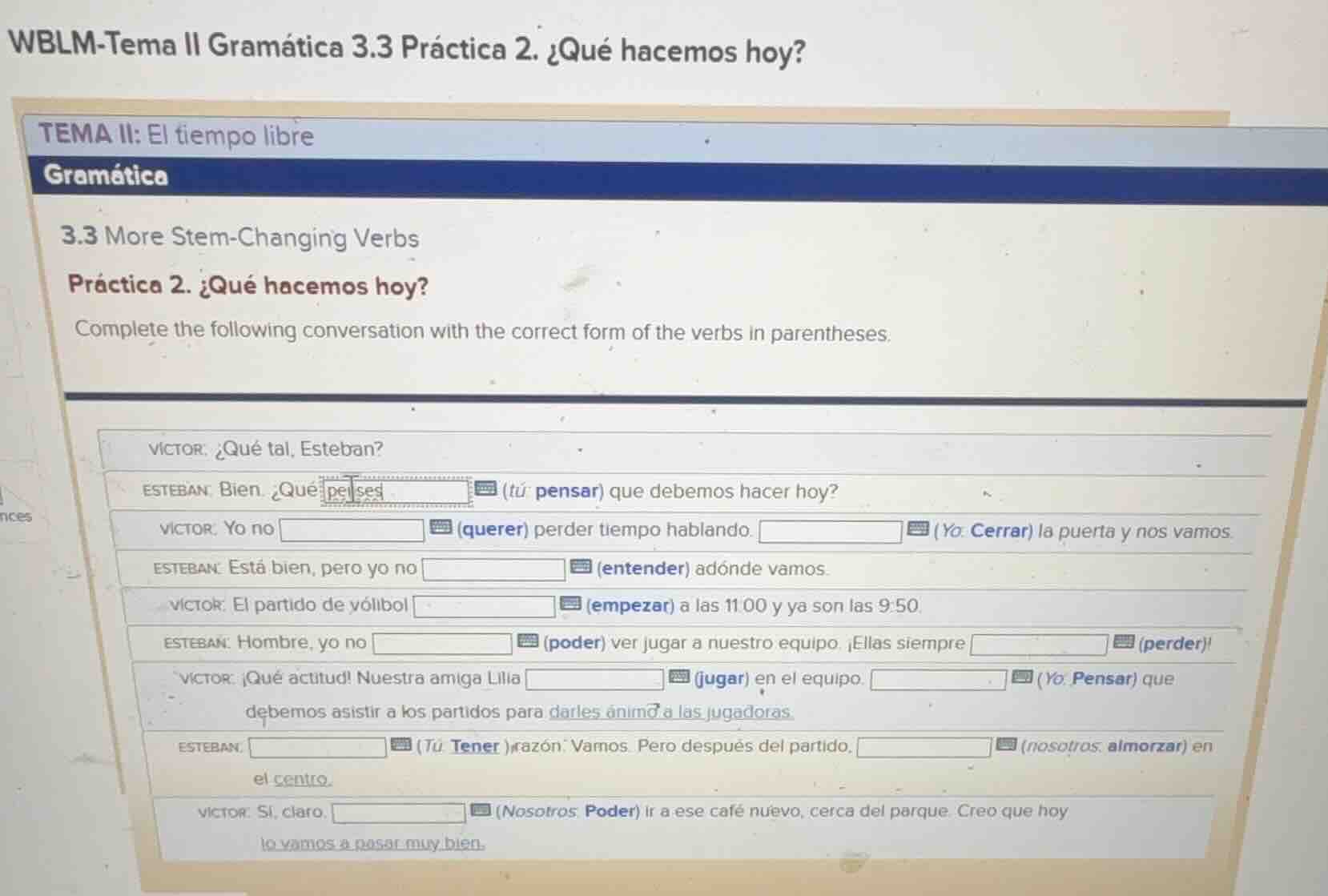
complete the following conversation with the correct form of the verbs in parentheses.
victor: ¿qué tal, esteban?
esteban: bien. ¿qué (tú: pensar) que debemos hacer hoy?
victor: yo no (querer) perder tiempo hablando. (yo: cerrar) la puerta y nos vamos.
esteban: está bien, pero yo no (entender) adónde vamos.
victor: el partido de vólibol (empezar) a las 11:00 y ya son las 9:50.
esteban: hombre, yo no (poder) ver jugar a nuestro equipo. ¡ellas siempre (perder)!
victor: ¡qué actitud! nuestra amiga lilia (jugar) en el equipo. (yo: pensar) que debemos asistir a los partidos para darles ánimo a las jugadoras.
esteban: (tú: tener) razón. vamos. pero después del partido, (nosotros: almorzar) en el centro.
victor: sí, claro. (nosotros: poder) ir a ese café nuevo, cerca del parque. creo que hoy lo vamos a pasar muy bien.
Conjugate "pensar" for "tú"
Using the Spanish Stem-Changing Verbs and Spanish Irregular Present Tense knowledge points
The verb pensar is an \(e
ightarrow ie\) stem-changing verb. For the subject pronoun tú, the ending is -as.
Conjugate "querer" and "cerrar" for "yo"
Using the Spanish Stem-Changing Verbs and Spanish Irregular Present Tense knowledge points
Both querer and cerrar are \(e
ightarrow ie\) stem-changing verbs. For the subject pronoun yo, the ending is -o.
Conjugate "entender" and "empezar"
Using the Spanish Stem-Changing Verbs and Spanish Irregular Present Tense knowledge points
Entender and empezar are \(e
ightarrow ie\) stem-changing verbs.
- For yo (entender):
- For el partido de vólibol (singular third-person, empezar):
Conjugate "poder", "perder", and "jugar"
Using the Spanish Stem-Changing Verbs and Spanish Irregular Present Tense knowledge points
- Poder is an \(o
ightarrow ue\) stem-changing verb. For yo:
- Perder is an \(e
ightarrow ie\) stem-changing verb. For ellas (third-person plural):
- Jugar is a \(u
ightarrow ue\) stem-changing verb. For nuestra amiga Lilia (singular third-person):
Conjugate "pensar", "tener", "almorzar", and "poder"
Using the Spanish Stem-Changing Verbs and Spanish Irregular Present Tense knowledge points
- For yo (pensar):
- Tener is an irregular \(e
ightarrow ie\) verb. For tú:
- Almorzar is an \(o
ightarrow ue\) stem-changing verb. For nosotros, there is no stem change:
- Poder is an \(o
ightarrow ue\) stem-changing verb. For nosotros, there is no stem change:

Snap & solve any problem in the app
Get step-by-step solutions on Sovi AI
Photo-based solutions with guided steps
Explore more problems and detailed explanations
| No. | Verb & Subject | Conjugation |
|---|---|---|
| 2 | yo querer | quiero |
| 3 | yo cerrar | cierro |
| 4 | yo entender | entiendo |
| 5 | el partido empezar | empieza |
| 6 | yo poder | puedo |
| 7 | ellas perder | pierden |
| 8 | Lilia jugar | juega |
| 9 | yo pensar | pienso |
| 10 | tú tener | tienes |
| 11 | nosotros almorzar | almorzamos |
| 12 | nosotros poder | podemos |