QUESTION IMAGE
Question
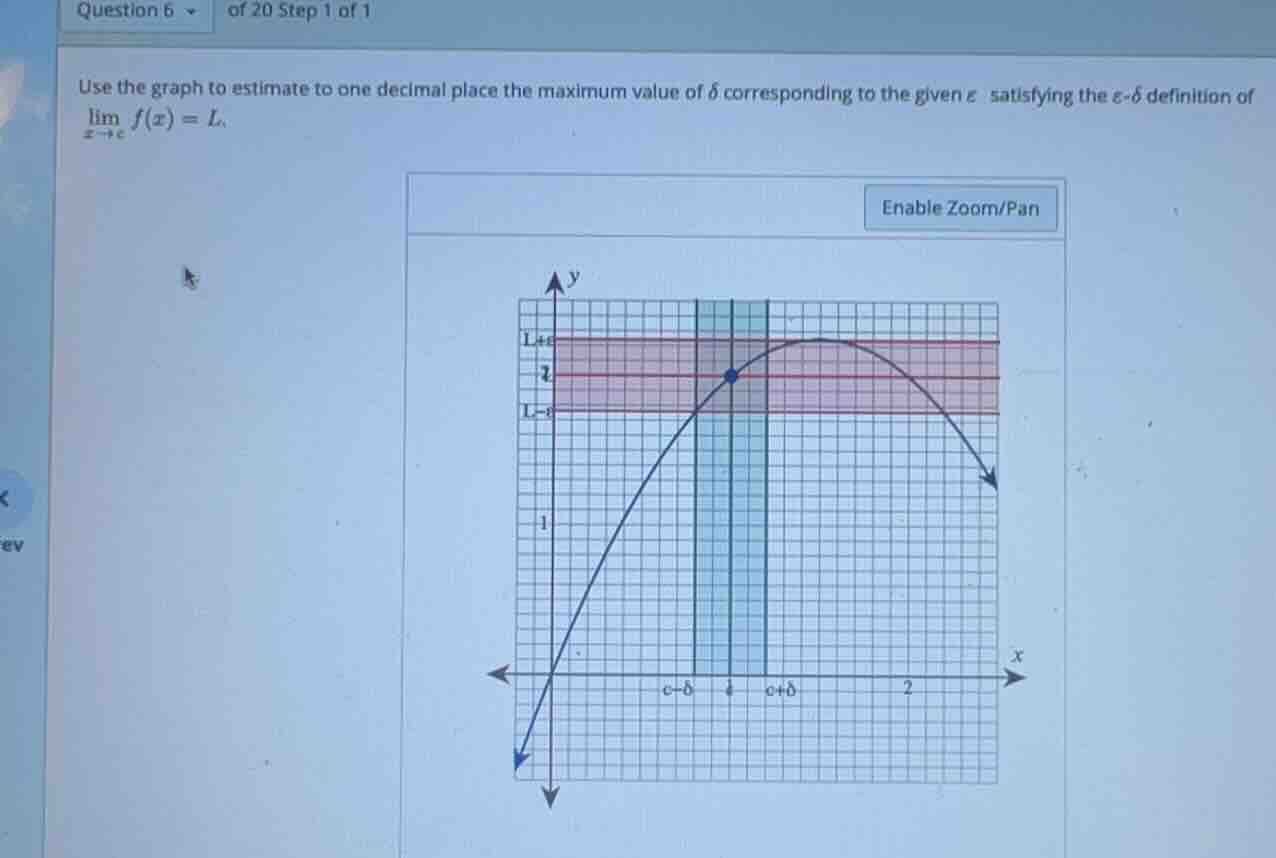
use the graph to estimate to one decimal place the maximum value of \\(\delta\\) corresponding to the given \\(\varepsilon\\) satisfying the \\(\varepsilon\\)-\\(\delta\\) definition of \\(\lim_{x \to c} f(x) = l\\).
Identify the given values from the grid
Let's determine the scale of the grid and locate the key values:
- The x-axis has a major label at \(2\). Counting the grid lines from \(0\) to \(2\), there are \(10\) grid subdivisions. Thus, each grid square represents \(0.2\) units along the x-axis.
- The y-axis has a major label at \(1\). Counting the grid lines from \(0\) to \(1\), there are \(5\) grid subdivisions. Thus, each grid square represents \(0.2\) units along the y-axis.
- The point \(c\) is located on the x-axis. Counting from \(0\), it is \(7\) grid units to the right, so \(c = 7 \times 0.2 = 1.4\).
- The limit value \(L\) is located on the y-axis. Counting from \(0\), it is \(12\) grid units up, so \(L = 12 \times 0.2 = 2.4\).
Determine the epsilon interval boundaries
The horizontal red band represents the interval \((L - \epsilon, L + \epsilon)\):
- The lower boundary \(L - \epsilon\) is at \(11\) grid units on the y-axis: \(L - \epsilon = 11 \times 0.2 = 2.2\).
- The upper boundary \(L + \epsilon\) is at \(13\) grid units on the y-axis: \(L + \epsilon = 13 \times 0.2 = 2.6\).
- This gives \(\epsilon = 0.2\).
Find the corresponding x-intervals
We find where the horizontal lines \(y = 2.2\) and \(y = 2.6\) intersect the function curve near \(x = c\):
- The curve intersects the lower horizontal boundary \(y = 2.2\) at approximately \(5.5\) grid units from the y-axis: \(x_1 = 5.5 \times 0.2 = 1.1\).
- The curve intersects the upper horizontal boundary \(y = 2.6\) at approximately \(9\) grid units from the y-axis: \(x_2 = 9 \times 0.2 = 1.8\).
Calculate the maximum allowable delta
For the \(\epsilon\)-\(\delta\) definition to hold, we need the interval \((c - \delta, c + \delta)\) to be contained within the interval \((x_1, x_2)\):
- The distance from \(c\) to the left boundary is:
- The distance from \(c\) to the right boundary is:
- To guarantee that all x-values within \(\delta\) of \(c\) map to y-values within \(\epsilon\) of \(L\), we must choose the smaller of these two distances:

Snap & solve any problem in the app
Get step-by-step solutions on Sovi AI
Photo-based solutions with guided steps
Explore more problems and detailed explanations
\(0.3\)