QUESTION IMAGE
Question
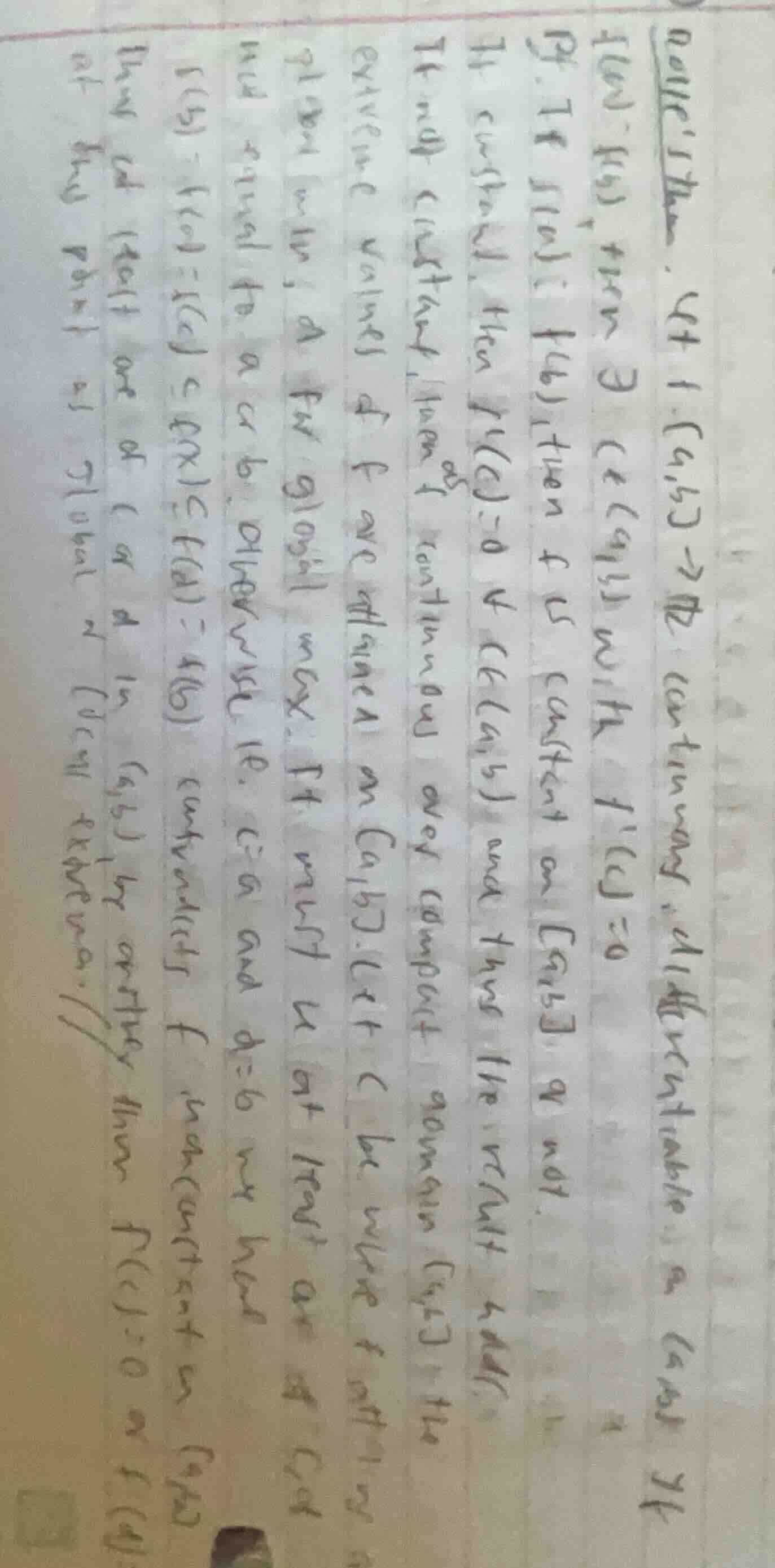
rolles thm. let \\(f: a,b \to \mathbb{r}\\) continuous, differentiable on \\((a,b)\\). if \\(f(a) = f(b)\\), then \\(\exists\\ c \in (a,b)\\) with \\(f(c) = 0\\).
pf. if \\(f(a) = f(b)\\), then \\(f\\) is constant on \\(a,b\\) or not.
if constant, then \\(f(c) = 0\\ \forall\\ c \in (a,b)\\) and thus the result holds.
if not constant, since \\(f\\) continuous over compact domain \\(a,b\\), the extreme values of \\(f\\) are attained on \\(a,b\\). let \\(c\\) be where \\(f\\) attains global min, \\(d\\) for global max. it must be at least one of \\(c, d\\) not equal to \\(a\\) or \\(b\\). otherwise if \\(c=a\\) and \\(d=b\\) we have \\(f(b) = f(a) = f(c) \le f(x) \le f(d) = f(b)\\) contradicts \\(f\\) non-constant in \\((a,b)\\).
thus at least one of \\(c\\) or \\(d\\) in \\((a,b)\\), by another thm \\(f(c) = 0\\) or \\(f(d) = 0\\) at this point of global w local extrema.
State the theorem and assumptions
Using the Rolles Theorem knowledge point
Let \(f: [a, b] \to \mathbb{R}\) be continuous on \([a, b]\) and differentiable on \((a, b)\). If \(f(a) = f(b)\), then there exists some \(c \in (a, b)\) such that \(f'(c) = 0\).
Analyze the constant case
Using the Rolles Theorem knowledge point
If \(f\) is constant on \([a, b]\), then \(f'(x) = 0\) for all \(x \in (a, b)\), so any \(c \in (a, b)\) satisfies \(f'(c) = 0\).
Apply Extreme Value Theorem
Using the Extreme Value Theorem knowledge point
Since \([a, b]\) is compact and \(f\) is continuous, \(f\) attains its global minimum at some \(c \in [a, b]\) and its global maximum at some \(d \in [a, b]\), meaning \(f(c) \le f(x) \le f(d)\) for all \(x \in [a, b]\).
Locate interior extremum
Using the Rolles Theorem knowledge point
If \(f\) is not constant, at least one of the extrema \(c\) or \(d\) must lie in the open interval \((a, b)\), because if both were boundary points, we would have \(f(c) = f(d) = f(a) = f(b)\), forcing \(f\) to be constant.
Apply Fermat's Theorem
Using the Fermats Theorem on Stationary Points knowledge point
Since the extremum (say \(c\)) lies in the open interval \((a, b)\) where \(f\) is differentiable, the derivative at this local extremum must vanish, yielding \(f'(c) = 0\).

Snap & solve any problem in the app
Get step-by-step solutions on Sovi AI
Photo-based solutions with guided steps
Explore more problems and detailed explanations
The provided text presents a complete and mathematically rigorous proof of Rolle's Theorem using the following logical structure:
- Hypothesis: We assume \(f: [a, b] \to \mathbb{R}\) is continuous on \([a, b]\), differentiable on \((a, b)\), and satisfies \(f(a) = f(b)\).
- Case 1 (Constant Function): If \(f(x)\) is constant on \([a, b]\), then its derivative \(f'(x) = 0\) for all \(x \in (a, b)\). Thus, any point \(c \in (a, b)\) satisfies \(f'(c) = 0\).
- Case 2 (Non-constant Function):
- By the Extreme Value Theorem, since \([a, b]\) is a compact interval and \(f\) is continuous, \(f\) must attain a global minimum at some \(c \in [a, b]\) and a global maximum at some \(d \in [a, b]\).
- Since \(f\) is not constant, at least one of these extrema (either \(c\) or \(d\)) must lie in the open interval \((a, b)\). If both were at the boundaries (i.e., \(\{c, d\} \subseteq \{a, b\}\)), then \(f(c) = f(d) = f(a) = f(b)\), which contradicts the assumption that \(f\) is non-constant.
- Let this interior extremum point be \(c \in (a, b)\). By Fermat's Theorem on Stationary Points, since \(f\) has a local extremum at \(c\) and is differentiable on \((a, b)\), we must have:
This completes the proof.