QUESTION IMAGE
Question
question 3
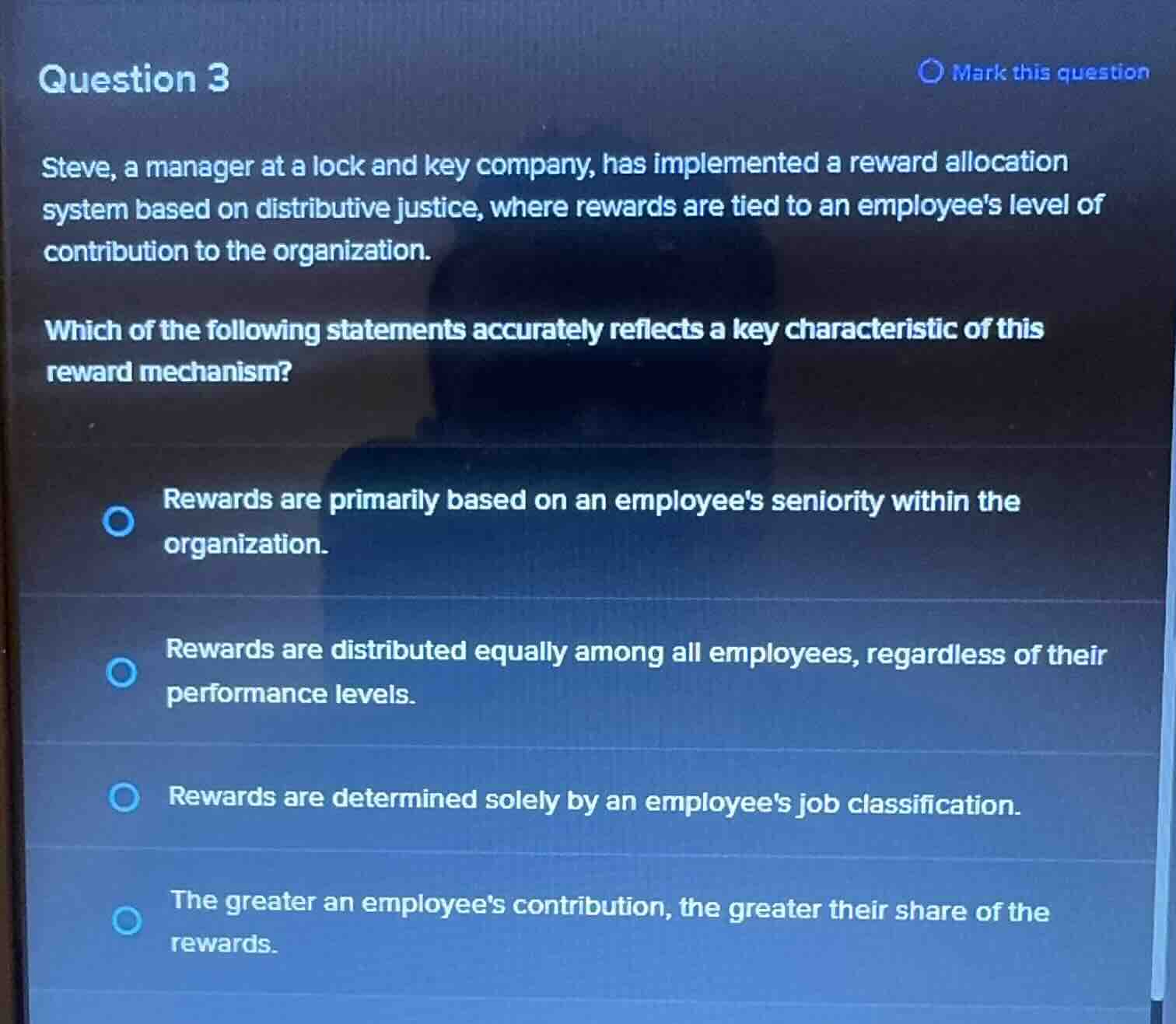
steve, a manager at a lock and key company, has implemented a reward allocation system based on distributive justice, where rewards are tied to an employees level of contribution to the organization.
which of the following statements accurately reflects a key characteristic of this reward mechanism?
- rewards are primarily based on an employees seniority within the organization.
- rewards are distributed equally among all employees, regardless of their performance levels.
- rewards are determined solely by an employees job classification.
- the greater an employees contribution, the greater their share of the rewards.
Define distributive justice in reward allocation
Using the Equity Theory knowledge point
Distributive justice refers to the perceived fairness of how rewards and resources are distributed within an organization. When a reward allocation system is based on distributive justice (specifically the equity rule), rewards are distributed in proportion to each employee's inputs or contributions.
Evaluate the given statements
- Statement 1: "Rewards are primarily based on an employee's seniority within the organization." This describes a seniority-based allocation, not contribution-based equity.
- Statement 2: "Rewards are distributed equally among all employees, regardless of their performance levels." This describes an equality-based allocation rule, rather than an equity/contribution-based rule.
- Statement 3: "Rewards are determined solely by an employee's job classification." This describes a position-based allocation, not individual contribution.
- Statement 4: "The greater an employee's contribution, the greater their share of the rewards." This directly aligns with the definition of contribution-based distributive justice (equity), where outcomes are proportional to inputs.

Snap & solve any problem in the app
Get step-by-step solutions on Sovi AI
Photo-based solutions with guided steps
Explore more problems and detailed explanations
- Rewards are primarily based on an employee's seniority within the organization.
- Rewards are distributed equally among all employees, regardless of their performance levels.
- Rewards are determined solely by an employee's job classification.
- The greater an employee's contribution, the greater their share of the rewards. (Correct answer)