QUESTION IMAGE
Question
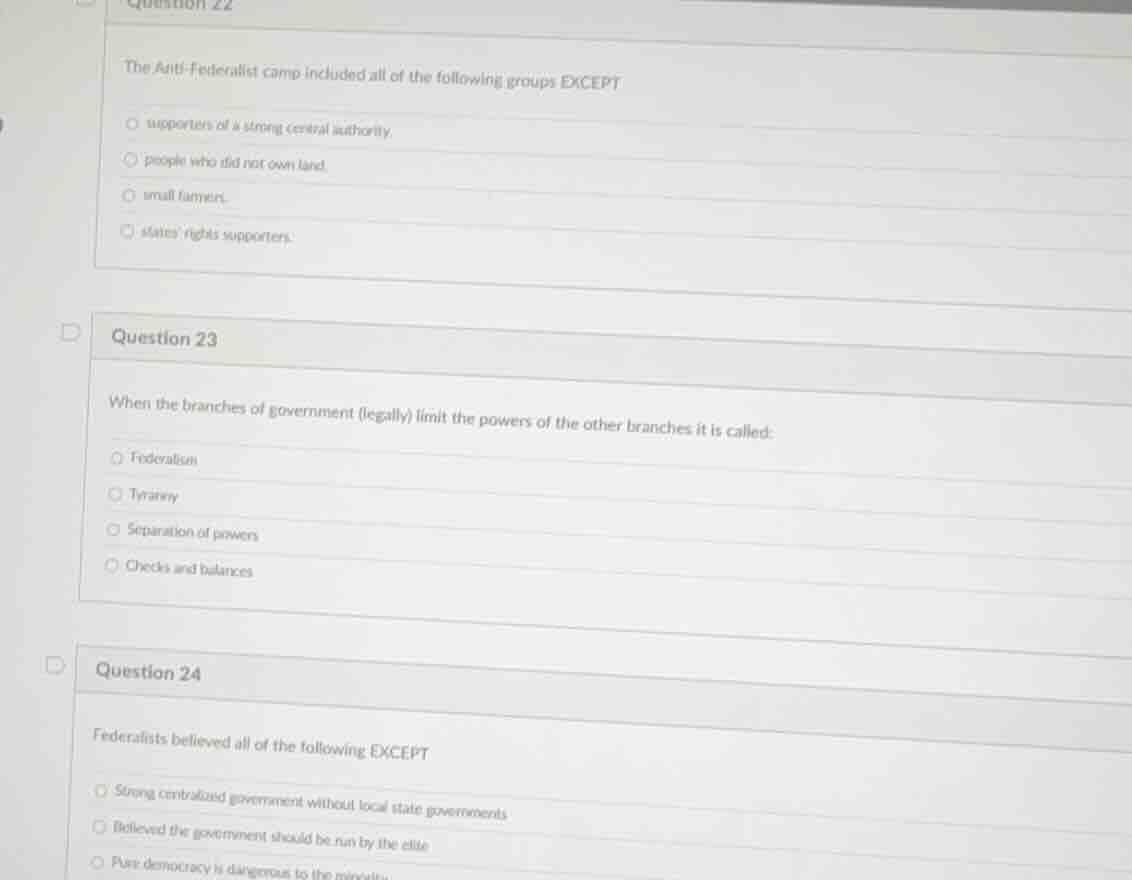
question 22
the anti-federalist camp included all of the following groups except
supporters of a strong central authority
people who did not own land
small farmers
states rights supporters
question 23
when the branches of government (legally) limit the powers of the other branches it is called:
federalism
tyranny
separation of powers
checks and balances
question 24
federalists believed all of the following except
strong centralized government without local state governments
believed the government should be run by the elite
pure democracy is dangerous to the minority
<pre_analysis>
{
"quality": "clear",
"question_count": 3,
"skills_matched": [
"direct_cot",
"multiple_choice_formatter",
"explain_then_answer",
"quick"
],
"needs_drawing": false,
"concepts_used": [
"Federalists and Anti-Federalists",
"Federalism"
],
"new_concepts": [
"Checks and Balances",
"Separation of Powers"
],
"current_concepts": [
"Federalists and Anti-Federalists",
"Federalism",
"Checks and Balances",
"Separation of Powers"
]
}
</pre_analysis>
<reasoning>
Analyze Question 22
The Anti-Federalists opposed a strong national government and favored state sovereignty. Therefore, supporters of a strong central authority would belong to the Federalist camp, not the Anti-Federalist camp.
Analyze Question 23
The system where branches of government legally limit and control the powers of the other branches to prevent any one branch from becoming too powerful is defined as checks and balances.
Analyze Question 24
Federalists favored a strong central government but did not advocate for the complete elimination of local state governments; they supported a federal system where power is shared between the national and state levels.
</reasoning>
<answer>
Question 22
<mcq-correct>(A) supporters of a strong central authority</mcq-correct>
<mcq-option>(B) people who did not own land</mcq-option>
<mcq-option>(C) small farmers</mcq-option>
<mcq-option>(D) states' rights supporters</mcq-option>
Question 23
<mcq-option>(A) Federalism</mcq-option>
<mcq-option>(B) Tyranny</mcq-option>
<mcq-option>(C) Separation of powers</mcq-option>
<mcq-correct>(D) Checks and balances</mcq-correct>
Question 24
<mcq-correct>(A) Strong centralized government without local state governments</mcq-correct>
<mcq-option>(B) Believed the government should be run by the elite</mcq-option>
<mcq-option>(C) Pure democracy is dangerous to the minority</mcq-option>
</answer>
<post_analysis>
{
"subject": "Social Science",
"question_type": "Multiple Choice",
"knowledge_point": [
"Social Science",
"U.S. History",
"Constitutional Foundations"
]
}
</post_analysis>
Snap & solve any problem in the app
Get step-by-step solutions on Sovi AI
Photo-based solutions with guided steps
Explore more problems and detailed explanations
<pre_analysis>
{
"quality": "clear",
"question_count": 3,
"skills_matched": [
"direct_cot",
"multiple_choice_formatter",
"explain_then_answer",
"quick"
],
"needs_drawing": false,
"concepts_used": [
"Federalists and Anti-Federalists",
"Federalism"
],
"new_concepts": [
"Checks and Balances",
"Separation of Powers"
],
"current_concepts": [
"Federalists and Anti-Federalists",
"Federalism",
"Checks and Balances",
"Separation of Powers"
]
}
</pre_analysis>
<reasoning>
Analyze Question 22
The Anti-Federalists opposed a strong national government and favored state sovereignty. Therefore, supporters of a strong central authority would belong to the Federalist camp, not the Anti-Federalist camp.
Analyze Question 23
The system where branches of government legally limit and control the powers of the other branches to prevent any one branch from becoming too powerful is defined as checks and balances.
Analyze Question 24
Federalists favored a strong central government but did not advocate for the complete elimination of local state governments; they supported a federal system where power is shared between the national and state levels.
</reasoning>
<answer>
Question 22
<mcq-correct>(A) supporters of a strong central authority</mcq-correct>
<mcq-option>(B) people who did not own land</mcq-option>
<mcq-option>(C) small farmers</mcq-option>
<mcq-option>(D) states' rights supporters</mcq-option>
Question 23
<mcq-option>(A) Federalism</mcq-option>
<mcq-option>(B) Tyranny</mcq-option>
<mcq-option>(C) Separation of powers</mcq-option>
<mcq-correct>(D) Checks and balances</mcq-correct>
Question 24
<mcq-correct>(A) Strong centralized government without local state governments</mcq-correct>
<mcq-option>(B) Believed the government should be run by the elite</mcq-option>
<mcq-option>(C) Pure democracy is dangerous to the minority</mcq-option>
</answer>
<post_analysis>
{
"subject": "Social Science",
"question_type": "Multiple Choice",
"knowledge_point": [
"Social Science",
"U.S. History",
"Constitutional Foundations"
]
}
</post_analysis>