QUESTION IMAGE
Question
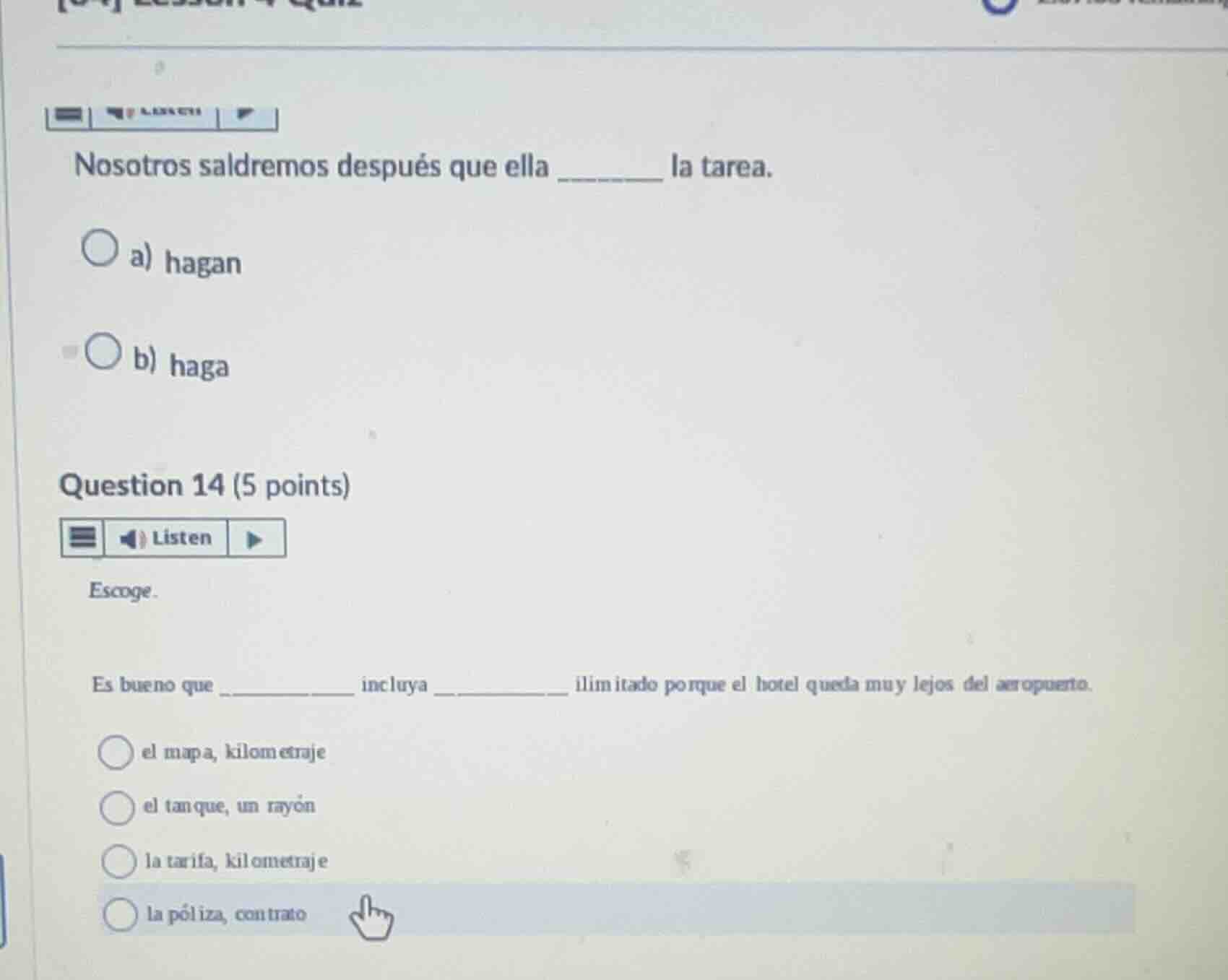
nosotros saldremos después que ella ______ la tarea.
a) hagan
b) haga
question 14 (5 points)
escoge.
es bueno que ____ incluya ____ ilimitado porque el hotel queda muy lejos del aeropuerto.
el mapa, kilometraje
el tanque, un rayón
la tarifa, kilometraje
la póliza, contrato
Analyze the first sentence structure
The first sentence is: "Nosotros saldremos después que ella ________ la tarea."
This sentence contains an adverbial clause introduced by después de que (or después que), which refers to a future, pending action (indicated by the future tense verb saldremos). In Spanish, when an adverbial conjunction of time refers to a future action, the subjunctive mood is required.
Determine the correct verb conjugation
Using the Spanish Subject Verb Agreement knowledge point, we identify the subject of the dependent clause as ella (she). The verb to conjugate is hacer (to do/make) in the present subjunctive.
- The present subjunctive stem of hacer is hag-.
- For the subject ella, the ending is -a, resulting in haga.
- The plural form hagan corresponds to ellos/ellas/ustedes, which does not agree with ella.
Analyze the second sentence context
The second question is: "Es bueno que ______ incluya ______ ilimitado porque el hotel queda muy lejos del aeropuerto."
This sentence translates to: "It is good that the [Option 1] includes unlimited [Option 2] because the hotel is located very far from the airport."
We need to select the pair of nouns that logically fits a travel context involving a long distance from the airport (likely renting a car).
Evaluate the vocabulary options
Using the Spanish Vocabulary knowledge point, we evaluate each choice:
- el mapa, kilometraje: "the map, mileage". Unlimited mileage (kilometraje ilimitado) is a standard feature when renting a car, especially useful if the hotel is far away.
- el tanque, un rayón: "the tank, a scratch". "Unlimited scratch" does not make sense.
- la tarifa, kilometraje: "the rate, mileage". La tarifa (the rate/fare) is feminine, which agrees with the verb incluya (it includes), but "unlimited mileage" fits perfectly. Let's check grammatical agreement: "Es bueno que la tarifa incluya kilometraje ilimitado" translates to "It is good that the rate includes unlimited mileage". This is grammatically perfect and highly logical.
- la póliza, contrato: "the policy, contract". "Unlimited contract" does not make sense in this context.
Comparing el mapa vs la tarifa: A map does not "include" mileage. A rental rate (la tarifa) includes mileage. Therefore, "la tarifa, kilometraje" is the most logical and contextually accurate choice.

Snap & solve any problem in the app
Get step-by-step solutions on Sovi AI
Photo-based solutions with guided steps
Explore more problems and detailed explanations
Question 1
- a) hagan
- b) haga (Correct answer)
Question 2
- el mapa, kilometraje
- el tanque, un rayón
- la tarifa, kilometraje (Correct answer)
- la póliza, contrato