QUESTION IMAGE
Question
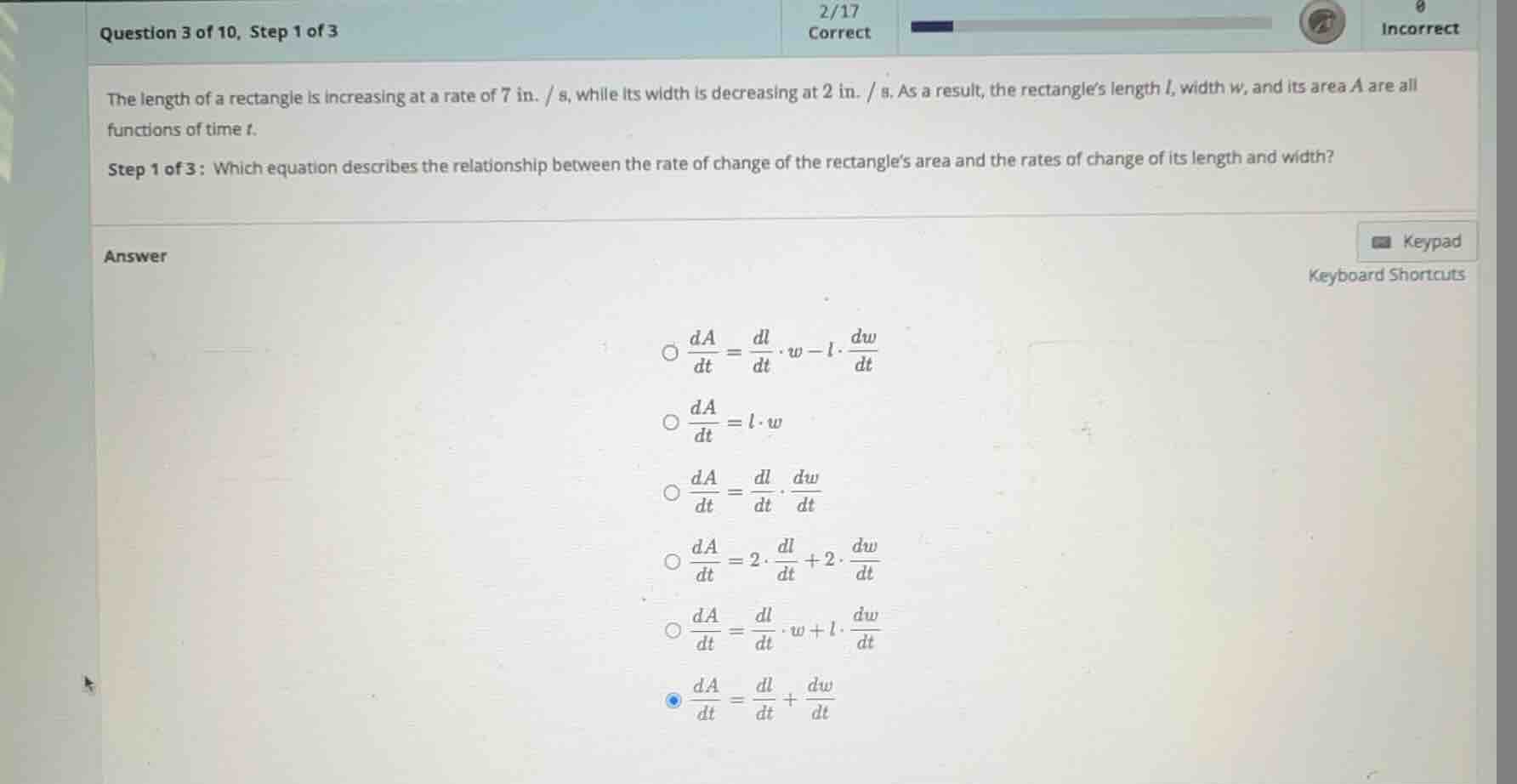
the length of a rectangle is increasing at a rate of 7 in. / s, while its width is decreasing at 2 in. / s. as a result, the rectangles length \\(l\\), width \\(w\\), and its area \\(a\\) are all functions of time \\(t\\).
step 1 of 3: which equation describes the relationship between the rate of change of the rectangles area and the rates of change of its length and width?
- \\(\frac{da}{dt} = \frac{dl}{dt} \cdot w - l \cdot \frac{dw}{dt}\\)
- \\(\frac{da}{dt} = l \cdot w\\)
- \\(\frac{da}{dt} = \frac{dl}{dt} \cdot \frac{dw}{dt}\\)
- \\(\frac{da}{dt} = 2 \cdot \frac{dl}{dt} + 2 \cdot \frac{dw}{dt}\\)
- \\(\frac{da}{dt} = \frac{dl}{dt} \cdot w + l \cdot \frac{dw}{dt}\\)
- \\(\frac{da}{dt} = \frac{dl}{dt} + \frac{dw}{dt}\\)
State the area formula
Using the Product Rule Differentiation knowledge point
$$
A = l \cdot w
$$
Differentiate with respect to time
Using the Product Rule Differentiation knowledge point
$$
\frac{dA}{dt} = \frac{dl}{dt} \cdot w + l \cdot \frac{dw}{dt}
$$

Snap & solve any problem in the app
Get step-by-step solutions on Sovi AI
Photo-based solutions with guided steps
Explore more problems and detailed explanations
- (A) \(\frac{dA}{dt} = \frac{dl}{dt} \cdot w - l \cdot \frac{dw}{dt}\)
- (B) \(\frac{dA}{dt} = l \cdot w\)
- (C) \(\frac{dA}{dt} = \frac{dl}{dt} \cdot \frac{dw}{dt}\)
- (D) \(\frac{dA}{dt} = 2 \cdot \frac{dl}{dt} + 2 \cdot \frac{dw}{dt}\)
- (E) \(\frac{dA}{dt} = \frac{dl}{dt} \cdot w + l \cdot \frac{dw}{dt}\) (Correct answer)
- (F) \(\frac{dA}{dt} = \frac{dl}{dt} + \frac{dw}{dt}\)