Sovi.AI - AI Math Tutor

Scan to solve math questions

QUESTION IMAGE

how does syntax affect setting? by revealing the authors purpose in wri…

Question

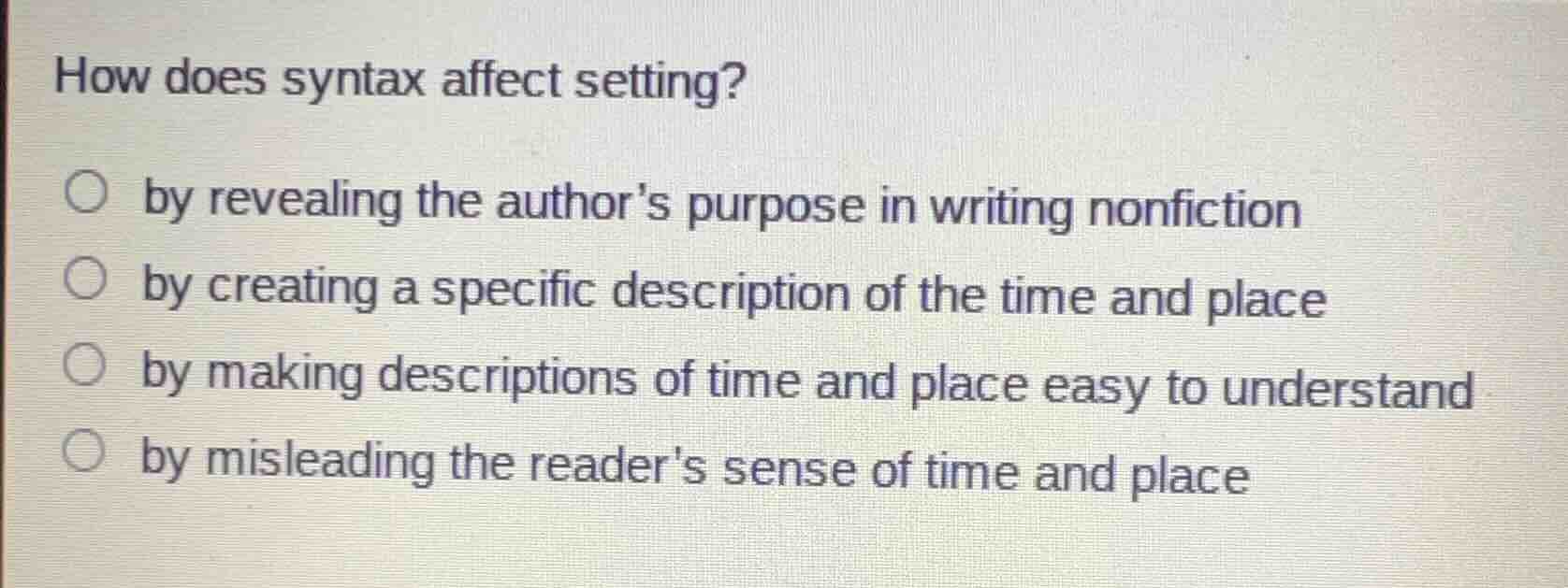
how does syntax affect setting?

by revealing the authors purpose in writing nonfiction
by creating a specific description of the time and place
by making descriptions of time and place easy to understand
by misleading the readers sense of time and place

Explanation:

Response

<pre_analysis>
{
"quality": "clear",
"question_count": 1,
"skills_matched": [
"direct_cot",
"multiple_choice_formatter",
"explain_then_answer",
"tutor",
"mastery_adaptive_brevity"
],
"needs_drawing": false,
"concepts_used": [
"Syntax Analysis",
"Setting Analysis"
],
"new_concepts": [],
"current_concepts": [
"Syntax Analysis",
"Setting Analysis"
]
}
</pre_analysis>

<reasoning>

Analyze the relationship between syntax and setting

Using the Syntax Analysis and Setting Analysis knowledge points

  • Syntax refers to the arrangement of words, sentence structure, and grammatical patterns.
  • Setting refers to the time, place, and social environment in which a story occurs.
  • Authors manipulate sentence length, complexity, and rhythm (syntax) to paint a vivid, specific picture of the environment, thereby establishing the atmosphere, mood, and details of the time and place.

Evaluate the given options

  • Option 1: "by revealing the author's purpose in writing nonfiction" — Incorrect. Syntax can reveal purpose, but this does not explain how it specifically affects setting.
  • Option 2: "by creating a specific description of the time and place" — Correct. The structure of sentences directly shapes how details of the setting are delivered and perceived, building a vivid depiction of the time and place.
  • Option 3: "by making descriptions of time and place easy to understand" — Incorrect. Syntax can sometimes be complex or archaic to match a historical setting, which does not necessarily make it "easy" to understand.
  • Option 4: "by misleading the reader's sense of time and place" — Incorrect. While syntax can create suspense, its primary literary function regarding setting is to establish it accurately rather than to mislead.

</reasoning>

<answer>
<mcq-option>(A) by revealing the author's purpose in writing nonfiction</mcq-option>
<mcq-correct>(B) by creating a specific description of the time and place</mcq-correct>
<mcq-option>(C) by making descriptions of time and place easy to understand</mcq-option>
<mcq-option>(D) by misleading the reader's sense of time and place</mcq-option>
</answer>

<post_analysis>
{
"subject": "Arts",
"question_type": "Multiple Choice",
"knowledge_point": [
"Arts",
"Literary Analysis",
"Syntax Analysis"
]
}
</post_analysis>

Answer:

<pre_analysis>
{
"quality": "clear",
"question_count": 1,
"skills_matched": [
"direct_cot",
"multiple_choice_formatter",
"explain_then_answer",
"tutor",
"mastery_adaptive_brevity"
],
"needs_drawing": false,
"concepts_used": [
"Syntax Analysis",
"Setting Analysis"
],
"new_concepts": [],
"current_concepts": [
"Syntax Analysis",
"Setting Analysis"
]
}
</pre_analysis>

<reasoning>

Analyze the relationship between syntax and setting

Using the Syntax Analysis and Setting Analysis knowledge points

  • Syntax refers to the arrangement of words, sentence structure, and grammatical patterns.
  • Setting refers to the time, place, and social environment in which a story occurs.
  • Authors manipulate sentence length, complexity, and rhythm (syntax) to paint a vivid, specific picture of the environment, thereby establishing the atmosphere, mood, and details of the time and place.

Evaluate the given options

  • Option 1: "by revealing the author's purpose in writing nonfiction" — Incorrect. Syntax can reveal purpose, but this does not explain how it specifically affects setting.
  • Option 2: "by creating a specific description of the time and place" — Correct. The structure of sentences directly shapes how details of the setting are delivered and perceived, building a vivid depiction of the time and place.
  • Option 3: "by making descriptions of time and place easy to understand" — Incorrect. Syntax can sometimes be complex or archaic to match a historical setting, which does not necessarily make it "easy" to understand.
  • Option 4: "by misleading the reader's sense of time and place" — Incorrect. While syntax can create suspense, its primary literary function regarding setting is to establish it accurately rather than to mislead.

</reasoning>

<answer>
<mcq-option>(A) by revealing the author's purpose in writing nonfiction</mcq-option>
<mcq-correct>(B) by creating a specific description of the time and place</mcq-correct>
<mcq-option>(C) by making descriptions of time and place easy to understand</mcq-option>
<mcq-option>(D) by misleading the reader's sense of time and place</mcq-option>
</answer>

<post_analysis>
{
"subject": "Arts",
"question_type": "Multiple Choice",
"knowledge_point": [
"Arts",
"Literary Analysis",
"Syntax Analysis"
]
}
</post_analysis>