QUESTION IMAGE
Question
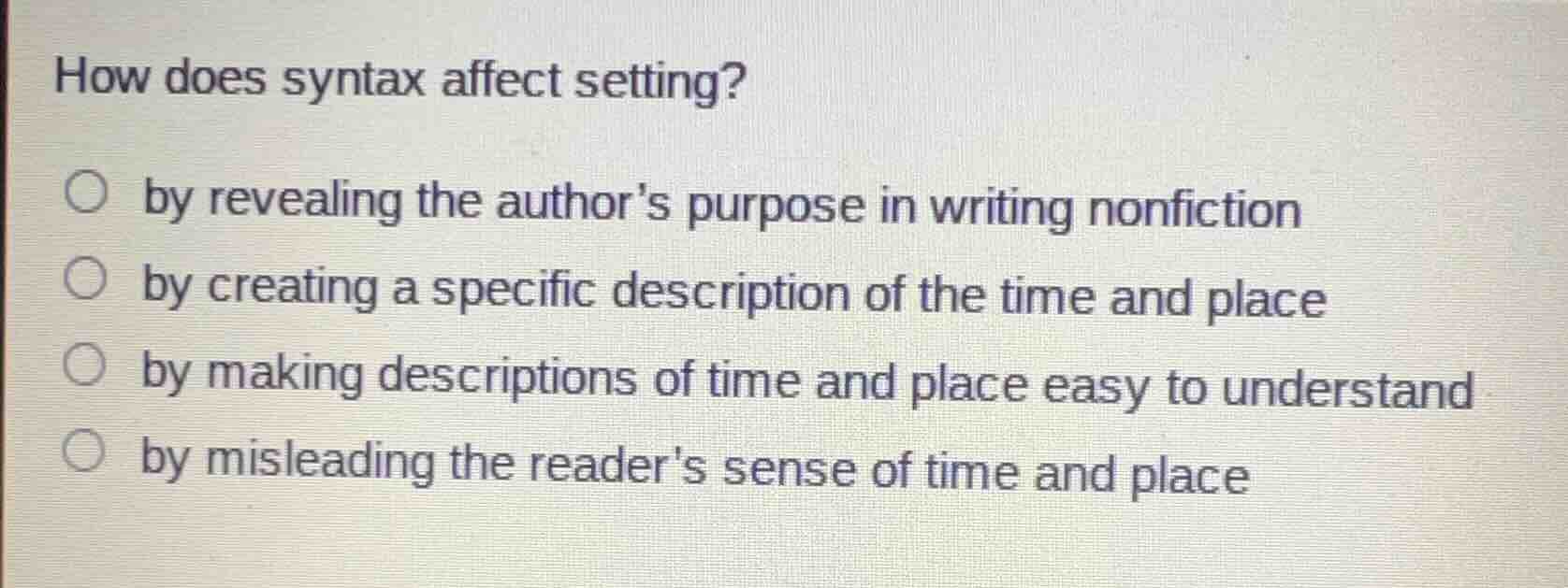
how does syntax affect setting?
by revealing the authors purpose in writing nonfiction
by creating a specific description of the time and place
by making descriptions of time and place easy to understand
by misleading the readers sense of time and place
<pre_analysis>
{
"quality": "clear",
"question_count": 1,
"skills_matched": [
"direct_cot",
"multiple_choice_formatter",
"explain_then_answer",
"tutor",
"mastery_adaptive_brevity"
],
"needs_drawing": false,
"concepts_used": [
"Syntax Analysis",
"Setting Analysis"
],
"new_concepts": [],
"current_concepts": [
"Syntax Analysis",
"Setting Analysis"
]
}
</pre_analysis>
<reasoning>
Analyze the relationship between syntax and setting
Using the Syntax Analysis and Setting Analysis knowledge points
- Syntax refers to the arrangement of words, sentence structure, and grammatical patterns.
- Setting refers to the time, place, and social environment in which a story occurs.
- Authors manipulate sentence length, complexity, and rhythm (syntax) to paint a vivid, specific picture of the environment, thereby establishing the atmosphere, mood, and details of the time and place.
Evaluate the given options
- Option 1: "by revealing the author's purpose in writing nonfiction" — Incorrect. Syntax can reveal purpose, but this does not explain how it specifically affects setting.
- Option 2: "by creating a specific description of the time and place" — Correct. The structure of sentences directly shapes how details of the setting are delivered and perceived, building a vivid depiction of the time and place.
- Option 3: "by making descriptions of time and place easy to understand" — Incorrect. Syntax can sometimes be complex or archaic to match a historical setting, which does not necessarily make it "easy" to understand.
- Option 4: "by misleading the reader's sense of time and place" — Incorrect. While syntax can create suspense, its primary literary function regarding setting is to establish it accurately rather than to mislead.
</reasoning>
<answer>
<mcq-option>(A) by revealing the author's purpose in writing nonfiction</mcq-option>
<mcq-correct>(B) by creating a specific description of the time and place</mcq-correct>
<mcq-option>(C) by making descriptions of time and place easy to understand</mcq-option>
<mcq-option>(D) by misleading the reader's sense of time and place</mcq-option>
</answer>
<post_analysis>
{
"subject": "Arts",
"question_type": "Multiple Choice",
"knowledge_point": [
"Arts",
"Literary Analysis",
"Syntax Analysis"
]
}
</post_analysis>
Snap & solve any problem in the app
Get step-by-step solutions on Sovi AI
Photo-based solutions with guided steps
Explore more problems and detailed explanations
<pre_analysis>
{
"quality": "clear",
"question_count": 1,
"skills_matched": [
"direct_cot",
"multiple_choice_formatter",
"explain_then_answer",
"tutor",
"mastery_adaptive_brevity"
],
"needs_drawing": false,
"concepts_used": [
"Syntax Analysis",
"Setting Analysis"
],
"new_concepts": [],
"current_concepts": [
"Syntax Analysis",
"Setting Analysis"
]
}
</pre_analysis>
<reasoning>
Analyze the relationship between syntax and setting
Using the Syntax Analysis and Setting Analysis knowledge points
- Syntax refers to the arrangement of words, sentence structure, and grammatical patterns.
- Setting refers to the time, place, and social environment in which a story occurs.
- Authors manipulate sentence length, complexity, and rhythm (syntax) to paint a vivid, specific picture of the environment, thereby establishing the atmosphere, mood, and details of the time and place.
Evaluate the given options
- Option 1: "by revealing the author's purpose in writing nonfiction" — Incorrect. Syntax can reveal purpose, but this does not explain how it specifically affects setting.
- Option 2: "by creating a specific description of the time and place" — Correct. The structure of sentences directly shapes how details of the setting are delivered and perceived, building a vivid depiction of the time and place.
- Option 3: "by making descriptions of time and place easy to understand" — Incorrect. Syntax can sometimes be complex or archaic to match a historical setting, which does not necessarily make it "easy" to understand.
- Option 4: "by misleading the reader's sense of time and place" — Incorrect. While syntax can create suspense, its primary literary function regarding setting is to establish it accurately rather than to mislead.
</reasoning>
<answer>
<mcq-option>(A) by revealing the author's purpose in writing nonfiction</mcq-option>
<mcq-correct>(B) by creating a specific description of the time and place</mcq-correct>
<mcq-option>(C) by making descriptions of time and place easy to understand</mcq-option>
<mcq-option>(D) by misleading the reader's sense of time and place</mcq-option>
</answer>
<post_analysis>
{
"subject": "Arts",
"question_type": "Multiple Choice",
"knowledge_point": [
"Arts",
"Literary Analysis",
"Syntax Analysis"
]
}
</post_analysis>