QUESTION IMAGE
Question
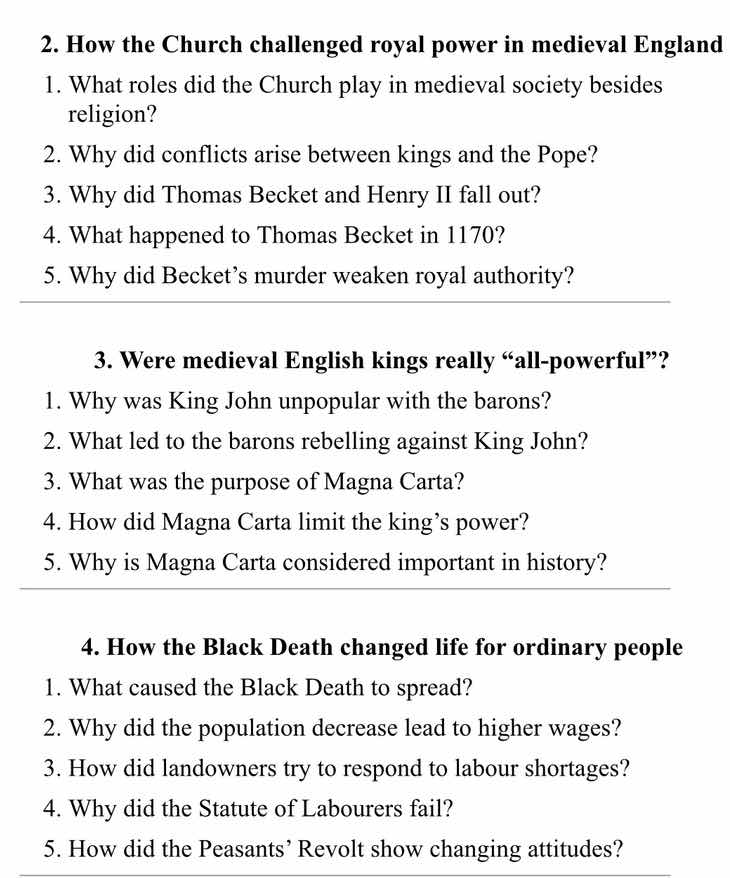
- how the church challenged royal power in medieval england
- what roles did the church play in medieval society besides religion?
- why did conflicts arise between kings and the pope?
- why did thomas becket and henry ii fall out?
- what happened to thomas becket in 1170?
- why did beckets murder weaken royal authority?
- were medieval english kings really \all-powerful\?
- why was king john unpopular with the barons?
- what led to the barons rebelling against king john?
- what was the purpose of magna carta?
- how did magna carta limit the kings power?
- why is magna carta considered important in history?
- how the black death changed life for ordinary people
- what caused the black death to spread?
- why did the population decrease lead to higher wages?
- how did landowners try to respond to labour shortages?
- why did the statute of labourers fail?
- how did the peasants revolt show changing attitudes?
Medieval Church and State
The Catholic Church was a dominant political, economic, and social force in medieval England. It owned vast amounts of land, collected taxes (tithes), and ran the legal system for clergy through ecclesiastical courts. Conflicts arose between kings and the Pope over investiture (who appoints bishops) and legal jurisdiction. The clash between Henry II and Archbishop Thomas Becket centered on whether "criminous clerks" (clergy who committed secular crimes) should be tried in royal courts. In 1170, Becket was murdered in Canterbury Cathedral by four of Henry's knights. This brutal act outraged Christendom, forcing Henry II to do public penance and abandon his attempts to try clergy in royal courts, thereby weakening royal authority over the Church.
Magna Carta and Royal Power
King John became highly unpopular with his barons due to heavy taxation (scutage), arbitrary justice, and military failures in France. These grievances led the barons to rebel and seize London. In 1215, they forced John to sign the Magna Carta (Great Charter) to limit his arbitrary power and protect their feudal rights. The charter established that the king was subject to the law, protected barons from illegal imprisonment, and guaranteed swift justice. It is historically significant because it established the foundational principle that even the monarch is not above the law, paving the way for constitutional governance and modern civil liberties.
The Black Death and Social Change
The Black Death (bubonic plague) was spread by fleas on rats along trade routes. The resulting catastrophic population loss created an acute labor shortage. With fewer peasants available to work the land, survivors demanded higher wages and better conditions. Landowners tried to respond by passing the Statute of Labourers (1351) to freeze wages at pre-plague levels and restrict peasant movement. This law failed because landowners desperately needed workers and secretly paid higher wages anyway. The resulting economic tension culminated in the Peasants' Revolt of 1381, which demonstrated that ordinary people were no longer willing to accept rigid feudal exploitation and were prepared to demand social equality.

Snap & solve any problem in the app
Get step-by-step solutions on Sovi AI
Photo-based solutions with guided steps
Explore more problems and detailed explanations
Question 2.1
Besides religion, the Church played vital roles in education, healthcare, social welfare, legal administration through church courts, and acted as a major landowner and political advisor to the king.
Question 2.2
Conflicts arose because both kings and the Pope claimed supreme authority over appointments of bishops (investiture) and the right to tax and judge the clergy.
Question 2.3
Thomas Becket and Henry II fell out over the jurisdiction of royal courts versus church courts, specifically whether clergy who committed crimes should be tried by the state.
Question 2.4
In 1170, Thomas Becket was murdered inside Canterbury Cathedral by four knights who believed they were acting on the wishes of King Henry II.
Question 2.5
Becket's murder outraged the public and the Pope, forcing Henry II to perform public penance and abandon his plans to limit the Church's legal independence.
Question 3.1
King John was unpopular because of his high taxes, military failures in France, and arbitrary abuse of his royal power against the barons.
Question 3.2
The barons rebelled due to John's continuous financial demands, his disregard for traditional feudal laws, and his refusal to address their grievances.
Question 3.3
The purpose of the Magna Carta was to limit the absolute power of the king and protect the rights and privileges of the barons and free citizens.
Question 3.4
Magna Carta limited the king's power by establishing that he could not raise taxes without common consent and could not imprison free men without due process of law.
Question 3.5
It is historically important because it established the principle that the monarch is subject to the law, forming the basis for modern constitutional democracy.
Question 4.1
The Black Death was caused by the Yersinia pestis bacteria, which spread rapidly through fleas living on black rats along trade routes and in crowded, unsanitary towns.
Question 4.2
The massive drop in population created a severe labor shortage, allowing surviving peasants to demand higher wages because their labor was in high demand.
Question 4.3
Landowners tried to respond by forcing peasants to work for pre-plague wages, passing laws to restrict their movement, and returning to traditional feudal labor duties.
Question 4.4
The Statute of Labourers failed because the demand for labor was too high, forcing landowners to ignore the law and pay higher wages to prevent their crops from rotting.
Question 4.5
The Peasants' Revolt showed that ordinary people were increasingly confident, politically aware, and willing to challenge the traditional feudal hierarchy and unfair taxation.